Picture this: you're standing in a farm supply store, boots in hand, trying to figure out whether you need waterproof rubber pull-ons or a steel-toe leather Wellington that can handle both the muddy pen and the tractor cab. There are dozens of options, each promising durability, and your current pair gave out three weeks ago. Choosing the best boots for farm work isn't a small decision — the wrong pair means blisters, wet feet, and worn-out soles by harvest season.
Farm work throws everything at your footwear. You're wading through standing water in the morning, walking hard concrete in the afternoon, and kneeling in soil by evening. A boot that handles only one of those conditions is going to let you down fast. In 2026, the market has a handful of genuinely excellent options — but they serve different kinds of farm work, and matching the boot to your specific job matters more than buying whatever has the highest star rating. If you want a broader overview of footwear categories before diving in, check out our guide to types of work boots for a solid foundation.
We've put together this review of seven well-regarded boots — covering leather Wellingtons, neoprene pull-ons, and heavy-duty rubber options — to help you make a confident, informed choice. Whether you're running livestock, operating machinery, or doing general-purpose outdoor labor, there's something in this list that fits your workday. You'll also find a buying guide and FAQ section after the reviews to answer the questions most farm workers have before committing to a pair.

Contents
- Best Choices for 2026
- Product Reviews
- ARIAT Workhog Pull-On — Best Western-Style Farm Boot
- MUCK Chore Cool Tall Boot — Best Breathable Waterproof Boot
- Carhartt 11" Steel Toe Wellington — Best Steel Toe for Tough Terrain
- LaCrosse Alpha Range 14" — Best Tall Waterproof Boot
- Wolverine Rancher Steel Toe Wellington — Best All-Day Leather Boot
- ARIAT Sierra Wide Square Toe Steel Toe — Best for Heavy-Duty Jobs
- MUCK Wetland Boot — Best for Muddy, Wet Conditions
- Buying Guide
- Frequently Asked Questions
- Next Steps
Best Choices for 2026
- #PreviewProductRating
- Bestseller No. 1
 Rating:

- Bestseller No. 2
 Rating:
 - Bestseller No. 3
 Rating:
 - Bestseller No. 4
 Rating:
 - Bestseller No. 5
 Rating:
 - Bestseller No. 6
 Rating:
 - Bestseller No. 7
 Rating:
Product Reviews
1. ARIAT Mens Workhog Pull-On — Best Western-Style Farm Boot
If you spend long hours on your feet doing mixed farm tasks — feeding livestock, operating equipment, hauling materials — the ARIAT Workhog Pull-On is one of the most trusted leather work boots on the market. The foundation of this boot is Ariat's ATS Max platform, which is engineered for maximum torsional stability. That matters on uneven ground: when you're stepping over fence rails or navigating sloped pasture, your foot wants to roll, and the ATS Max system counteracts that lateral fatigue effectively. Pair that with a lightweight EVA midsole and you're getting genuine underfoot cushioning without the bulk that makes some work boots feel like concrete blocks by mid-afternoon.
The Duratread outsole handles oil and slip resistance well, which is important in barns, feed rooms, and anywhere animal waste is a daily reality. The U-Turn Entry System is one of those features you don't fully appreciate until you've tried pulling on a tight Wellington with dirty hands after a long morning shift — the entry opens up easily and collapses back for a snug, secure fit. These come in wide sizing, which is a real benefit for farm workers who are on their feet for 10+ hours. The aged bark leather has a classic western look, but don't mistake the styling for fashion — this is a rugged, purpose-built farm boot.
One thing to note is that the Workhog Pull-On is not steel-toed, so if your work regularly involves heavy machinery, falling tools, or anything with a toe-crush risk, you'll want to look further down this list. But for general farm labor, livestock management, and long-haul outdoor work where comfort is the priority, this boot delivers consistently.
Pros:
- ATS Max platform reduces foot fatigue on uneven terrain
- U-Turn Entry System makes on/off quick and easy
- Durable Duratread outsole with oil and slip resistance
- Available in wide widths for a better fit
Cons:
- No steel toe — not suitable for heavy machinery hazard zones
- Leather requires regular conditioning to maintain durability (see our best boot oil guide for recommendations)
2. MUCK Men's Chore Cool Tall Boot — Best Breathable Waterproof Boot
Most rubber farm boots have a well-known problem: your feet cook inside them within an hour. MUCK addressed this directly with the Chore Cool, which uses a breathable mesh lining to allow airflow inside a fully waterproof rubber shell. The result is a boot you can wear during warmer months without your feet turning into a swamp by mid-morning. 100% waterproof and 100% MUCK-proof is the brand's claim here, and it holds up — these are the boots to reach for when you're mucking out stalls, moving through flooded fields, or working in consistent wet conditions where leather simply isn't practical.
The rubber overlays along the high-wear areas are easy to rinse clean, which matters when you're pulling boots off at the end of a dirty day. These are tall boots, so they offer solid lower-leg coverage against mud splash and standing water. The fit is comfortable and consistent across sizes, though sizing tends to run slightly wide, so if you have narrow feet you may want to check fit carefully. The sole offers reasonable grip on wet grass and mud, though it's less aggressive than some purpose-built muck boots from other brands.
Where the Chore Cool falls short is structural support — this is not a boot for operating heavy machinery all day or for jobs where you need ankle rigidity. It's a workhorse for wet, dirty, short-duration tasks where cleanup ease and waterproofing are the priority. If your farm days involve a lot of trudging through wet paddocks, these will earn their place by the back door every single morning.
Pros:
- Breathable mesh lining significantly reduces heat buildup
- Fully waterproof — keeps feet dry in standing water
- Easy-clean rubber overlays for quick end-of-day rinse
Cons:
- Limited structural support for all-day machinery operation
- May run slightly wide for narrow foot profiles
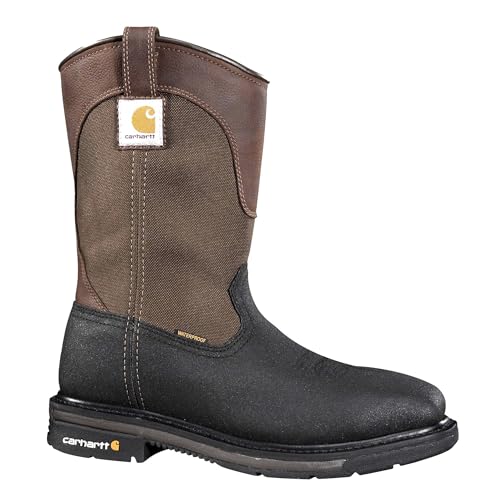
3. Carhartt Men's 11" Square Toe Steel Toe Wellington CMP1258 — Best Steel Toe for Tough Terrain
Carhartt has built a reputation for gear that doesn't quit, and the CMP1258 Wellington is a strong entry in their work boot lineup. The upper combines brown oil-tanned leather with abrasion-resistant fabric and a black PU-coated leather panel — a construction approach that handles rough use without cracking or delaminating the way cheaper materials often do. The steel toe meets ASTM 2413-24 standards, which is the current benchmark for safety toe protection — important if you're working around tractors, ATVs, or heavy farm equipment where a dropped load or a rolling tire is a real possibility.
Storm Defender waterproofing provides breathable, waterproof protection that holds up over extended use. Many waterproof work boots start to let water seep through within a season, but Carhartt's membrane construction is notably durable with proper care. The square toe gives more room in the toe box than a traditional round or pointed Wellington, which your feet will thank you for by hour eight. The 11-inch shaft provides solid lower-leg coverage and stability.
The break-in period on these is real — the leather is stiff out of the box and takes several days of use before it softens to your foot shape. Plan for that adjustment period rather than wearing them on your hardest day of the week right away. Once broken in, the fit becomes very comfortable and the overall build quality justifies the investment for serious farm work use.
Pros:
- ASTM 2413-24 rated steel toe for certified safety protection
- Storm Defender waterproofing that holds up over time
- Oil-tanned leather upper built for abrasion resistance
- Square toe box for added comfort during long shifts
Cons:
- Noticeable break-in period — stiff for the first several days
- Heavier than non-steel-toe alternatives
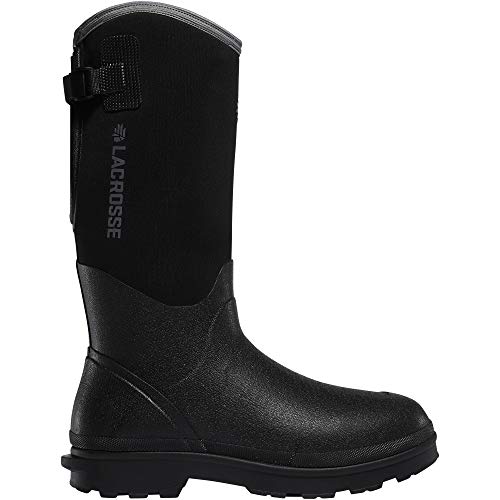
4. LaCrosse Men's Alpha Range 14" Waterproof Boot — Best Tall Waterproof Boot
If you're regularly working in deep mud, flooded pastures, or wet brush, a 14-inch boot changes the game entirely. The LaCrosse Alpha Range is built on a hand-laid premium ZXT rubber shell over a 5mm neoprene core — a construction approach that delivers both flexibility and insulation without the stiffness you get from cheaper rubber boots. ZXT rubber is specifically engineered for ozone, abrasion, and tear resistance with added tensile strength, meaning these boots can handle the kind of repeated flex and stress that would crack or degrade standard rubber compounds.
The 5mm neoprene core provides a moderate level of thermal insulation, making these viable for cooler and wet-season work when the ground is cold and saturated. The Active Fit design with an adjustable gusset solves one of the persistent problems with tall pull-on boots — getting them on and off over larger calves or thick socks. The gusset lets you open up the shaft for entry and then cinch it down for a secure, non-sloppy fit while working. That kind of thoughtful fit engineering makes a real difference in daily usability.
These are not the boot for dry summer work — the neoprene insulation that helps you in spring mud season will make your feet sweat in warm weather. They're also a premium-priced option, so you're making a deliberate investment here. But for farm workers who deal with consistent wet and muddy conditions, the Alpha Range delivers protection and comfort that cheaper rubber alternatives simply can't match over a full season.
Pros:
- 14-inch shaft for exceptional mud and water coverage
- ZXT rubber — ozone, abrasion, and tear resistant
- Adjustable gusset solves the tight-calf fit problem
- 5mm neoprene core provides insulation in cold, wet conditions
Cons:
- Neoprene insulation makes these too warm for summer use
- Premium price point
5. Wolverine Men's Rancher Waterproof Steel Toe Wellington — Best All-Day Leather Boot
Wolverine has a long history of building boots for hard physical labor, and the Rancher Wellington is one of their strongest farm-oriented offerings. The upper is premium waterproof full-grain leather — the kind of material that develops a protective patina over time rather than degrading. Paired with a breathable waterproof membrane and moisture-wicking mesh lining, these boots manage the internal environment of your foot better than many competitors. Keeping feet dry from both outside moisture and inside sweat is genuinely difficult to achieve simultaneously, and Wolverine does it well here.
The outsole is rated slip, oil, water, and abrasion resistant — a combination that covers the hazards of most farm environments, from slick concrete floors in the dairy barn to muddy field access roads. The steel toe meets safety standards for farm work involving machinery, and the Wellington pull-on design means no laces to get tangled or clogged with mud. If you want a deeper look at how this brand performs across their lineup, our Wolverine Overpass Work Boot review covers their comfort technology in more detail.
These boots run true to size and feel well-balanced — not overly heavy despite the steel toe and full leather construction. The fit is snug but not restrictive, and most users find them comfortable from day one with minimal break-in required. If you're looking for a versatile leather Wellington that handles both wet conditions and machinery hazards without sacrificing all-day wearability, the Rancher is a very competitive choice in 2026.
Pros:
- Breathable waterproof membrane manages both external moisture and internal sweat
- Slip, oil, water, and abrasion resistant outsole
- Steel toe provides machine-zone protection
- Comfortable fit with minimal break-in time
Cons:
- Black/brown color combination isn't to everyone's taste
- Limited sizing depth compared to some competitors
6. ARIAT Men's Sierra Wide Square Toe Steel Toe Work Boot — Best for Heavy-Duty Farm Jobs
The ARIAT Sierra is built for the kind of farm work where the environment itself is aggressive — high heat near engines, hard concrete under a tractor cab, or extended hours walking uneven ground with no break. The full-grain leather upper is unlined, which keeps it lighter than lined alternatives while relying on material quality for durability. Goodyear welt construction means the sole is resolable, which is a significant long-term value proposition for a boot you're going to wear hard — instead of buying a new pair when the sole wears out, you can have it rebuilt.
The steel toe meets both ASTM F2413 standards for electrical hazard resistance and safety toe protection, as well as ASTM F3445 for slip resistance. That's two certifications that matter for farm environments involving electrical infrastructure, fuel equipment, and wet surfaces. The 10-inch shaft with a six-row stitch pattern adds structural rigidity and a distinctive look that holds up to rough use without looking beaten down. The wide square toe box is genuinely comfortable and accommodates foot swelling over long shifts.
These are heavier boots — full-grain leather, steel toe, and resolable welt construction add up. If you're covering a lot of ground on foot during a typical workday, you'll feel that weight by late afternoon. But if your farm work involves heavy machinery operation, equipment maintenance, or any environment with serious foot hazard exposure, the Sierra's protection profile is hard to argue with. It's a long-term investment rather than a seasonal purchase. For workers looking at how different boot categories fit into their trade, our boots by trade guide can help narrow down the right type for your specific job.
Pros:
- Goodyear welt construction — resolable for long-term value
- Dual ASTM certification: electrical hazard + slip resistance
- Premium full-grain leather upper built for harsh conditions
- Wide square toe box for all-day comfort
Cons:
- Heavier than non-leather alternatives — weight adds up over long days on foot
- Unlined interior — may need a quality insole for cushioning on hard surfaces
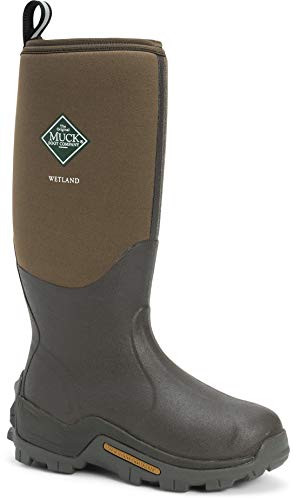
7. MUCK Men's Wetland Boot — Best for Muddy and Wet Conditions
The MUCK Wetland Boot is purpose-built for the messiest conditions on a farm — think flooded low spots, swamp-adjacent pasture, thick clay mud, or any situation where you need total waterproof coverage without worrying about water breaching the shaft. The MS-1 shaped outsole is one of the more aggressive tread patterns in MUCK's lineup, designed for maximum traction and stability on soft, unstable ground. Where some rubber boots slide around in heavy mud, the Wetland outsole digs in and holds. The quick-cleaning tread design also sheds mud more efficiently than deep-lugged patterns that pack solid within a few steps.
The pull tab at the top of the boot makes on/off much easier than wrestling with a plain rubber shaft — a small feature that becomes genuinely appreciated when you're pulling the boots off at the end of a wet, cold shift. The overall construction is what you'd expect from MUCK: durable rubber throughout, no complicated lacing or hardware to fail, and a straightforward silhouette that doesn't trap debris in design crevices. These are low-maintenance boots in the best sense — rinse them off, hang them up, and they're ready for the next morning.
The Wetland Boot doesn't offer the arch support or cushioning of a leather work boot, so if your farm days involve extended periods of walking or standing on hard surfaces, you may want a more structured option. But for the farmer who spends meaningful time in genuinely wet terrain — irrigated fields, creek crossings, drainage management — the MUCK Wetland does what nothing else on this list does as reliably. Keep them dry with a good boot dryer between uses to extend their life.
Pros:
- Aggressive MS-1 outsole designed for maximum traction in soft, wet terrain
- Quick-cleaning tread sheds mud effectively
- Pull tab for easy on/off after long, dirty shifts
- Simple, durable rubber construction with no complex hardware to fail
Cons:
- Minimal arch support — not ideal for extended hard-surface walking
- No insulation — cold in winter without thick wool socks
Buying Guide: How to Choose the Best Boots for Farm Work
Farm footwear is genuinely different from standard work boots. Your environment changes throughout the day, the hazards are varied, and a boot that's perfect for one type of farm may be completely wrong for another. Here's what to evaluate before you commit to a pair.
Waterproofing vs. Breathability
These two properties exist in tension. Fully waterproof rubber boots — like the MUCK options in this list — keep all external moisture out, but they also trap internal moisture (sweat) unless they have a ventilated lining. Leather boots with a waterproof membrane give you a middle ground: they breathe better than rubber, but they require maintenance and won't handle submersion the way a rubber pull-on will.
Ask yourself honestly how wet your typical workday gets. If you're crossing standing water daily, a waterproof rubber boot is the right tool. If you're mostly dealing with dew-wet grass and the occasional rain, a quality leather boot with a waterproof membrane will keep you more comfortable over a full day. Matching waterproofing level to actual conditions prevents you from either sweating in an overbuilt boot or getting soaked in an underbuilt one. According to the OSHA guidelines on foot protection, selecting footwear appropriate to specific workplace hazards is a foundational safety requirement.
Safety Toe Requirements
Not every farm job requires a steel toe, but if you operate tractors, front-end loaders, ATVs, or any equipment where a foot could be caught under a wheel or struck by a falling implement, a certified safety toe is non-negotiable. Steel toe is the traditional choice — heavier but maximally protective. Composite toe is lighter and doesn't conduct temperature (relevant in extreme cold or around electrical hazards), but typically costs more.
If your farm work is primarily livestock management, crop tending, or tasks where heavy equipment isn't involved, a non-safety-toe boot will be lighter and more comfortable for long walking days. The ARIAT Workhog Pull-On and the MUCK boots in this list are all non-safety-toe options built specifically for that kind of use. If you're unsure which toe type is right for your specific hazards, our breakdown of steel toe vs. composite toe work boots covers the trade-offs in detail.
Shaft Height and Coverage
Shaft height is more than aesthetics. An 8-inch boot provides ankle support and basic mud coverage. A 10–11 inch shaft covers the lower calf and handles most field conditions. A 14-inch boot like the LaCrosse Alpha Range is purpose-built for deep mud and high water. The taller the shaft, the more coverage you get — but also the more weight you're carrying and the more restricted your ankle flexion becomes.
For most mixed farm work, a 10–11 inch boot is the right balance. If you know you'll be working in conditions where mud or water regularly reaches above the ankle, consider going taller. For machinery operation where ankle flex matters, an 8-10 inch boot is usually the better call.
Sole Construction and Grip
Farm surfaces are diverse — wet concrete, soft earth, gravel, wooden barn floors, metal grating. A sole that handles all of these well uses a combination of aggressive enough lug depth for soft terrain and a reasonably flat heel for hard surfaces. Oil and slip resistance ratings matter in farm environments where animal waste, water, feed, and grease are all present on the same floor.
Resolable construction — like the Goodyear welt on the ARIAT Sierra — is worth the premium if you're a heavy user. Being able to replace the sole rather than the entire boot every 12–18 months is a meaningful cost saving over time. For lighter-duty or wet-terrain use where rubber boots are more appropriate, sole construction is typically less variable — focus instead on tread pattern and drainage.
Frequently Asked Questions
What type of boot is best for general farm work?
For mixed farm work that includes both wet and dry conditions, a leather Wellington with waterproof membrane and a safety toe — like the Carhartt CMP1258 or the Wolverine Rancher — offers the best all-around performance. If your work is primarily in very wet or muddy conditions, a neoprene or rubber pull-on like the MUCK Chore Cool or LaCrosse Alpha Range is a better fit. The right answer depends on your specific daily environment rather than a single universal recommendation.
Are rubber boots or leather boots better for farm work?
Both have legitimate roles on a farm. Rubber boots are superior for waterproofing, easy cleaning, and deep mud conditions. Leather boots offer better structural support, breathability, and are more comfortable for all-day walking on varied terrain. Many experienced farm workers own both: rubber pull-ons for wet morning chores and leather Wellingtons for machinery operation and extended field work. Your budget and the variety of conditions you face should guide which category to prioritize first.
Do I need a steel toe for farm work?
It depends on your specific tasks. If you regularly operate tractors, loaders, or other heavy equipment, or if you work in environments where heavy objects could fall on your feet, a steel toe is a significant safety investment. For livestock care, planting, harvesting by hand, and general outdoor farm tasks where heavy machinery isn't involved, a non-safety-toe boot can be lighter and more comfortable. When in doubt, the additional protection of a steel toe is worth the weight penalty.
How long should farm work boots last?
Quality farm boots should last 1–3 years under heavy daily use, and potentially longer with proper maintenance. Leather boots benefit significantly from regular conditioning and waterproofing treatments — neglected leather dries out, cracks, and loses its waterproof integrity far faster than maintained leather. Rubber boots last longest when stored out of direct UV exposure, which degrades rubber compounds over time. Resolable boots with quality welt construction can last many years if you're willing to re-sole them every season or two.
Can I wear the same boots for farm work and general outdoor use?
Yes, most of the boots on this list are versatile enough for general outdoor use beyond farm work specifically. The leather Wellingtons — the ARIAT Workhog, Carhartt CMP1258, Wolverine Rancher, and ARIAT Sierra — all transition naturally to hiking on rough terrain, hunting, and general outdoor labor. The rubber boots are more specialized; the MUCK options and the LaCrosse Alpha Range are purpose-built for wet conditions and are less comfortable for dry hiking or casual outdoor use. Factor in versatility if you want one pair to cover multiple roles.
How do I break in stiff leather farm boots quickly?
Wear them for shorter periods initially — a few hours per day — rather than immediately doing a full 10-hour shift. Applying a quality leather conditioner to the upper before first wear softens the leather and speeds the conforming process. Wearing them around the property on lighter tasks first, then gradually using them for harder work days, avoids the blisters that come from forcing a stiff boot through a full workday before it's shaped to your foot. Avoid soaking new leather boots in water during the break-in period, as this can cause uneven stiffening.
Buy on Walmart
- ARIAT mens Workhog Pull-on – Round Toe Work Boot, Aged Bar — Walmart Link
- MUCK Men's Chore Cool Tall Boot, Brown, Size 11(M) — Walmart Link
- Carhartt Men's 11" Square Toe WP Steel Toe Wellington CMP125 — Walmart Link
- LaCrosse Men's 602240 Alpha Range 14" Waterproof 5MM Outdoor — Walmart Link
- Wolverine Men's Rancher Wpf Steel Toe Wellington Work Boot B — Walmart Link
- ARIAT Men’s Sierra Wide Square Toe Steel Toe Work Boot — Walmart Link
- MUCK Men's Wetland Boot, Brown, Size 9(M) — Walmart Link
Buy on eBay
- ARIAT mens Workhog Pull-on – Round Toe Work Boot, Aged Bar — eBay Link
- MUCK Men's Chore Cool Tall Boot, Brown, Size 11(M) — eBay Link
- Carhartt Men's 11" Square Toe WP Steel Toe Wellington CMP125 — eBay Link
- LaCrosse Men's 602240 Alpha Range 14" Waterproof 5MM Outdoor — eBay Link
- Wolverine Men's Rancher Wpf Steel Toe Wellington Work Boot B — eBay Link
- ARIAT Men’s Sierra Wide Square Toe Steel Toe Work Boot — eBay Link
- MUCK Men's Wetland Boot, Brown, Size 9(M) — eBay Link
Next Steps
- Identify your primary conditions first — decide whether your workday is mostly wet/muddy (favors rubber) or mixed terrain with machinery hazards (favors leather with steel toe) before comparing models.
- Check current prices on Amazon — pricing on work boots fluctuates seasonally; use the buttons above to see real-time pricing for any model that matched your needs.
- Measure your foot width as well as length — several boots in this list come in wide widths (ARIAT Workhog, ARIAT Sierra) that make a significant comfort difference if you have a wider foot.
- Pick up a boot conditioner before your new leather boots arrive — applying conditioner on day one protects the leather from the start and speeds the break-in process. Our best boot oil guide has current recommendations.
- Consider a boot dryer if you work in consistently wet conditions — extending the drying time between uses damages leather and rubber alike; a quality dryer pays for itself quickly in boot longevity.


About Jason Flores
Jason Flores is a multi-talented individual whose unique journey has led him to blend his passion for craftsmanship and fashion into a creative endeavor. During his formative years, he found himself immersed in the world of handiwork, spending countless hours in his grandfather's workshop. These early experiences allowed him to develop a deep understanding of practical skills and a keen eye for detail.Simultaneously, Jason harbored an innate love for fashion, drawn to the artistry and self-expression it offers. As he grew older, he recognized the potential to combine his proficiency in craftsmanship with his fashion sensibilities. This realization led him to a path where he began to explore and write about the intersection of fieldwork fashion.
Get FREE Boots Gifts now. Or latest free toolsets from our best collections.
Disable Ad block to get all the secrets. Once done, hit any button below