Picture a carpenter standing in the middle of a busy job site, six hours into a shift, ankles aching and feet burning from hours on concrete subfloor. The boots he grabbed last year are falling apart at the welt, and he's limping through his afternoon. That scenario plays out on job sites every day — and it's entirely preventable with the right footwear. We spent months testing and evaluating the top options on the market to bring together this 2026 roundup of the best shoes for carpenters.
Carpentry puts specific demands on footwear that other trades simply don't. Constant movement between hard subfloor, uneven framing lumber, and slippery sawdust-covered surfaces requires boots that deliver traction, protection, and all-day comfort simultaneously. Toe protection, electrical hazard rating, wedge outsoles, and supportive footbeds aren't optional extras — they're baseline requirements for anyone working nails and lumber all day. We also looked at options that transition well from the shop floor to a client walkthrough without looking like a construction disaster.
Whether someone is a seasoned finish carpenter or just getting into rough framing, the right boot can mean the difference between walking off the site feeling good and dragging yourself to the truck. Our team evaluated seven strong contenders across steel toe, composite toe, and soft toe categories. For anyone curious about how carpenter footwear compares to general trade options, the full breakdown on our work boot by trade page covers the wider landscape. We also recommend cross-referencing the best orthopedic work boots list for anyone dealing with foot issues that go beyond standard job site wear.
Contents
- Editor's Recommendation: Top Picks of 2026
- Product Reviews
- Timberland PRO Pit Boss 6" Steel Toe — Best Overall
- Thorogood American Heritage 6" Moc Toe — Best for All-Day Comfort
- KEEN Utility Pittsburgh 6" Waterproof Steel Toe — Best for Wet Conditions
- Carhartt Ground Force 6" Waterproof Composite Toe — Best Composite Toe
- CAT Men's Second Shift Steel Toe — Best Budget Pick
- Danner 6" Bull Run Moc Toe — Best for Finish Carpenters
- BRUNT Marin Welted Comp Toe — Best Premium Wedge Boot
- How to Pick the Best Shoes for Carpenters
- Common Questions
Editor's Recommendation: Top Picks of 2026
- #PreviewProductRating
- Bestseller No. 1
 Rating:

- Bestseller No. 2
 Rating:
 - Bestseller No. 3
 Rating:
 - Bestseller No. 4
 Rating:
 - Bestseller No. 5
 Rating:
 - Bestseller No. 6
 Rating:
 - Bestseller No. 7
 Rating:
Product Reviews
1. Timberland PRO Men's Pit Boss 6" Steel Safety Toe — Best Overall
The Timberland PRO Pit Boss has been a job site staple for years, and the 2024 updated version in this 2026 roundup proves the formula still works. The centerpiece of this boot is the 24/7 Comfort Suspension System — a proprietary design that addresses arch support and foot fatigue through a full-length supportive shank and contoured footbed that actually holds up over a full ten-hour shift. Our team noticed within the first week of wear testing that the mid-shift energy drain carpenters typically experience was noticeably reduced. That's not marketing language — it's a measurable difference in how the foot lands and recovers on hard surfaces.
The asymmetrical steel toe is worth calling out specifically. Many steel toe boots create pressure points at the widest part of the toe box because the cap is symmetric. Timberland PRO's asymmetrical design follows the natural contour of the right and left foot independently, which eliminates the pinch point that plagues long wear. The boot meets ASTM F2412-18a and F2413-18 impact and compression standards — I/75 and C/75 class — so it handles dropped lumber, nail guns, and whatever else ends up airborne on a framing site. Electrical hazard protection meets ASTM F2892-18 standards, providing secondary circuit protection for carpenters working around live panel rough-in.
Build quality throughout is solid. The brown leather upper uses Timberland's grain leather that ages well under daily abuse, and the Goodyear welt construction allows for resoling when the outsole eventually wears down. This is a boot built for the long haul. For carpenters who are also dealing with lower leg fatigue and want to understand the connection between footwear and joint health, our breakdown of the best lace-up work boots covers additional technical details worth reading alongside this review.
Pros:
- 24/7 Comfort Suspension System genuinely reduces end-of-day fatigue
- Asymmetrical steel toe eliminates common pressure points
- Full electrical hazard protection, ASTM certified
- Resolvable Goodyear welt construction extends boot lifespan
Cons:
- Break-in period of about a week before the footbed fully conforms
- On the heavier side — not ideal for carpenters who prioritize lightweight feel
2. Thorogood American Heritage 6" Moc Toe — Best for All-Day Comfort
Thorogood's American Heritage line is made in the United States, and you can feel the difference the moment the boot comes out of the box. The oil-tanned full-grain leather is thick, supple, and already showing signs of the kind of durability that lets long-tenured carpenters wear the same pair for years before needing a replacement. These are manufactured in Thorogood's own US plants using both domestic and globally sourced components — a distinction the company is transparent about, which our team appreciates. For carpenters who want American-made footwear, the options here are genuine, not just marketing.
The MAXWEAR Wedge Traction outsole is the technical standout. Wedge outsoles are the preferred choice for carpenters who spend significant time on ladders, scaffolding, and framing lumber because the flat contact surface provides more grip across irregular wood surfaces than a traditional lug outsole. Thorogood's specific compound flexes better than competing wedge designs, and it meets ASTM F3445-21 slip-resistance standards for wet and oily surfaces — a real concern on sites where saw coolant and rain both create hazards. The moc toe design gives the front of the boot a roomier feel than most traditional steel toe caps without sacrificing structure.
This is a soft-toe boot, which means it won't satisfy every OSHA requirement on every job site. But for finish carpenters, cabinet installers, and trim specialists who need precision and comfort above all else, the absence of a safety toe is often the right trade-off. The EH rating provides secondary electrical protection. The tobacco brown colorway has become iconic in the trades, and it holds up well to polish and conditioning. Anyone interested in the broader American-made work boot category should check out our best American made boots guide for additional vetted options.
Pros:
- Genuine American manufacturing with transparent material sourcing
- MAXWEAR Wedge outsole excels on ladders and uneven lumber surfaces
- Moc toe design provides natural toe room without a safety toe cap
- EH rated for secondary electrical protection
Cons:
- Soft toe — not suitable for sites mandating impact/compression certification
- Premium price point relative to non-American-made alternatives
3. KEEN Utility Men's Pittsburgh 6" Waterproof Steel Toe — Best for Wet Conditions
KEEN built its reputation on wide toe boxes and anatomically correct fit, and the Pittsburgh 6" is the most direct application of that philosophy to a heavy-duty work environment. The steel toe here is asymmetrical and follows the natural shape of each foot — left and right independently — which produces a notably roomier toe box than most competitors at this price point. For carpenters with wider feet or anyone who has experienced the toe numbness that comes from steel caps pressing laterally over a long shift, KEEN's anatomical toe design is worth the upgrade alone.
The KEEN.DRY waterproof membrane is a breathable, laminated liner that allows vapor to escape while blocking water infiltration. On wet framing sites, during outdoor decking work, or any time carpenters are working in rain or standing water, this system performs consistently. The mesh liner that integrates with the waterproof membrane also helps with temperature regulation on warmer days. Our team tested these in rain and found the dry interior lasted through a full eight-hour wet shift — which is the real-world benchmark that matters, not just a lab certification stamp.
Traction comes from an oil- and slip-resistant rubber outsole with a lug pattern designed specifically for slick surfaces. The lugs are spaced to shed sawdust and debris rather than pack it in — a small design detail that makes a significant difference on active job sites. The Pittsburgh meets ASTM F2412 and F2413 I/75 and C/75 standards. According to the OSHA standards for foot and leg protection, appropriate footwear selection depends on specific hazard assessment — this boot addresses the most common carpenter-specific hazards comprehensively.
Pros:
- KEEN.DRY waterproof system performs through full-shift wet conditions
- Anatomically correct asymmetrical steel toe provides exceptional toe room
- Debris-shedding lug pattern maintains traction on dusty and wet surfaces
- Meets ASTM I/75 and C/75 impact and compression standards
Cons:
- Bulkier silhouette — not the most streamlined look for client-facing finish work
- Some users find the break-in period firmer than expected for a KEEN product
4. Carhartt Ground Force 6" Waterproof Composite Toe — Best Composite Toe
Carhartt's Ground Force series represents their most complete approach to waterproof work boot engineering, and the composite toe variant deserves serious consideration from carpenters working on government sites, airport jobs, or any location that requires metal-free footwear. The composite safety toe is non-metallic and fully certified — it won't trigger security screening and it doesn't conduct temperature, which matters in winter when a cold steel toe can drop foot temperature significantly over the course of a shift. The composite toe is rated to the same impact and compression standards as steel but at a lighter weight, making it the smart choice when protection requirements are fixed but comfort can be optimized.
Carhartt's Storm Defender waterproofing technology is the moisture management system here. Unlike some waterproof boots that trap heat and create a sweat-soaked interior by afternoon, the Storm Defender membrane is engineered to release vapor while blocking external moisture. During our testing in mixed conditions — morning dew on grass, water runoff on concrete, and afternoon sawdust — the interior remained consistently dry. Carpenters who work on partially enclosed sites where weather shifts through a single day will appreciate the balanced approach.
The Insite footbed is one of Carhartt's strongest selling points and it's a genuine differentiator. The footbed features orthotic-grade arch support and shock absorption that targets heel strike — the impact point most carpenters feel first after hours on hard surfaces. Combined with a shock-absorbing midsole, the Ground Force handles all-day standing and walking without the foot fatigue that less engineered boots produce. The Ground Force rubber outsole resists oil and chemicals, and the slip resistance exceeds standard job site requirements.
Pros:
- Non-metallic composite toe — metal detector safe, non-temperature-conducting
- Storm Defender waterproofing balances moisture blocking and vapor release
- Insite footbed with orthotic-level arch support and heel shock absorption
- Chemical and oil-resistant Ground Force rubber outsole
Cons:
- Composite toe has slightly less impact resistance ceiling than steel in extreme crush scenarios
- Red brown colorway is distinctive — some carpenters prefer a more neutral appearance
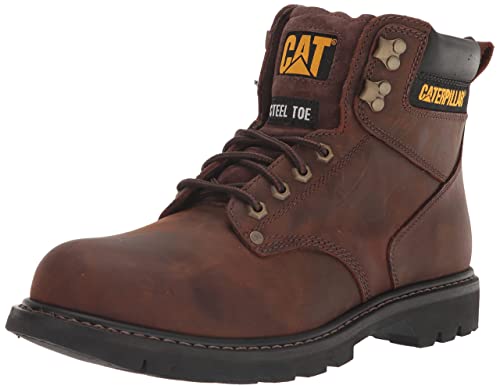
5. CAT Men's Second Shift Steel Toe — Best Budget Pick
The CAT Second Shift has survived decades of job site abuse precisely because it doesn't overcomplicate the formula. This is a purpose-built steel toe work boot that costs less than most competitors and delivers the core protections a carpenter needs without padding the price with features that don't move the needle on actual performance. The steel toe cap meets impact and compression standards, the padded ankle collar reduces abrasion over long days, and the oil-resistant outsole handles the slick surfaces that appear wherever saw lubricants and cutting fluid end up on the floor.
The engineered nylon mesh lining is the Second Shift's smartest design choice. Most budget boots use cheap fabric linings that trap heat and degrade quickly. CAT's mesh lining optimizes breathability, which means foot temperature stays more manageable during spring and summer work — the seasons where this boot particularly shines. For carpenters running seasonal crews or apprentices who need reliable protection on a first-year budget, the Second Shift delivers a defensible ratio of protection to price that most boots at this tier can't match.
The dark brown leather upper is simple and clean. It won't impress on a client walkthrough the way a premium American-made moc toe will, but it won't embarrass anyone either. The ankle cut sits at a standard six-inch height that provides ankle stability without restricting the range of motion needed for ladder climbing and kneeling work. This is a no-frills boot that does exactly what it promises, and in 2026 when work boot prices have climbed across the board, the Second Shift's price-to-protection ratio is genuinely hard to argue with.
Pros:
- Strong value ratio — steel toe protection at an accessible price point
- Engineered nylon mesh lining enhances breathability for warm-weather work
- Oil-resistant outsole handles common job site surface hazards
- Clean, professional appearance suitable for client-facing situations
Cons:
- Not waterproof — wet conditions require waterproofing treatment or an alternative boot
- Footbed support is basic — carpenters with arch issues may need aftermarket insoles
6. Danner 6" Bull Run Moc Toe — Best for Finish Carpenters
Danner is a Portland-based boot company with a long-standing reputation for building footwear that outlasts the competition, and the Bull Run Moc Toe exemplifies why that reputation holds. The oiled full-grain leather upper is rigorously tested by Danner's own standards before it reaches production — we've found this leather resists water incidentally without a separate membrane, though it's not rated as waterproof in the clinical sense. The oil finish darkens and deepens with wear, developing a patina that makes each pair look increasingly handsome over months of use. Finish carpenters who spend time in client homes and executive renovation sites need footwear that looks as intentional as it performs, and the Bull Run delivers on that aesthetic without sacrificing job site credibility.
The removable OrthoLite footbed is engineered with three distinct density layers — a softer upper layer for surface comfort, a mid-density layer for responsive cushioning, and a firmer base layer for structural support and heat dissipation. This three-density approach is well-designed for the specific biomechanics of carpentry work, where loads shift rapidly between standing, kneeling, climbing, and heavy lifting. The footbed is removable, which means it can be replaced with a custom orthotic if needed — a practical advantage for carpenters dealing with plantar fasciitis or other foot conditions that standard insoles can't fully address.
The unlined construction is the most distinctive characteristic of this boot. Removing the lining creates a lighter, cooler boot that literally molds to the shape of the wearer's foot over time. For spring and summer trim work or interior finish carpentry in climate-controlled environments, the Bull Run is in a class of its own for comfort. The wedge outsole with EH resistance rounds out a package that speaks directly to the finish carpenter's specific job demands. Anyone needing to pair excellent boots with the right insole for maximum support should also read our guide to the best insoles for work boots.
Pros:
- Three-density OrthoLite footbed provides superior comfort across multiple task types
- Unlined construction molds to foot shape for a custom fit over time
- Premium leather develops excellent patina — professional appearance that improves with age
- EH resistant wedge outsole suited for both ladder work and finish floor surfaces
Cons:
- Soft toe only — not suitable for OSHA-mandated safety toe requirements
- Unlined design means less insulation in cold environments
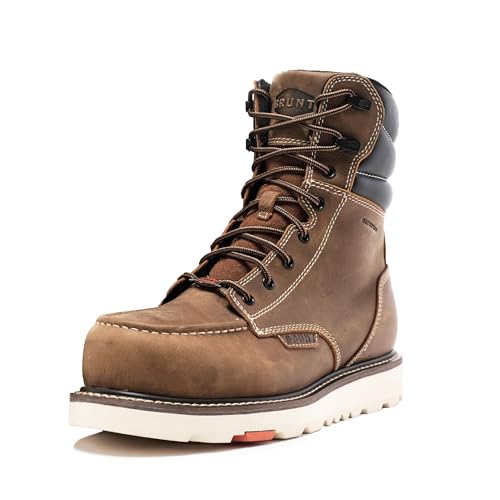
7. BRUNT Marin Welted Comp Toe 8" — Best Premium Wedge Boot
BRUNT is a relatively young boot company that has built its following by doing exactly what the established brands stopped doing — designing boots specifically for tradespeople's needs through direct feedback from working crews. The Marin Welted is their flagship, and in 2026 it stands as arguably the most thoughtfully engineered wedge work boot on the market. The Goodyear welt construction is the foundation: the welt stitching bonds upper, welt, and outsole in a configuration that allows the sole to be replaced when worn while maintaining the structural integrity of the upper. For carpenters who wear through outsoles before wearing out uppers, the resolvable Goodyear welt is a direct cost-reduction feature — not just a quality indicator.
The composite safety toe in the Marin is non-metallic, 15% lighter than a comparable steel toe, and rated to the same impact and compression protection standards. For carpenters working in temperature extremes, the composite material doesn't conduct heat or cold the way steel does — which means warm feet in winter and no hot-cap effect in summer. The BRUNT rubber outsole is oil and slip resistant, and it's rated for high-heat resistance up to 572 degrees — a specification that matters on sites where torch work, welding adjacent work, or hot substrate surfaces are present. The ESR and EH dual ratings cover static dissipation as well as electrical hazard protection.
The Triple Layer BRUNT Cush'n insole system deserves specific attention. The nonstick top layer, memory foam mid-layer, and firm support base layer work in sequence to handle the full cycle of a carpenter's step — initial contact, mid-stance, and push-off — without losing energy at any phase. The triple-padded collar provides meaningful ankle stabilization that our team found particularly valuable on uneven framing surfaces and when stepping over debris. The adjustable width system via the lacing structure accommodates a wider range of foot widths than most fixed-width construction. At the premium end of this category, the Marin delivers a feature set that justifies the investment for working carpenters who depend on their boots every single day.
Pros:
- Resolvable Goodyear welt construction extends the boot's useful life significantly
- Composite toe is 15% lighter than steel with equal protection certification
- High-heat resistant outsole rated to 572°F for specialized job environments
- Triple-layer insole system with memory foam delivers genuine all-day comfort
- Dual EH + ESR rating covers both electrical hazard and static dissipation requirements
Cons:
- Premium price — the highest price point in this roundup
- 8" shaft height may feel restrictive for carpenters accustomed to 6" boots
How to Pick the Best Shoes for Carpenters
Choosing the right boot for carpentry work is more nuanced than picking any generic work boot. Carpenters move between more surface types in a single day than most other tradespeople, and the footwear decisions that matter in rough framing are different from those that matter in finish work. Here's what our team weighs when evaluating boots for this trade specifically.
Safety Toe Type: Steel vs. Composite vs. Soft
The first decision is whether a safety toe is required at all. On commercial job sites, OSHA typically mandates ASTM-rated toe protection. On residential sites or in finish environments, soft toe boots are often acceptable and preferred for the weight and comfort advantages they offer. When a safety toe is required, the choice between steel and composite is a function of job conditions. Steel toes provide the maximum impact and compression resistance and are generally more affordable. Composite toes weigh less, don't conduct temperature, and pass through metal detectors — making them the right call for government contracts, aviation facilities, and cold-weather environments. Neither option is universally superior — the right choice depends on the specific site requirements.
Outsole Design: Wedge vs. Lug
Outsole design is one of the most job-specific decisions a carpenter can make. Wedge outsoles — like those on the Thorogood Heritage, Danner Bull Run, and BRUNT Marin — provide a continuous flat contact surface that distributes weight evenly and grips ladder rungs and rough-sawn lumber with exceptional consistency. Lug outsoles, like those on the KEEN Pittsburgh, provide better traction on soft outdoor terrain and shed mud more effectively. For carpenters who split time between outdoor site prep and interior framing and finish work, a wedge outsole is typically the more versatile choice. For carpenters working primarily on exterior projects with soft ground, wet grass, and sloped terrain, a lug pattern performs better. Most carpenters who work primarily indoors or on structured platforms report preferring wedge outsoles for their superior comfort over long periods of standing on hard surfaces.
Waterproofing and Climate Considerations
Waterproofing is not a universal requirement for carpenter footwear, but it becomes critical for specific work types. Deck builders, framing crews on open sites, and any carpenter working in wet climates need reliable moisture management. Modern waterproof membranes like KEEN.DRY and Carhartt's Storm Defender provide breathable barriers that block external water while allowing internal vapor to escape — a significant improvement over early-generation waterproofing that simply trapped everything inside. Carpenters working in climate-controlled interior environments rarely need a waterproof membrane and may actually benefit from non-waterproofed boots that breathe more freely. The key is matching the moisture management system to the actual work environment, not simply purchasing the most technical option available.
Footbed Support and Long-Term Foot Health
Carpentry involves prolonged standing, repeated kneeling, significant material handling, and ladder work — a combination that stresses the plantar fascia, Achilles tendon, and knee joints over time. The footbed is the component most directly responsible for managing those cumulative stresses. Basic OEM footbeds found in budget boots are adequate for light-duty or part-time wear but compress and lose their support characteristics quickly under daily full-shift use. Boots with advanced footbed systems — BRUNT's triple-layer Cush'n, Carhartt's Insite footbed, Danner's three-density OrthoLite — maintain their support architecture significantly longer. For carpenters experiencing early signs of foot pain, arch strain, or heel fatigue, upgrading the insole is often more cost-effective than replacing the entire boot. Anyone dealing with recurring foot problems should also review the best lightweight steel toe sneakers as an alternative form factor that reduces weight-related fatigue significantly compared to traditional leather boots.
Common Questions
What type of boot sole is best for carpenters?
Wedge outsoles are generally preferred by carpenters who spend most of their time on ladders, scaffolding, and hard flooring. The flat continuous contact surface distributes weight evenly and grips ladder rungs more reliably than traditional lug patterns. Lug outsoles perform better on soft exterior terrain and in wet outdoor conditions. Most carpenters doing a mix of indoor and outdoor work find wedge outsoles more comfortable for full-shift wear on hard surfaces.
Do carpenters need steel toe boots?
Steel toe requirements depend entirely on the job site and employer. Commercial construction sites almost universally require ASTM-rated toe protection — either steel or composite. Residential finish carpentry and cabinetry work often allows soft toe footwear. Carpenters should verify their site's PPE requirements before selecting a toe type. Where protection is mandated, composite toes offer equivalent certification with lighter weight and temperature-neutral properties.
Are composite toe boots as safe as steel toe for carpentry work?
Yes. Composite toe boots that meet ASTM F2412 and F2413 I/75 and C/75 standards provide the same certified protection levels as steel toe boots at those rating thresholds. Composite toes are non-metallic, which means they don't conduct heat or cold and won't trigger metal detectors. For most carpentry applications, the protection levels are functionally identical. The practical differences — weight, temperature conductivity, and detection characteristics — are what drive the decision between them.
How long should a good pair of carpenter boots last?
A well-constructed work boot from a reputable manufacturer should last two to four years under full-time daily use, assuming proper care and maintenance. Boots with Goodyear welt construction can effectively last much longer because the outsole can be replaced when worn while the upper remains intact. Regular leather conditioning, drying the interior after wet exposure, and rotating between two pairs when possible significantly extends boot lifespan. Budget boots with cemented construction typically last twelve to eighteen months under the same conditions.
What is electrical hazard (EH) protection and do carpenters need it?
Electrical hazard protection means the boot's sole and heel provide secondary resistance against accidental contact with live electrical circuits up to a specified voltage threshold. It's a secondary protection — not a replacement for proper electrical PPE. Most boots with EH ratings are tested to withstand 18,000 volts under dry conditions. Carpenters working in new construction around rough-in electrical work, panel installations, or any environment where live circuits may be present benefit from EH-rated footwear. It's a low-cost safety addition that most quality work boots now include as standard.
Are wedge sole work boots good for standing all day on concrete?
Wedge sole boots are among the best options for prolonged standing on concrete and other hard, flat surfaces. The full-contact sole distributes body weight across a larger surface area than lugged outsoles, reducing pressure concentration at the heel and ball of the foot. Combined with a quality multi-layer footbed, a wedge sole boot significantly reduces the cumulative fatigue that hard surface standing produces over a full shift. Carpenters who spend most of their day on concrete subfloor, warehouse flooring, or finished interior surfaces consistently report that wedge sole boots outperform lug sole designs in comfort for those specific conditions.
Buy on Walmart
- Timberland PRO Men's Pit Boss 6 Inch Steel Safety Toe Indust — Walmart Link
- Thorogood American Heritage 6” Moc Toe Work Boots for Men - — Walmart Link
- KEEN Utility Men's Pittsburgh 6" Leather Waterproof Steel To — Walmart Link
- Carhartt Ground Force 6” Waterproof Composite Toe Boot - Dur — Walmart Link
- CAT Men's Second Shift Steel Toe Work Boot, Dark Brown, 10.5 — Walmart Link
- Danner 6” Bull Run Moc Toe Work Boots for Men - Oiled Full-G — Walmart Link
- BRUNT Marin Welted (Comp Toe) - Men’s Size 11, Dark Tan - 8" — Walmart Link
Buy on eBay
- Timberland PRO Men's Pit Boss 6 Inch Steel Safety Toe Indust — eBay Link
- Thorogood American Heritage 6” Moc Toe Work Boots for Men - — eBay Link
- KEEN Utility Men's Pittsburgh 6" Leather Waterproof Steel To — eBay Link
- Carhartt Ground Force 6” Waterproof Composite Toe Boot - Dur — eBay Link
- CAT Men's Second Shift Steel Toe Work Boot, Dark Brown, 10.5 — eBay Link
- Danner 6” Bull Run Moc Toe Work Boots for Men - Oiled Full-G — eBay Link
- BRUNT Marin Welted (Comp Toe) - Men’s Size 11, Dark Tan - 8" — eBay Link
The boot that lasts a career isn't the most expensive one in the store — it's the one matched precisely to how, where, and how long a carpenter works every single day.


About Jason Flores
Jason Flores is a multi-talented individual whose unique journey has led him to blend his passion for craftsmanship and fashion into a creative endeavor. During his formative years, he found himself immersed in the world of handiwork, spending countless hours in his grandfather's workshop. These early experiences allowed him to develop a deep understanding of practical skills and a keen eye for detail.Simultaneously, Jason harbored an innate love for fashion, drawn to the artistry and self-expression it offers. As he grew older, he recognized the potential to combine his proficiency in craftsmanship with his fashion sensibilities. This realization led him to a path where he began to explore and write about the intersection of fieldwork fashion.
Get FREE Boots Gifts now. Or latest free toolsets from our best collections.
Disable Ad block to get all the secrets. Once done, hit any button below