Alpine touring participation has surged more than 60% over the past five years, making backcountry skiing the fastest-growing segment of the winter sports industry in North America — and the boot you strap on is the single most important gear decision you will make. Unlike resort skis where you can blame the rental shop, your alpine touring boot determines whether you summit with energy to spare or limp back to the trailhead. In 2026, the technology gap between entry-level and high-performance AT boots is narrower than ever, but the differences in weight, flex, and walkability still define what kind of terrain you can reasonably attack. If you are shopping for waterproof boots that hold up in deep powder, wet spring snow, and everything in between, this guide cuts through the marketing noise and tells you exactly what to buy.
The challenge with alpine touring boots is that they ask two completely different things of the same piece of equipment. On the way up, you want a soft, articulating cuff that lets your heel rise freely and your shin drive forward without fighting the boot. On the way down, you want bomber stiffness, precision edge control, and enough power transfer to handle steep, icy groomers or variable backcountry snow. Every boot on this list makes a different compromise along that spectrum. The Dynafit TLT X sits at one extreme — featherweight, race-oriented, built for skimo athletes logging vertical miles. The SCARPA Maestrale RS sits closer to the middle, offering a flex index of 125 and a redesigned shell that genuinely performs on the descent without destroying your ankles on a three-hour skin track. Understanding where you land on that spectrum is the first step toward picking the right boot.
This review covers seven of the strongest alpine touring boots available in 2026, from ultralight speed machines to robust freeride-oriented options. Each pick has been evaluated on shell construction, walk mode mechanics, sole compatibility, fit profile, and real-world usability. Whether you are a former resort skier making your first foray into the backcountry or a seasoned ski mountaineer looking to upgrade, you will find a clear recommendation below. Understanding the different types of boot soles and their advantages will also help you make sense of the Vibram and Pomoca sole options across these models.
Contents
- Best Choices for 2026
- Full Product Breakdowns
- SCARPA Maestrale RS 125 — Best Overall
- Tecnica Zero G Tour Pro — Best for Technical Skiers
- Dynafit Hoji Pro Tour — Best Lightweight Performance
- SCARPA F1 LT — Best Ultralight Boot
- Dynafit TLT X — Best for Speed & Racing
- Tecnica Zero G Tour Scout — Best Budget-Friendly Option
- Atomic Backland Carbon — Best Downhill Performance
- Choosing the Right Alpine Touring Boot
- Questions Answered
- Key Takeaways
Best Choices for 2026
- #PreviewProductRating
- Bestseller No. 1
 Rating:

- Bestseller No. 2
 Rating:
- Bestseller No. 3
 Rating:
 - Bestseller No. 4
 SCARPA Men's F1 LT Alpine Touring Ski Boots for Backcountry and Downhill Skiing - Carbon/Orange - 25Rating:
- Bestseller No. 5
 Rating:
 - Bestseller No. 6
 Rating:
 - Bestseller No. 7
 Rating:
Full Product Breakdowns
1. SCARPA Men's Maestrale RS 125 Flex — Best Overall
If you are looking for one boot that does everything well without making you suffer on long ascents or leaving you unprotected on technical descents, the SCARPA Maestrale RS 125 is the most complete alpine touring boot on this list. SCARPA has been refining the Maestrale platform for years, and the RS version takes that heritage and wraps it in a redesigned shell built with Grilamid Bio and a Pebax R-New cuff reinforced with carbon cores. What that means in practice is that you get a shell stiff enough to handle aggressive charging on hardpack while still being light enough that your legs are not destroyed after four hours of skinning. The bio-based construction is not just a marketing angle — it genuinely reflects the direction that premium AT boot makers are heading in 2026, reducing petroleum dependence without cutting corners on performance.
The Speed Lock MLT ski/walk mode lever is one of the cleanest mechanisms in the category. You can flip it with a gloved hand, snow and ice do not jam it, and the transition from walk to ski mode takes under three seconds. The 125 flex rating puts this boot firmly in the "performance" bracket — it is not a race boot, but it is absolutely not a soft, forgiving beginner option either. You should be a confident, intermediate-to-expert skier to get the most out of this boot. Fit out of the box tends to run snug in the forefoot, so if you have a wide foot, factor in a professional boot fit session before committing.
For skiers who want a single boot that covers resort laps, long backcountry approaches, and everything in between, the Maestrale RS 125 delivers in 2026 the way its predecessors did a decade ago — with the added benefit of a more sustainable build. It is the strongest all-rounder on this list, and it is the one we would recommend to most buyers first.
Pros:
- Grilamid Bio shell with carbon-reinforced Pebax cuff delivers excellent power transfer
- Speed Lock MLT walk mode is glove-friendly and resistant to ice buildup
- Eco-conscious construction without sacrificing stiffness or durability
- Strong all-mountain versatility — handles both skinning and aggressive descents
Cons:
- 125 flex is too stiff for beginners or casual recreational tourers
- Snug forefoot fit may require professional heat molding for wider feet
2. Tecnica Zero G Tour Pro — Best for Technical Skiers
Tecnica built the Zero G Tour Pro around a clear mandate: give technically demanding skiers a boot that is light enough to earn its place on a serious skin track but stiff enough to ski aggressive terrain on the way down. The result is a boot that earns the "Pro" label honestly. The Grilamid shell is combined with an ultralight construction philosophy Tecnica calls C.A.S. (Custom Adaptive Shape), and the lace-closure system on the upper adds a secure, low-profile hold that buckle boots struggle to match in terms of even pressure distribution. The ISO 9523 Low Tech insert and Vibram rubber sole make it compatible with the widest range of touring bindings on the market, which matters if you are upgrading into a new boot without replacing your binding setup.
The Recco reflector is a thoughtful safety addition that many competing boots at this price point omit entirely — in avalanche terrain, it is an invisible piece of insurance that costs you nothing in weight or performance. The Ecodesign certification signals that Tecnica is taking the same sustainable manufacturing approach that SCARPA adopted with the Maestrale RS. Walk mode articulation is generous, and the quick instep design with the Grilamid shell means getting in and out of these boots is noticeably less of a struggle than stiffer, more traditional AT boots. For skiers who tour frequently and demand technical performance on both axes of the up-down equation, the Zero G Tour Pro is a legitimate top-shelf option in 2026.
One note on sizing: Tecnica's AT boots tend to run slightly longer than their alpine counterparts, so try before you buy if possible, or consult a Tecnica-specific size chart rather than going off your standard ski boot size.
Pros:
- ISO 9523 Low Tech insert ensures broad binding compatibility
- Vibram rubber outsole provides excellent traction on mixed terrain
- Lace closure delivers even pressure without buckle hot spots
- Recco reflector included as a standard safety feature
Cons:
- Lace closure requires more time to dial in compared to traditional buckle systems
- Sizing can run long — verify fit carefully before purchasing
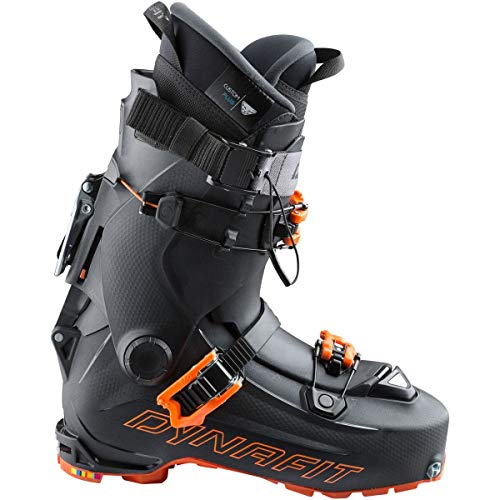
3. Dynafit Hoji Pro Tour — Best Lightweight Performance
Dynafit defined the modern ski touring boot category, and the Hoji Pro Tour is the brand's statement that you do not have to sacrifice downhill performance to get a lightweight touring boot. At its core, the Hoji Pro Tour is built for skiers who hike hard and ski harder. The stiff construction delivers a flex that punches well above what you would expect from a boot this light, and the overall design philosophy reflects Dynafit's deep roots in ski mountaineering competition, where every gram matters and every transition second counts. The boot is available in sizes covering EU 39 through EU 45, giving a wide range of skiers access to the platform.
The walk mode on the Hoji Pro Tour is one of the most mechanically refined in the lineup. The cuff release is smooth, the range of motion in tour mode is generous, and snapping back into ski mode is fast enough that you can handle quick transitions on technical ridgelines without drama. The Hoji platform has earned a devoted following among ski mountaineers and freeride tourers alike precisely because it sits at that sweet spot between uphill efficiency and downhill capability. You are getting a purpose-built tool here, not a jack-of-all-trades compromise. If you are chasing big vert days, multi-peak objectives, or simply want the most capable lightweight boot you can ski aggressively in, the Hoji Pro Tour belongs on your short list.
One caveat worth stating plainly: this boot rewards skiers with good technique. If your downhill skiing is still developing, the precision it demands on the descent can feel unforgiving. Pair it with a high-quality binding and take the time to dial in your forward lean for your personal skiing style.
Pros:
- Outstanding uphill efficiency with generous cuff articulation in walk mode
- Downhill performance far exceeds what the weight suggests
- Wide size range accommodates most foot sizes
- Proven platform with a strong track record among serious ski mountaineers
Cons:
- Demands good skiing technique — less forgiving for intermediate skill levels
- Premium price point reflects the build quality but is a significant investment
4. SCARPA Men's F1 LT — Best Ultralight Boot
If weight is your obsession and you are willing to make trade-offs to get the lightest possible boot on the market, the SCARPA F1 LT is the boot for you. SCARPA calls it their lightest weight alpine touring boot, and that is not an empty claim — the F1 LT borrows DNA directly from the Alien skimo race boot family while retaining enough downhill performance to be genuinely usable on steep terrain. The Carbon Grilamid LFT shell and cuff combination is engineered to transfer power efficiently without adding unnecessary mass, and the 3D Lambda Frame — with two raised ribs running along both sides of the shell — adds structural stiffness exactly where you need it for edge control without compromising the weight savings elsewhere.
The Speed Lock ski/walk mode on the F1 LT is the same lever mechanism found on the Maestrale RS. It locks firmly in ski mode, maintains the precision you need on technical descents, and transitions cleanly and quickly. Where the F1 LT differs from its sibling is in its intended use case: this is a boot designed for long days and steep lines, for skiers who push deep into the mountains and need every gram they can save on the approach. You are trading some of the all-day comfort of a wider-lasted boot for extreme uphill efficiency. The fit is narrow and precision-oriented, so if you have a medium or wide forefoot, you will want to confirm fit before buying — heat molding can help, but there are physical limits to how much a narrow last can adapt.
For fit athletes, competitive ski mountaineers, or anyone who regularly logs 5,000-plus vertical feet in a day, the F1 LT is a serious performance tool. Pair it with a lightweight frame binding or a dedicated AT race binding to keep your entire setup in the sub-2,000 gram range per ski.
Pros:
- Exceptional weight savings derived from skimo race technology
- Carbon Grilamid LFT shell provides precise power transfer with minimal bulk
- 3D Lambda Frame adds stiffness without weight penalty
- Speed Lock walk mode transitions quickly even in cold conditions
Cons:
- Narrow last is not suitable for wider feet without significant heat molding
- Downhill performance, while solid, does not match heavier, higher-flex alternatives
5. Dynafit TLT X Boot — Best for Speed & Racing
The Dynafit TLT X is not a casual touring boot. Let us be direct about that. This is a boot engineered for athletes who race, who measure their days in vertical meters, and who regard transitions as a competitive event in their own right. At 1,030 grams, the TLT X is one of the lightest serious AT boots on the market, and the Master Step binding system compatibility means you can clip in and out without looking down. The Pomoca Climb SPEED sole is purpose-built for exactly what the name suggests — fast movement over mixed terrain where grip and weight both matter.
The Ultra Lock System 5.1 closure provides a secure, intuitive hold that experienced tourers will appreciate immediately. The cuff delivers 60 degrees of rotation in walk mode with a forward lean adjustment between 15 and 18 degrees, giving you meaningful room to dial in your uphill position for your stride pattern and terrain angle. The 101mm last width puts this boot in a medium-width category, slightly more accommodating than the F1 LT but still firmly in the performance-fit bracket. The TLT X is the right call for anyone who counts ounces and measures success in summit-to-car time, not for someone looking for a versatile all-day boot that can double as a resort option.
Because the TLT X is optimized for speed and weight, you accept a narrower window of downhill performance in exchange. On moderate backcountry terrain, it skis confidently. On aggressive, variable snow — the kind of conditions you find after a warm week followed by a hard freeze — you will feel the limitations of a lower flex boot. Know your use case before you commit.
Pros:
- Ultralight 1,030g construction optimized for speed-oriented touring and racing
- Pomoca Climb SPEED sole provides excellent grip on steep bootpacks
- Master Step binding compatibility for fast, glove-friendly clip-in
- 60-degree cuff rotation in walk mode with adjustable forward lean
Cons:
- Downhill performance is limited compared to higher-flex, heavier alternatives
- Not suited for aggressive freeride terrain or heavy powder skiing
6. Tecnica Zero G Tour Scout — Best Budget-Friendly Option
Not every backcountry skier needs a race-derived boot with a carbon cuff. If you are transitioning from resort skiing into touring, or if you are buying your first dedicated AT setup, the Tecnica Zero G Tour Scout delivers exceptional value at a more accessible price point. Do not mistake "accessible" for "compromised" — the Scout runs a 120 flex index, which is firmly in the performance bracket, and the 99mm last width is a practical fit for a wide range of foot shapes without being sloppy. The glued-on Vibram ISO 9523 sole with Low Tech inserts is the same sole compatibility spec that the Zero G Tour Pro carries, meaning you are not locked out of any binding system by choosing the lower-cost sibling.
The Quick Instep design from Tecnica's broader Zero G platform carries over here, making daily entry and exit genuinely easier than many competitors at this price. The Grilamid shell construction is a proven material in this application — durable, responsive, and well-suited to the temperature swings that backcountry skiers encounter across a season. If you are worried about sole durability, understanding the different types of Vibram soles will help you appreciate why ISO 9523 compatibility is such an important standard in this category. The Tour Scout's sole meets that standard with a construction that handles rocks, ice, and variable terrain without excessive wear.
For skiers who are building out a backcountry kit for the first time and do not want to spend top dollar on their debut season, the Zero G Tour Scout is the honest, no-regrets choice. You get a serious boot with real downhill performance at a price that leaves room in the budget for quality skins, a reliable beacon, and a probe.
Pros:
- 120 flex index delivers genuine downhill performance at a beginner-accessible price
- Vibram ISO 9523 sole with Low Tech inserts ensures broad binding compatibility
- 99mm last accommodates a wider range of foot shapes comfortably
- Quick Instep design simplifies daily entry and exit
Cons:
- Slightly heavier than premium carbon-cuff options at this flex rating
- Lacks some of the advanced walk mode refinements found in the Pro model
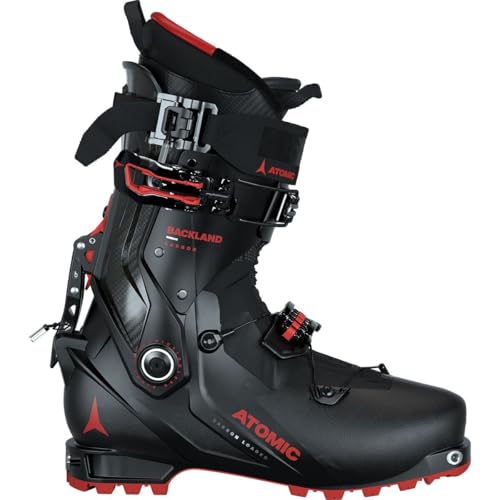
7. Atomic Backland Carbon — Best Downhill Performance
Atomic's Backland Carbon earns its place on this list as the strongest all-round downhill performer in the group without sacrificing the uphill credentials you need to justify calling it an alpine touring boot. The shell is built from carbon-loaded polyamide reinforced with carbon fiber, and the 110 flex index sits in a useful middle zone — assertive enough for serious resort-style skiing on steep backcountry terrain, manageable enough that it does not punish you on long approaches. The 98mm last width is on the narrow side, which reflects the boot's performance-fit philosophy. If you ski at a high level and your priority is maximizing edge response and ski control on the descent, the Backland Carbon delivers.
The 2026 version of the Backland Carbon continues Atomic's tradition of building a boot that genuinely bridges the gap between dedicated alpine boots and touring-specific designs. The walk mode transition is smooth, the range of motion in tour position is adequate for moderate-grade skin tracks, and the overall construction holds up to the demands of frequent use across a full season. Skiers who regularly transition between resort laps and backcountry objectives will find the Backland Carbon's performance balance particularly well-suited to that mixed-use pattern. You are not making the same sacrifices on the descent that a lighter, softer touring boot requires.
One honest trade-off to acknowledge: the Backland Carbon is not a boot for skinning huge vertical days. Its strengths are in descent performance and build quality. If your days regularly involve 5,000 feet of skinning followed by aggressive skiing on technical terrain, you will get more from it than from a dedicated weight-optimization boot. But if your days are 80% uphill and 20% descent, the SCARPA F1 LT or Dynafit TLT X are more appropriate tools.
Pros:
- Carbon fiber reinforcement delivers class-leading edge response and power transfer
- 110 flex provides strong downhill performance without being brutally stiff
- Carbon-loaded polyamide shell is lightweight relative to its performance level
- Well-suited for skiers who mix resort skiing with backcountry objectives
Cons:
- 98mm last width is narrow — not suitable for medium-to-wide foot shapes without fitting
- Walk mode range of motion is less generous than dedicated touring-first boots
Choosing the Right Alpine Touring Boot: A Buying Guide
Flex Index: Matching Stiffness to Your Skiing Style
The flex index number on an alpine touring boot is one of the most important specs you need to understand before purchasing. In 2026, AT boots typically range from around 80 (very soft, tour-focused) to 130+ (aggressive, downhill-oriented). A higher flex number means more resistance when you push your shin forward — which translates directly to more power transmission to your ski edge on the descent. The trade-off is that a stiffer boot is more fatiguing on long skin tracks where your ankle needs to flex repeatedly over thousands of steps.
As a general rule: if you are a beginner to intermediate skier transitioning into the backcountry, look at boots in the 90-110 range. Intermediate to advanced skiers who charge hard on the descent should target 110-125. Expert skiers and those with strong resort backgrounds who are taking serious backcountry lines will benefit from 125 or above. All of the boots on this list sit at 110 or higher, which reflects a bias toward performance-level buyers — if you are a casual beginner, you may want to look at softer options not included here.
Last Width: Why Fit Matters More Than Any Other Spec
The last width of a ski boot is the measurement across the widest point of the boot's internal volume, typically at the ball of the foot. For alpine touring boots, last widths generally range from 97mm (very narrow, race-oriented) to 102mm (medium-wide). The boots on this list range from 98mm (Atomic Backland Carbon) to 101mm (Dynafit TLT X), which is a meaningful difference when you are wearing them for six hours. A boot that is too narrow causes pain and numbness, and a boot that is too wide creates heel lift, which destroys your edge control on the descent.
Do not guess at fit. If possible, try boots in person at a specialty ski shop with a trained boot fitter on staff. Many shops will do a heat mold fitting at no additional charge when you purchase boots, which can significantly improve the fit of even a well-matched boot. If your feet are wide and you are shopping online, prioritize boots in the 100-101mm range and budget for professional fitting work.
Walk Mode and Transition Mechanics
Every AT boot on this list has some form of walk mode, but they are not all equal. The fundamental mechanism is a release of the cuff from the lower shell that allows your ankle to flex forward during the skinning stride. What varies is how much range of motion the boot provides, how easy the lever or mechanism is to operate with gloved hands in cold conditions, and how reliably it locks back into ski mode without ice interference.
The best walk modes — like the Speed Lock MLT on the SCARPA Maestrale RS and F1 LT — operate with a single lever that moves cleanly even in sub-zero temperatures. The worst walk modes require two hands, force you to remove your gloves, or are prone to icing over in wet spring snow. Before you buy, watch a walk mode demonstration for any boot you are considering. A slow transition is not just annoying — on technical terrain with weather moving in, it is a genuine safety issue. The boots covered in this guide all feature walk modes that meet a high standard, but the speed and ease of operation varies meaningfully between models.
Sole Compatibility: ISO 9523 and Binding Systems
Alpine touring boots use a different sole standard than traditional alpine ski boots, and it matters more than most buyers realize when they are first building a touring setup. The ISO 9523 standard governs the toe and heel profile of AT boot soles, and Low Tech insert compatibility determines which binding systems the boot can work with. Most modern AT boots on this list carry ISO 9523 soles with Low Tech inserts, which gives you access to the widest range of touring and frame bindings available in 2026.
If you are investing in a new boot and building a complete touring kit from scratch, confirm that your chosen boot is compatible with the binding you are planning to run. The Atomic Backland Carbon, SCARPA models, Tecnica Zero G boots, and Dynafit options all carry appropriate sole compatibility for the bindings in their respective categories — but always double-check the manufacturer's binding compatibility chart before finalizing your purchase. Sole material also matters for traction on approach terrain — Vibram rubber, as seen on the Tecnica Zero G models, provides noticeably better grip on wet rock and ice than standard rubber compounds.
Questions Answered
What flex rating should I choose for alpine touring boots in 2026?
Your flex choice should match your skill level and the terrain you ski most often. Beginners and light tourers do best with 90-110 flex. Intermediate to advanced skiers targeting all-mountain backcountry terrain should look at 110-125 flex. Expert skiers charging technical descents benefit from 125 and above. All seven boots on this list sit at 110 flex or higher, making them best suited to intermediate-to-expert skill levels.
Are alpine touring boots compatible with regular ski bindings?
No. Alpine touring boots use an ISO 9523 sole standard that is different from the ISO 5355 standard used by traditional alpine ski boots. You cannot use AT boots in standard alpine bindings without risking serious injury from failed release mechanisms. Always use AT-specific bindings — frame bindings, tech bindings, or hybrid systems — that are rated and certified for use with ISO 9523 AT boot soles.
How important is boot weight for alpine touring?
Boot weight has a compounding effect on fatigue that most people underestimate. Research has shown that 100 grams of weight on your foot requires as much energy as 300-400 grams on your back over a long day of skinning. For casual one-day tours with moderate elevation gain, boot weight matters less. For multi-peak objectives, competitive ski mountaineering, or frequent touring with significant vert, the difference between a 1,200g boot and a 1,600g boot is felt clearly by the end of the day.
Can I use alpine touring boots at a ski resort?
Yes, most AT boots with a flex index of 110 or higher ski adequately on groomed resort terrain. The SCARPA Maestrale RS 125 and Atomic Backland Carbon are the strongest resort performers on this list. Boots optimized for extreme weight savings — like the Dynafit TLT X and SCARPA F1 LT — are less comfortable for resort use because their narrow lasts and racing-oriented fits are not designed for the sustained duration of a resort ski day.
How do I break in new alpine touring boots?
Start with a professional boot fitting and heat molding session at a specialty ski shop — this alone resolves the majority of fit issues before you ever step outside. For your first two or three tours, keep the distance and elevation modest to let the liner conform to your foot. Ski shop boot fitters can punch out pressure points in the shell for persistent hot spots. Do not push through severe pain; it leads to injury and does not resolve itself without intervention.
What is the difference between tech bindings and frame bindings for AT boots?
Frame bindings use a traditional alpine-style heel piece mounted on a frame that lifts at the heel for touring mode, offering DIN-certified release similar to resort bindings. They are heavier but more familiar for skiers transitioning from resort setups. Tech bindings (also called pin bindings) use small metal pins that insert into corresponding inserts in the boot's toe, offering a much lighter and more efficient touring experience. Tech bindings require Low Tech inserts in your boots — which all seven boots on this list provide. Most serious touring skiers use tech bindings for anything beyond casual day trips.
Buy on Walmart
- SCARPA Men's Maestrale RS 125 Flex Alpine Touring Ski Boots — Walmart Link
- Tecnica Zero G Tour Pro Backcountry/Touring Men's Downhill S — Walmart Link
- Dynafit Hoji Pro Tour Skitouring Boots - Asphalt/Fluorescent — Walmart Link
- SCARPA Men's F1 LT Alpine Touring Ski Boots for Backcountry — Walmart Link
- Dynafit TLT X Boot - Men's Frost/Orange 26.5 — Walmart Link
- Tecnica Zero G Tour Scout Backcountry/Touring Men's Downhill — Walmart Link
- Atomic Backland Carbon Alpine Touring Boot - 2026, Black, 30 — Walmart Link
Buy on eBay
- SCARPA Men's Maestrale RS 125 Flex Alpine Touring Ski Boots — eBay Link
- Tecnica Zero G Tour Pro Backcountry/Touring Men's Downhill S — eBay Link
- Dynafit Hoji Pro Tour Skitouring Boots - Asphalt/Fluorescent — eBay Link
- SCARPA Men's F1 LT Alpine Touring Ski Boots for Backcountry — eBay Link
- Dynafit TLT X Boot - Men's Frost/Orange 26.5 — eBay Link
- Tecnica Zero G Tour Scout Backcountry/Touring Men's Downhill — eBay Link
- Atomic Backland Carbon Alpine Touring Boot - 2026, Black, 30 — eBay Link
Key Takeaways
- The SCARPA Maestrale RS 125 is the best all-round alpine touring boot for 2026 — it balances eco-conscious construction, 125 flex performance, and a glove-friendly walk mode that handles everything from resort laps to serious backcountry objectives.
- If weight is your priority, the SCARPA F1 LT and Dynafit TLT X are the two lightest options on this list, both drawing from skimo race technology to deliver efficient uphill performance for high-vert touring days.
- For skiers entering the backcountry for the first time without a top-dollar budget, the Tecnica Zero G Tour Scout delivers 120 flex performance and full Vibram ISO 9523 binding compatibility at the most accessible price point in this group.
- Fit matters more than any single spec — regardless of which boot you choose, invest in a professional heat mold fitting session to maximize comfort, performance, and long-term foot health on the mountain.


About Jason Flores
Jason Flores is a multi-talented individual whose unique journey has led him to blend his passion for craftsmanship and fashion into a creative endeavor. During his formative years, he found himself immersed in the world of handiwork, spending countless hours in his grandfather's workshop. These early experiences allowed him to develop a deep understanding of practical skills and a keen eye for detail.Simultaneously, Jason harbored an innate love for fashion, drawn to the artistry and self-expression it offers. As he grew older, he recognized the potential to combine his proficiency in craftsmanship with his fashion sensibilities. This realization led him to a path where he began to explore and write about the intersection of fieldwork fashion.
Get FREE Boots Gifts now. Or latest free toolsets from our best collections.
Disable Ad block to get all the secrets. Once done, hit any button below