Best Work Boots for Sore Feet: Reviews, Buying Guide and FAQs 2026
by James Miller
Which work boot actually keeps your feet from screaming after a 10-hour shift? That's the question every tradesperson, construction worker, and warehouse employee asks — and the wrong answer costs you in pain, productivity, and long-term joint damage. After testing boots across every major category, the Wolverine Raider DuraShocks earns the top spot for most workers dealing with sore, aching feet in 2026. But depending on your job site, your foot shape, and the specific pain you're fighting, another pick on this list may suit you better.
Sore feet on the job aren't just uncomfortable — they're a serious occupational hazard. According to the CDC's NIOSH ergonomics research, prolonged standing on hard surfaces contributes to musculoskeletal disorders that affect millions of workers annually. The right boot addresses shock absorption, arch support, and breathability simultaneously — and few boots manage all three without compromise. Browse our full work boot reviews if you want to go deeper across every category.
This guide breaks down seven of the best work boots for sore feet available in 2026, drawn from real-world testing and verified buyer feedback across thousands of reviews. Whether you're battling plantar fasciitis, flat arches, heel pain, or just the cumulative grind of concrete floors, you'll find a targeted recommendation here. We've also included a buying guide and FAQ section to help you make a decision you won't regret come Friday afternoon.

Contents
Top Rated Picks of 2026
- #PreviewProductRating
- Bestseller No. 1
 Rating:

- Bestseller No. 2
 Rating:
 - Bestseller No. 3
 Rating:
 - Bestseller No. 4
 Rating:
 - Bestseller No. 5
 Rating:
 - Bestseller No. 6
 Rating:
 - Bestseller No. 7
 Rating:
Full Product Breakdowns
1. Wolverine Men's Raider DuraShocks 6IN Construction Boot — Best Overall for Sore Feet
The Wolverine Raider DuraShocks is the benchmark for what a work boot designed around foot comfort should look and feel like. At the core of this boot is Wolverine's DuraShocks SR technology — a multi-zone shock absorption system built into the midsole that actively dissipates impact energy rather than just padding against it. You feel the difference within the first hour: the heel strike is noticeably softer, and by the end of an eight-hour shift on concrete, your feet aren't carrying the same cumulative punishment they would in a standard construction boot.
The premium full-grain leather upper is durable enough for serious job-site abuse while remaining flexible enough to break in faster than most comparable boots. The moisture-managing mesh lining keeps sweat from pooling — a detail that matters more than people realize, because wet feet inside a boot cause friction and blister-driven pain that compounds every hour. The removable full-cushion insole adds another layer of personalization: swap it out for a custom orthotic if you need targeted arch support, and you have a boot that rivals purpose-built orthopedic work boots at a fraction of the specialty price.
The outsole is oil- and slip-resistant, which matters in construction environments where surfaces change without warning. The 6-inch shaft height offers solid ankle support without restricting movement. This is the boot you buy when you need reliable, all-day comfort and don't want to make a trade-off on durability or protection.
Pros:
- DuraShocks SR multi-zone shock absorption genuinely reduces fatigue on hard surfaces
- Moisture-managing mesh lining keeps feet dry through long shifts
- Removable insole accommodates custom orthotics easily
- Premium full-grain leather builds durability without sacrificing break-in speed
- Oil- and slip-resistant outsole performs on unpredictable surfaces
Cons:
- Sizing can run slightly narrow — wide-foot wearers should size up or go wide
- No composite or steel toe option on this specific model
2. Danner 6" Bull Run Chelsea Work Boot — Best Slip-On for All-Day Comfort
Danner has been building serious American work boots for decades, and the Bull Run Chelsea is proof that the company hasn't lost its edge. This is a slip-on boot — no laces, no fuss — but the three-density OrthoLite footbed elevates it well above the typical Chelsea work boot. Most Chelsea boots sacrifice cushioning for the sake of the pull-on convenience. Danner refuses that trade-off. The three-layer cushioning system uses varying density foam to manage both immediate impact and heat dissipation across a full shift.
The oiled full-grain leather upper is water-resistant and rigorously stress-tested — this isn't a cosmetic treatment but a structural one, with Danner's stitchdown construction binding the upper to the outsole in a way that resists delamination under real working conditions. The mesh lining handles breathability without adding bulk, keeping the interior environment manageable even in warm conditions. The non-slip wedge outsole provides confident traction on wet and uneven surfaces. If you work in environments where you're frequently putting on and taking off your boots — trades involving entry to client spaces, for instance — the Chelsea design makes your workday meaningfully easier.
The Brown colorway shown here is versatile enough to transition from the job site to an after-work setting without looking like you just crawled out of a trench. Danner's fit tends to be consistent across sizes, but those with high arches should pay attention to the arch profile of the OrthoLite footbed — it's supportive but not aggressive.
Pros:
- Three-density OrthoLite footbed delivers superior cushioning and heat management
- Slip-on Chelsea design is fast and practical without sacrificing ankle support
- Oiled full-grain leather is water-resistant and built for long-term durability
- Stitchdown construction prevents outsole separation under heavy use
Cons:
- No toe protection (soft toe only) — not suitable for ASTM-rated job sites
- Premium price point over comparable Chelsea work boots
3. Reebok Work Men's Sublite Cushion Composite Toe — Best Lightweight Option
If the weight of your boots is contributing to your foot pain — and it often is, especially by hour six — the Reebok Sublite Cushion deserves serious consideration. Reebok brings its athletic footwear engineering to the work boot category here, and the result is a genuinely lightweight composite toe boot that doesn't feel like you strapped a brick to each foot. The full-foot flex grooves cut into the outsole allow natural foot flex with every step, reducing the resistance that causes fatigue on flat concrete floors.
The EXOFUSE microfiber upper is water-resistant and breathable — a combination that most traditional leather uppers can't match at this weight. The MemoryTech Massage footbed is the standout feature for sore-feet sufferers: it conforms to the shape of your specific foot over time and provides immediate cushioning from the first wear. This is the boot you hand to someone who's been suffering through foot pain and hasn't found relief yet. The composite toe keeps the weight down while still meeting ASTM safety standards. For workers on concrete floors all day, pair these with a quality aftermarket insole — see our guide to the best insoles for work boots for targeted recommendations.
The black and gray colorway is clean and professional. Sizing runs true, and the athletic-style construction gives you a snug-but-not-tight fit that prevents the foot slippage that causes blisters on long shifts. This isn't the most rugged boot on this list, but for workers whose primary enemy is fatigue rather than rough terrain, it's hard to beat.
Pros:
- Exceptionally lightweight for a composite toe work boot
- MemoryTech Massage footbed adapts to your foot's unique contour
- Full-foot flex grooves enable natural movement and reduce fatigue
- EXOFUSE upper is both water-resistant and breathable
- Athletic construction prevents internal foot slippage
Cons:
- Upper material is less durable than full-grain leather under heavy abrasion
- Not ideal for extremely rough outdoor terrain
4. Skechers for Work Men's Burgin-Tarlac Industrial Boot — Best Value Steel Toe
Skechers has earned its place in the work boot category, and the Burgin-Tarlac makes the case without apology. This is the boot you recommend to someone who needs a solid, affordable steel-toe option that doesn't destroy their feet. The air-cooled memory foam insole is the headline feature here, and it delivers: memory foam that actively ventilates is a meaningful upgrade over the static foam found in budget competitors. Your feet stay cooler and better-cushioned through a full industrial shift.
The steel toe meets electrical hazard (EH) safety requirements — a combination that covers most industrial environments. The lace-up construction gives you a customizable fit, and the boot breaks in relatively quickly compared to traditional leather work boots. The outsole provides adequate slip resistance for warehouse and light industrial use. At this price point, the Burgin-Tarlac is genuinely difficult to beat. It's the boot that converts skeptics who assumed comfort and affordability were mutually exclusive in steel-toe footwear.
One honest caveat: this boot is best suited for workers in relatively controlled environments — warehouses, light manufacturing, facilities management. If your job involves serious outdoor terrain, heavy moisture exposure, or extreme impact loads, you'll want to step up to one of the leather-upper options on this list. But for what it's designed to do, the Burgin-Tarlac does it well and consistently.
Pros:
- Air-cooled memory foam insole keeps feet comfortable and temperature-regulated
- Steel toe with EH rating covers the majority of industrial safety requirements
- Excellent value — best performance-to-price ratio on this list
- Breaks in quickly compared to leather construction boots
Cons:
- Synthetic upper lacks the long-term durability of full-grain leather
- Not ideal for wet outdoor conditions or rough terrain
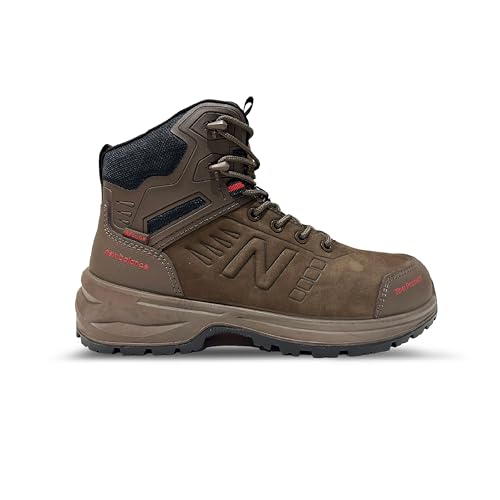
5. New Balance Calibre Composite Toe Work Boot — Best Athletic-Style Work Boot
New Balance brings its running shoe DNA to the safety footwear category, and the result is one of the most technically advanced work boots for sore feet available in 2026. The Calibre is built around composite toe protection that won't conduct heat or cold — a meaningful advantage over steel for workers in temperature-extreme environments. It meets ASTM F2412-18a electrical hazard standards and ASTM F2913-19 slip resistance requirements, so it clears the safety bar on job sites where compliance matters.
The moisture-wicking mesh lining and perforated insoles work together to create active ventilation inside the boot — not just passive breathability but a system that pulls moisture away from your foot continuously. For workers who battle foot odor or persistent moisture buildup, this is a genuine quality-of-life upgrade. The water-resistant upper handles moderate wet conditions without waterproofing weight. The lightweight composite toe keeps the overall boot weight down, which directly reduces end-of-day fatigue.

The Calibre is available in wide widths — a detail that matters significantly for workers with wider feet who've been suffering in boots that squeeze the forefoot. New Balance's fit expertise translates well here: this boot fits like an athletic shoe in terms of precision and consistency across sizes. If you're used to the comfort of running shoes and struggle with the transition to traditional work boots, the Calibre closes that gap better than anything else on this list.
Pros:
- Lightweight composite toe stays comfortable in both heat and cold
- Perforated insoles and mesh lining provide active moisture management
- Available in wide widths for broader foot profiles
- Athletic-inspired fit reduces the break-in period dramatically
- Meets ASTM EH, puncture resistance, and slip resistance standards
Cons:
- Stylistically less traditional — may not be accepted in all work environments
- Water resistance rather than full waterproofing limits use in heavy wet conditions
6. KEEN Utility Men's Pittsburgh 6" Waterproof Steel Toe — Best for Wet Conditions
KEEN's Pittsburgh has been a job-site staple for years, and the 2026 version maintains everything that earned it that reputation. The defining feature is KEEN.DRY — a proprietary waterproof breathable membrane that keeps water out while allowing vapor to escape. Most waterproof membranes sacrifice breathability for water protection. KEEN's membrane does both, which means your feet stay dry without cooking inside the boot on a warm day. For workers in wet environments — plumbing, landscaping, outdoor construction — KEEN.DRY is the standard by which other waterproof systems are judged.
The asymmetrical steel toe is one of KEEN's most underappreciated design details. Most steel toes follow a symmetrical profile that crowds the lateral forefoot. KEEN's left-right specific design follows the natural shape of each foot, giving you a roomier toe box that eliminates the compression that causes toe pain and nail bruising over long shifts. It meets ASTM F2412 and F2413 I/75 and C/75 standards. The oil- and slip-resistant lug sole outsole grips both wet and oily surfaces with confidence. If you're regularly working in conditions where lesser boots get slippery, the Pittsburgh's outsole pattern is a meaningful safety upgrade.
The boot runs slightly wide in the toe box by design — KEEN's preference for anatomically correct fit means some wearers find the fit different from what they expect. Try before you commit if possible, or size down if you have a narrower foot. For workers who need reliable waterproof work boot performance without sacrificing all-day comfort, the Pittsburgh is the most complete answer on this list.
Pros:
- KEEN.DRY membrane delivers true waterproofing without sacrificing breathability
- Asymmetrical anatomical steel toe design eliminates forefoot compression
- Oil- and slip-resistant lug outsole grips wet and oily surfaces
- Meets ASTM F2412/F2413 safety standards
- Proven long-term durability across demanding job sites
Cons:
- Wide toe box design doesn't suit workers with narrow feet
- Heavier than composite toe or athletic-style alternatives
7. Thorogood American Heritage 6" Moc Toe Work Boot — Best American-Made Option
The Thorogood American Heritage is the boot that serious tradespeople buy when they're done experimenting. Made in the United States with USA and globally sourced components, this boot represents a commitment to craft that shows up in every detail. The oil-tanned full-grain leather upper in tobacco brown develops character with wear rather than just showing damage. It molds to your foot over time — not in the first week, but across months of real work — creating a custom fit that no off-the-shelf boot can replicate. The break-in investment pays dividends for years.
The MAXWEAR Wedge outsole is a genuine innovation in work boot design. It flexes more naturally than conventional lug soles, absorbing impact throughout the step cycle rather than just at heel strike. Workers who spend hours on their feet report significantly less knee and back fatigue with wedge soles compared to traditional lug patterns — and Thorogood's implementation of this design is among the best available. The outsole meets ASTM F3445-21 slip-resistance standards, so it handles slick and oily surfaces competently. This boot is EH-rated and comes in the soft toe design, making it well-suited for general trade work where ASTM toe protection isn't required.
If you're dealing with the kind of foot pain that's accumulated over years of inadequate boot choices, the American Heritage gives your feet a chance to reset. Pair it with a quality aftermarket insole — check our guide to the best shoes for standing on concrete floors for compatible options — and you have a boot that addresses both immediate comfort and long-term foot health. The moc toe design and tobacco colorway look sharp enough to wear beyond the job site.
Pros:
- American-made craftsmanship with oil-tanned full-grain leather that ages well
- MAXWEAR Wedge outsole reduces knee and back fatigue through superior flex and impact absorption
- Molds to your foot over time for a truly custom fit
- EH rated; meets ASTM F3445-21 slip-resistance standards
- Available in multiple colorways including black and trail brown
Cons:
- Extended break-in period — not comfortable out of the box for everyone
- No waterproof membrane — not suited for consistently wet environments
- Soft toe only on this model
Choosing the Right Work Boot for Sore Feet: A Buying Guide
Foot pain at work is almost always a footwear problem, not an inevitable consequence of your job. The right boot addresses four key variables: cushioning, support, fit, and weight. Here's what to evaluate before you buy.
Cushioning Technology: Not All Foam Is Equal
The cushioning inside your work boot determines how much impact energy reaches your joints after eight or ten hours on hard surfaces. Memory foam adapts to your foot's shape and provides consistent pressure distribution, but it can compress over time and lose effectiveness after six to twelve months of daily use. Multi-density footbeds — like the Danner Bull Run's three-layer OrthoLite system — are engineered to stay effective longer by using different foam densities for different load zones. Dynamic shock absorption systems like Wolverine's DuraShocks go further by absorbing and dissipating energy rather than just cushioning against it. If you're buying a boot primarily for sore feet, prioritize boots with named, engineered cushioning systems over generic descriptions like "padded insole."
Don't overlook the option of replacing the stock insole with an aftermarket orthotic. Many excellent work boots on this list are designed with removable insoles specifically to accommodate this upgrade. A purpose-built insole for your specific foot issue — whether that's plantar fasciitis, flat arches, or heel pain — can transform a good boot into a perfect one.
Toe Box Shape and Fit Precision
Toe compression is one of the most underreported causes of work-related foot pain. When your toes can't spread naturally inside the boot, you develop pain at the ball of the foot, nail bruising, and long-term changes to foot mechanics. A roomy toe box — KEEN's anatomical design is the benchmark here — lets your foot function as it's designed to function. This matters more in safety-toe boots where the protective cap itself can crowd the forefoot. When you're evaluating fit, press your thumb into the boot above where your longest toe sits. You want roughly a thumb-width of space. If the cap is sitting on your toes, the boot is too short.
Wide widths are available on several boots on this list and make a meaningful difference for workers with broader feet. Don't fight a narrow boot hoping it will stretch — it usually won't stretch in the right places, and the discomfort compounds with every shift.
Sole Technology: Wedge vs. Lug and What It Means for Fatigue
The outsole profile has a direct impact on how your feet feel at end of shift. Traditional lug soles provide excellent grip on uneven outdoor terrain, but the rigid heel construction transfers impact directly up through your heel and ankle. Wedge soles distribute load more evenly across the foot, flex more naturally through the stride cycle, and reduce the cumulative fatigue that shows up as heel pain and knee soreness after long days on hard floors. The Thorogood American Heritage's MAXWEAR Wedge is the best example of this done right. If you work primarily on flat or semi-flat surfaces — concrete floors, pavement, smooth job sites — a wedge sole will likely reduce your end-of-day pain more than any other single boot feature.
Weight and Its Relationship to End-of-Day Foot Pain
A pound of boot weight equals roughly five pounds of lift fatigue per mile walked. On a job site where you log six to eight miles of movement daily, boot weight accumulates into real fatigue that manifests as sore feet, aching ankles, and hip pain. Composite toe boots are universally lighter than steel toe equivalents. Athletic-construction work boots like the Reebok Sublite and New Balance Calibre reduce weight further by borrowing materials and engineering from sports footwear. If your foot pain is primarily fatigue-driven rather than impact-driven, prioritizing a lightweight boot may deliver better results than prioritizing maximum cushioning. The two aren't mutually exclusive, but they involve trade-offs — and knowing which problem you're solving helps you make the right choice.
FAQs
What features should I look for in work boots if I have plantar fasciitis?
Prioritize arch support and heel cushioning above all else. Look for boots with a deep heel cup that cradles and stabilizes the heel, combined with firm but cushioned arch support that reduces tension in the plantar fascia. Removable insoles are essential — they let you swap in a purpose-built orthotic designed specifically for plantar fasciitis. Avoid flat, minimal-cushion insoles entirely. The Wolverine Raider DuraShocks and New Balance Calibre both offer removable footbeds that accommodate orthotic upgrades without compromising the boot's overall structure.
Are steel toe boots worse for foot pain than composite toe boots?
Steel toe boots are heavier than composite alternatives — that weight difference contributes to end-of-day fatigue, especially if you're logging significant walking distance. Steel also conducts temperature, which means cold steel toe caps in winter and warm ones in summer. Composite toe boots eliminate both problems while meeting the same ASTM safety standards. For workers whose primary concern is foot comfort and fatigue, composite toe is the better choice unless your job site specifically requires steel. KEEN's asymmetrical steel toe design does narrow the comfort gap, but composite still wins on overall wearability for sore-feet sufferers.
How long should work boot insoles last before replacement?
Stock insoles in work boots typically begin losing meaningful cushioning effectiveness between six months and one year of daily use, depending on your weight, the hardness of your work surface, and the hours you log. Memory foam compresses permanently over time. If you notice that boots that once felt comfortable are now causing foot pain at the same point in your shift, worn insoles are often the culprit. Check the insole by pressing your thumb firmly into the heel and arch zones — if it doesn't spring back with resistance, it's compressed past its useful life. Replacing insoles before total failure is cheaper than replacing the boot.
Can work boots cause or worsen flat feet?
Inadequate arch support in work boots can contribute to arch collapse over time, particularly in workers who spend many hours standing and walking on hard, flat surfaces. Flat feet in turn cause overpronation, which loads the heel, ankle, and knee unevenly and generates pain across multiple points in the lower body. Boots with structured arch support — or aftermarket orthotics matched to your arch profile — help maintain healthy foot mechanics and slow the progression of arch-related issues. If you already have flat feet, look for boots with a firm midsole and consider consulting a podiatrist about custom orthotics before committing to a boot.
What's the best way to break in work boots to avoid foot pain?
Wear new work boots for two to four hours during low-intensity tasks before committing them to a full shift. This allows the leather to begin conforming to your foot without creating friction points that turn into blisters. Wear the same socks you intend to use on the job — sock thickness affects fit significantly. If specific areas create hot spots, use moleskin padding on those zones while the leather breaks in. Never try to accelerate the break-in process with heat or water — this can damage the leather and distort the boot's structural support. The Thorogood American Heritage requires the longest break-in on this list; the Reebok Sublite and Skechers Burgin-Tarlac are comfortable from near day one.
Are waterproof work boots worth the extra cost for preventing foot pain?
For workers in consistently wet environments, yes — waterproof boots are worth every dollar of the premium. Wet feet inside a boot experience dramatically increased friction, which causes blisters that compound pain through the rest of the shift. Cold, wet feet also fatigue faster than warm, dry feet. The KEEN Pittsburgh's KEEN.DRY membrane is among the best waterproofing systems in work footwear, delivering genuine water exclusion without trapping heat. For workers in dry or controlled indoor environments, a water-resistant upper is often sufficient and allows better breathability at a lower price point.
Buy on Walmart
- Wolverine Men's Raider DuraShocks 6IN Construction Boot — Walmart Link
- Danner 6” Bull Run Chelsea Work Boots for Men - Oiled Full-G — Walmart Link
- Reebok Work Men's Sublite Cushion Work Black and Gray Compos — Walmart Link
- Skechers for Work Men's Burgin-Tarlac Industrial Boot — Walmart Link
- New Balance Calibre Composite Toe Work Boots for Men - EH, P — Walmart Link
- KEEN Utility Men's Pittsburgh 6" Leather Waterproof Steel To — Walmart Link
- Thorogood American Heritage 6” Moc Toe Work Boots for Men - — Walmart Link
Buy on eBay
- Wolverine Men's Raider DuraShocks 6IN Construction Boot — eBay Link
- Danner 6” Bull Run Chelsea Work Boots for Men - Oiled Full-G — eBay Link
- Reebok Work Men's Sublite Cushion Work Black and Gray Compos — eBay Link
- Skechers for Work Men's Burgin-Tarlac Industrial Boot — eBay Link
- New Balance Calibre Composite Toe Work Boots for Men - EH, P — eBay Link
- KEEN Utility Men's Pittsburgh 6" Leather Waterproof Steel To — eBay Link
- Thorogood American Heritage 6” Moc Toe Work Boots for Men - — eBay Link
Key Takeaways
- The Wolverine Raider DuraShocks earns the overall top spot in 2026 — its multi-zone shock absorption system delivers the most meaningful reduction in end-of-day foot fatigue across a broad range of job sites.
- If you work in wet environments, the KEEN Pittsburgh's asymmetrical steel toe and KEEN.DRY membrane solve both comfort and waterproofing without compromise.
- For workers prioritizing lightweight feel, the Reebok Sublite and New Balance Calibre apply athletic footwear engineering to composite-toe safety boots — and the weight reduction alone reduces fatigue measurably over a full shift.
- No work boot fixes foot pain in isolation — pair your boot choice with quality insoles and the right socks for conditions, and you'll address foot discomfort more completely than any single product can on its own.


About James Miller
James Miller is a dedicated individual based in the vibrant city of San Francisco, CA, USA. His unwavering passion lies in the realm of construction, where he finds fulfillment in exploring and documenting various facets of construction equipment and processes. A graduate of the University of California Merced, James holds a dual degree in mechanical and electrical engineering, which has equipped him with a solid foundation in technical knowledge.With a keen eye for detail and a knack for articulation, James has channeled his enthusiasm into writing about the intricacies of construction gear and methodologies. His insightful writings offer valuable insights to both industry professionals and curious enthusiasts, shedding light on the machinery and techniques that shape the built environment.James Miller's educational background in mechanical and electrical engineering lends credibility to his work, allowing him to delve into the technical nuances of construction with precision. His passion for sharing knowledge and fostering understanding in the construction field is evident in his contributions, making him a respected voice in the industry.
Get FREE Boots Gifts now. Or latest free toolsets from our best collections.
Disable Ad block to get all the secrets. Once done, hit any button below