According to the American Podiatric Medical Association, roughly 77% of Americans experience foot pain at some point in their lives — and ill-fitting footwear is one of the primary causes. If you spend eight to twelve hours a day in work boots, a pair that's even a half-size too tight can cause blisters, bunions, and serious long-term damage. Learning how to stretch work boots is one of the smartest moves you can make for your foot health and on-the-job comfort. Whether your new boots are pinching your toes on day one or a recent foot injury changed your fit needs, there are proven methods to get them fitting the way they should. For more boot care advice, visit our boot tips and guides.
Stretching work boots isn't guesswork. Different materials respond differently, and the wrong technique can crack leather, warp structure, or compromise waterproofing. The good news is that most quality leather boots have enough give to stretch a full half-size — sometimes more — without professional help. You just need the right approach and a little patience.
This guide covers everything from quick at-home wins to when you should hand your boots over to a cobbler. You'll also get a cost breakdown, a troubleshooting section for when things go sideways, and targeted advice for different boot constructions. Let's get into it.
Contents
- When Your Work Boots Need Stretching — And When They Don't
- Why Leather Work Boots Resist Stretching
- Fast Home Methods to Stretch Work Boots
- Choosing the Right Method for Your Boot Type
- Troubleshooting: When Stretching Doesn't Work
- What It Costs to Stretch Work Boots
- Frequently Asked Questions
- Final Thoughts
When Your Work Boots Need Stretching — And When They Don't
Signs You Should Stretch Your Boots
Not every uncomfortable boot needs stretching. But there are clear, reliable signals that tell you it's the right move. Consistent pressure across the ball of your foot, tightness along the outer edges of your toes, or a pinky toe squeezed hard against the boot wall — these are all solid indicators. Blisters forming on the exact same spots after every wear are another dead giveaway.
New leather boots that feel tight at the toe box but fit well at the heel and instep are almost always stretchable. That's expected. Raw leather hasn't conformed to your foot yet, and a little targeted stretching can save you weeks of painful break-in time. If your feet have also changed shape due to age, weight fluctuation, or injury, boots that once fit well may now feel snug in specific areas like the instep or around the ankle collar.
Pro Tip: If your boots feel tight when you first put them on but loosen after 20–30 minutes of wear, the leather is breaking in naturally. Stretching can speed things up, but it isn't always necessary.
When Stretching Won't Solve the Problem
If your boots are too long — meaning there's little to no gap at the toe — stretching won't help. Stretching works on width and localized pressure points. It doesn't add length. If you're debating whether to stretch a boot that's a full size too small, don't. Start with the correct size and save yourself the frustration.
Rigid thermoplastic components built into certain safety boots are also a problem. Some work boots are engineered with fixed structural elements around the toe cap and heel counter that simply don't flex. Forcing them can crack the material or compromise the safety rating. And if tight boots are digging into your ankle rather than squeezing your foot, that's a different problem — our guide on how to prevent shoes from cutting your ankle covers exactly that scenario with targeted fixes.
Why Leather Work Boots Resist Stretching
How Leather Behaves Under Pressure
Leather is a natural material made from treated animal hide. Its dense fiber network gives it durability and structure, but that same density is what makes it resist deformation initially. When leather gets wet — from sweat, water, or a conditioning solution — those fibers relax and become more pliable. As the leather dries under pressure or around a form, it sets in a new shape. That's the science behind every stretching method in this guide.
Full-grain leather, the standard for quality work boots from brands like Thorogood, Red Wing, or Wolverine, has the densest fiber structure and the best stretch potential. Full-grain leather can typically stretch between a quarter-inch and a full half-size when treated correctly. Corrected-grain and split leather, found in cheaper boots, stretch less reliably and are more prone to cracking if you push them hard.
The Break-In Period Explained
Every leather work boot has a break-in period — typically 80 to 100 hours of wear — during which the leather molds progressively to your foot. This is normal and expected. What you're doing when you stretch boots proactively is accelerating that process in targeted areas rather than grinding through weeks of discomfort and waiting for it to happen on its own.
The break-in period also affects the insole and midsole, not just the upper. As the boot flexes and compresses, the cushioning softens in the right places. Stretching the upper speeds up fit comfort, but it doesn't replace the need for the insole to conform to your arch and heel. Keep that in mind if the boot still feels off after you've successfully stretched the upper — the insole may be the remaining culprit.
Fast Home Methods to Stretch Work Boots
There are several proven at-home techniques for how to stretch work boots, and most don't require special equipment. The best approach depends on your boot's material and how much stretch you actually need. Below are the three most effective methods, starting with the simplest.
The Thick Sock Method
This is the easiest method and works well when you need modest, even stretch across the forefoot. Pull on two pairs of thick wool or athletic socks, then force your feet into the boots. Walk around the house for 20 to 30 minutes. The added bulk forces the leather to expand. Repeat this daily over three to five days for gradual, even stretch across the entire forefoot.
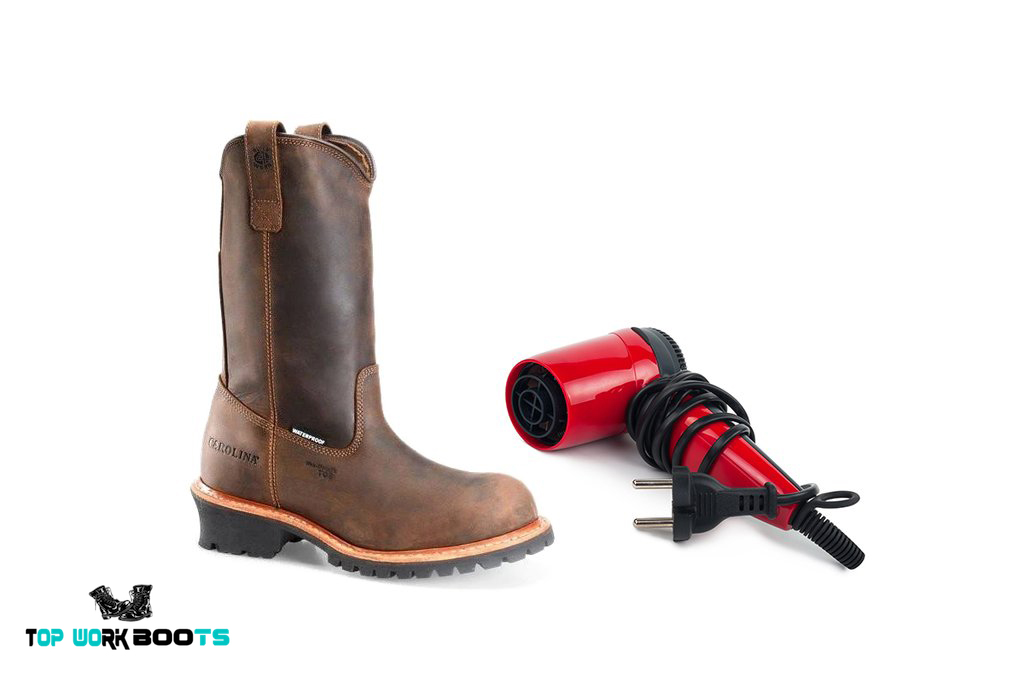
For faster results, use a hair dryer on medium heat while wearing the thick socks inside the boots. Keep the dryer moving — never hold it in one spot for more than five to ten seconds. The heat softens the leather fibers, the socks provide expanding pressure, and as the leather cools, it sets in the stretched position. Always condition the leather afterward with a quality boot conditioner to replace the moisture that heat removes.
Warning: Don't use high heat settings or hold the dryer too close — excessive heat dries out leather rapidly and leads to cracking and premature wear.
Rubbing Alcohol Spray
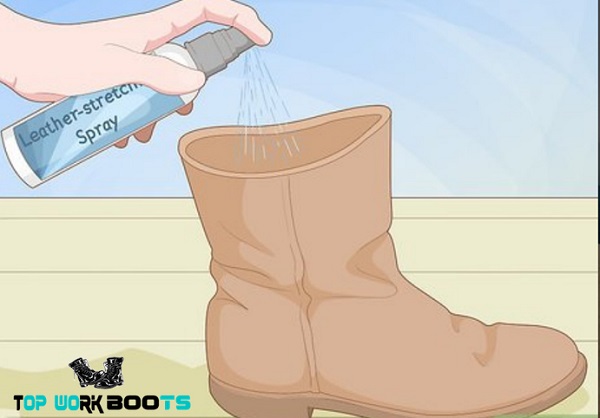
A 50/50 mix of rubbing alcohol and water is one of the most effective spot-stretching solutions available. Fill a spray bottle, spray the tight areas inside and outside the boot, then immediately put them on with thick socks and walk around until the leather dries completely. The alcohol relaxes the leather fibers quickly, allowing them to conform to your foot without prolonged heat exposure.
This method works especially well for pinch points around the toe box and instep. It's also one of the most controlled approaches — you're targeting exactly where you need it rather than applying uniform pressure across the entire boot. Follow up with a leather conditioner once the boot dries fully. Skipping this step is the most common mistake and leads to dried, brittle leather within weeks.
The Freezer Method
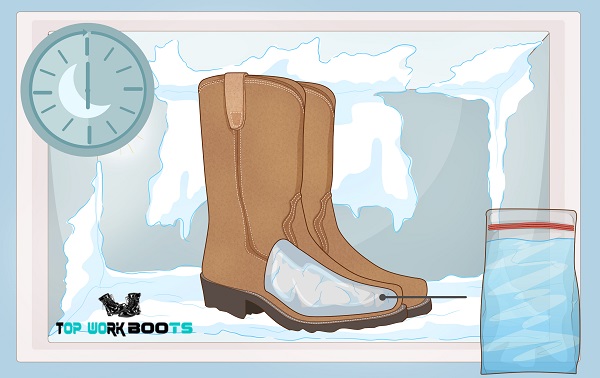
Fill two zip-lock bags with water, seal them tight, and place them inside your boots in the areas that feel tightest. Put the boots in the freezer overnight. Water expands by roughly 9% as it freezes, and that slow, steady expansion puts gentle, even pressure on the leather from the inside — no heat, no chemicals required.
This method is particularly useful for the toe box, where applying direct heat risks damaging the toe cap structure. Let the boots return to room temperature naturally before removing the bags — forcing the ice out can tear the liner. One overnight session often produces noticeable improvement. You can repeat the process two or three times for a more significant stretch, but check the fit between each cycle.
Choosing the Right Method for Your Boot Type
Before you pick your approach, know what your boots are made of and how they're built. Using the wrong technique on the wrong material is how you end up with a ruined pair instead of a fixed one.
Full-Grain Leather Boots
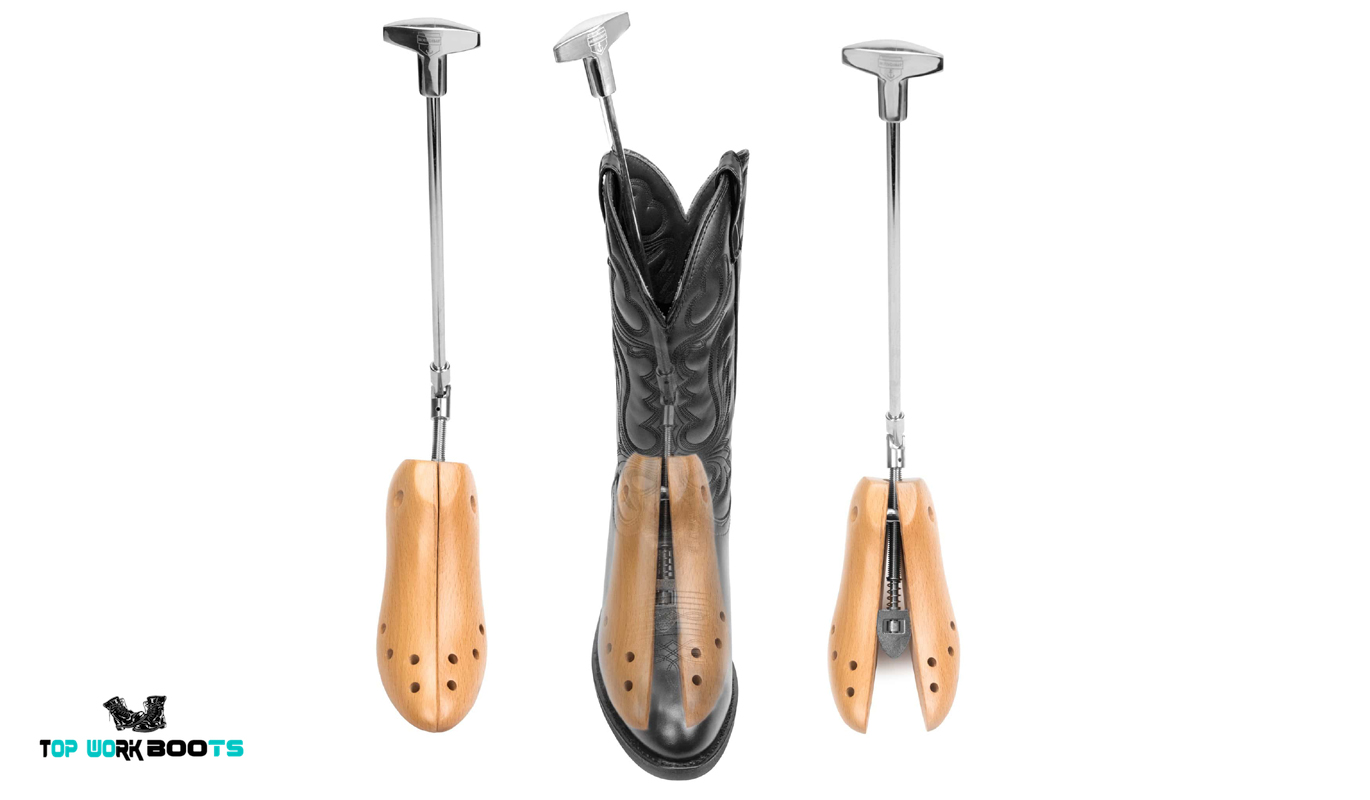
Full-grain leather is the most forgiving material to work with. All three home methods — thick socks with heat, alcohol spray, and the freezer method — work well on it. Boot stretchers, which are wooden or plastic shoe-tree-style devices designed specifically for this purpose, also perform excellently with full-grain leather. A two-way boot stretcher lets you expand both length and width simultaneously, and stretching plugs let you target specific pressure points around bunions or toe knuckles.
If you own cowboy-style work boots and are dealing with tightness higher up the leg shaft rather than at the foot, the principles are similar but the technique differs. Our detailed guide on how to stretch cowboy boots around the calf covers that specific scenario with step-by-step instructions tailored to the shaft construction.
For full-grain leather, always work in sessions rather than trying to force maximum stretch in a single attempt. Patient, repeated sessions produce lasting, even results without stressing the leather's fiber structure beyond its limits.
Synthetic and Composite Boots
Synthetic leather, nylon, and composite uppers require more caution. Heat methods are generally not recommended for synthetics — many will deform unevenly or lose structural integrity under direct heat. The freezer method is the safest option for synthetic uppers, as the pressure is gradual and temperature-neutral. The alcohol method can work on some synthetics, but test it on a small, inconspicuous area first since alcohol can strip surface finishes or cause discoloration on certain materials.
Composite toe and steel toe boots present an additional constraint — the toe box structure is fixed and non-stretchable regardless of upper material. Stretching can only widen the soft leather immediately behind the cap, not the cap itself. If your problem is specifically inside the toe cap area, sizing up on your next purchase is the better long-term solution rather than repeatedly forcing a boot that physically cannot accommodate your foot there.
Troubleshooting: When Stretching Doesn't Work
Still Too Tight After Stretching
If you've completed two or three stretching sessions and the boot still feels too tight, there are a few likely explanations. The most common is that the boot is genuinely too small — more than a half-size off your true size. Stretching compensates for minor fit issues, not significant ones. At that point, you have two realistic options: take the boots to a professional cobbler with a mechanical stretching machine, or accept that this pair isn't the right fit for your foot.
A cobbler's mechanical stretcher applies consistent, calibrated pressure over 24 to 48 hours and achieves results that DIY methods can't match. For boots you've invested serious money in, this service fee is almost always worth it. Professional stretching typically delivers a quarter-inch to a half-inch of additional width that holds permanently.
Another culprit worth checking: a thick factory insole eating into your available interior space. Pull the insole and walk around in just socks. If the fit immediately improves, swap it for a thinner aftermarket insole rather than stretching the boot further. This is a surprisingly common fix that most people overlook.
Overstretched Boots
Overstretching is a real risk, especially with the freezer method run through too many consecutive cycles or a boot stretcher cranked too aggressively. If your boots suddenly feel sloppy — heel lifting with each step, lateral movement in the toe box — you've gone too far. Leather stretched past its optimal point is difficult to return to its original dimensions.
Partially overstretched boots can sometimes be improved with a leather-shrinking approach: wet the interior lightly with water, insert a correctly-sized shoe tree, and let the boot dry at room temperature. The leather will contract slightly as it dries around the form. This doesn't always bring it back fully, but it can reduce excess stretch enough to make the boot wearable again. Prevention is the better answer — work in incremental sessions and check the fit after each one before continuing.
What It Costs to Stretch Work Boots
DIY Costs vs. Professional Cobbler Fees
One of the biggest advantages of stretching your own work boots is cost. Most at-home methods require materials you either already own or can pick up for under $10. A boot stretcher — the single most useful tool you can own for this purpose — runs from $15 to $50 depending on quality and whether it's a single-direction or two-way model. Here's how the options stack up:
| Method | Cost | Difficulty | Stretch Potential | Best For |
|---|---|---|---|---|
| Thick socks + walking | $0 | Easy | 1/8 – 1/4 inch | Minor tightness, gradual break-in |
| Rubbing alcohol spray | $2 – $5 | Easy | 1/4 – 3/8 inch | Localized pinch points |
| Freezer method | $1 (zip-lock bags) | Easy | 1/4 – 3/8 inch | Toe box width, no heat risk |
| Boot stretcher (DIY) | $15 – $50 | Moderate | Up to 1/2 inch | Even full-width stretch |
| Professional cobbler | $20 – $75 | N/A | Up to 1/2 inch+ | Maximum results, stubborn fits |
Is It Worth the Investment?
The math is straightforward. A quality pair of work boots — Red Wing Iron Rangers, Thorogood 1957 series, Danner Quarry — runs anywhere from $200 to $400. Spending $20 on a good boot stretcher or $50 at a cobbler to save a $300 pair is an obvious return on investment. Even mid-tier boots in the $100 to $150 range are worth a modest stretching investment compared to buying a new pair.
Where it stops making financial sense is with sub-$80 work boots built from inferior materials. Stretching methods are less predictable on low-grade leather and synthetics, and these boots often don't have enough structural integrity to hold the stretch long-term. In those cases, putting the money toward a better-fitting pair with proper construction is the smarter move. If you're unsure whether your current boots are worth saving, most cobblers will give you an honest assessment at no charge before you commit to a paid service.
Frequently Asked Questions
Can you stretch work boots that have steel toes?
Yes, but only in the areas behind and around the steel toe cap — the cap itself is a fixed structural element and cannot be stretched. Focus your efforts on widening the forefoot and instep regions. If the tightness is specifically inside the toe cap, no stretching method will resolve it, and you need a boot with a wider toe box or a larger toe cap size.
How long does it take to stretch work boots?
Most DIY methods show results within one to three sessions spread over three to seven days. The alcohol spray can produce noticeable improvement after a single session. A professional cobbler with a mechanical stretcher typically finishes the job in 24 to 48 hours. Slow, repeated sessions hold longer than aggressive single-session attempts — patience produces better long-term results.
Will stretching work boots damage waterproofing?
Chemical methods like rubbing alcohol can strip waterproofing treatments if used in excess. After any alcohol-based stretching, re-apply a waterproofing wax or conditioner once the leather is fully dry. Heat methods can also affect waterproof membranes like Gore-Tex if applied directly over those areas. The freezer method is the safest option for boots with waterproof ratings.
Final Thoughts
Knowing how to stretch work boots correctly can save you hundreds of dollars, weeks of discomfort, and keep a well-made pair in service far longer than a painful break-in would otherwise allow. Start with the simplest method that matches your boot's material, work in incremental sessions, and escalate to a cobbler if two or three rounds don't produce results — don't force it beyond its limits. Head over to our boot tips and guides section, pick the method that fits your situation, and give your feet the fit they've been working without.


About James Miller
James Miller is a dedicated individual based in the vibrant city of San Francisco, CA, USA. His unwavering passion lies in the realm of construction, where he finds fulfillment in exploring and documenting various facets of construction equipment and processes. A graduate of the University of California Merced, James holds a dual degree in mechanical and electrical engineering, which has equipped him with a solid foundation in technical knowledge.With a keen eye for detail and a knack for articulation, James has channeled his enthusiasm into writing about the intricacies of construction gear and methodologies. His insightful writings offer valuable insights to both industry professionals and curious enthusiasts, shedding light on the machinery and techniques that shape the built environment.James Miller's educational background in mechanical and electrical engineering lends credibility to his work, allowing him to delve into the technical nuances of construction with precision. His passion for sharing knowledge and fostering understanding in the construction field is evident in his contributions, making him a respected voice in the industry.
Get FREE Boots Gifts now. Or latest free toolsets from our best collections.
Disable Ad block to get all the secrets. Once done, hit any button below