Nearly 77 percent of Americans experience foot problems linked to poorly fitting shoes, according to the American Podiatric Medical Association — and tight work boots are among the biggest culprits on job sites everywhere. If your boots are pinching your toes, cutting into your instep, or leaving red pressure marks at the end of a long shift, knowing how to use a shoe stretcher is one of the fastest fixes you can make at home without buying a new pair. This guide covers every step of the process, from choosing the right type of stretcher to getting results that actually hold. For more practical footwear advice, explore the boot tips and guides collection.
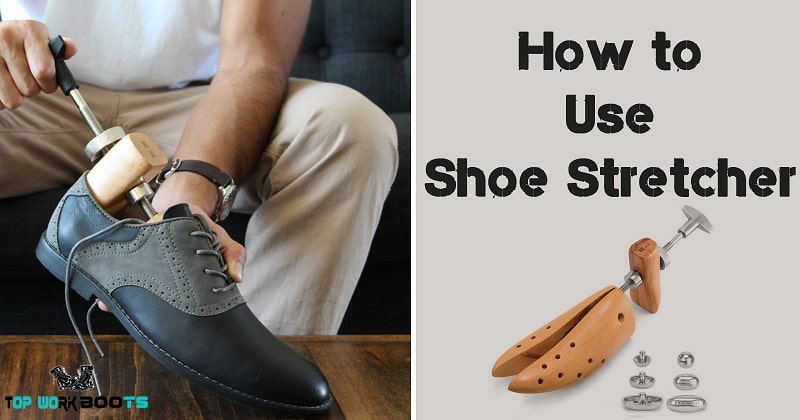
A shoe stretcher is a wooden or plastic tool that you insert into your boot or shoe to widen the material from the inside out. You turn a knob to expand it, leave it in place for several hours, and the leather or synthetic upper gradually relaxes into a more comfortable shape. The process works because slow, steady pressure is far more effective — and far safer for your boots — than trying to force the material to stretch quickly.
Before reaching for a stretcher, it pays to confirm your boots are actually the right size. Check whether your boots fit correctly before stretching — if they're already too large, stretching makes the problem worse. But if the size is right and specific pressure points are making your feet miserable, keep reading. You're in the right place.
Contents
Shoe Stretcher Types: A Quick Comparison
The Four Main Stretcher Styles
Not all shoe stretchers are built the same. There are four main types, and each one targets a different kind of fit problem. Using the wrong type wastes your time and can actually cause uneven stretching.
- Two-way stretcher — expands your boot both in width and length simultaneously. The best all-purpose option for most work boots. Gives you the most control.
- One-way stretcher — widens the shoe left-to-right only. Good for targeting pressure across the ball of the foot when length is fine but width is the problem.
- Ball-and-ring stretcher — a smaller tool that targets a single tight spot, like a bunion (a bony bump on the joint at the base of your big toe) or a hammer toe (a toe that bends downward at the middle joint).
- Boot stretcher — a full-length version built for tall-shaft boots like cowboy boots or high-ankle work boots. Includes a long handle to reach the shaft.
Picking the Right One for Work Boots
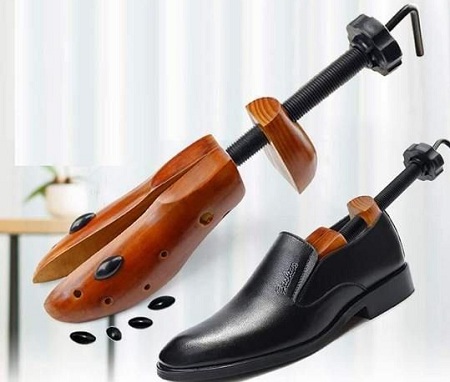
For standard lace-up work boots, a two-way stretcher with plug attachments is your best choice. The plugs are small raised inserts that screw into holes on the stretcher face. You position them directly over any pressure points — a bunion bump, a tight spot over a toe — and the stretcher creates a small pocket of extra room exactly where you need it.
Match the stretcher size to your boot size. Most stretchers come in small, medium, large, and extra-large, labeled by men's and women's size ranges. A stretcher that's too small won't make full contact with the upper. One that's too large forces the boot open unevenly and can warp the toe box.
| Stretcher Type | Best Use Case | Adjustments | Price Range |
|---|---|---|---|
| Two-way | Overall tightness in work boots | Width + length | $15–$35 |
| One-way | Ball-of-foot width tightness | Width only | $10–$25 |
| Ball-and-ring | Bunions, hammer toes | Spot targeting | $8–$20 |
| Boot stretcher | Tall shaft, cowboy, or lineman boots | Width + shaft height | $20–$45 |
If you wear cowboy-style work boots and need to widen the calf area as well as the foot, that's a separate challenge with its own technique. See the full guide on how to stretch cowboy boots around the calf for that process.
Why Work Boots Get Tight (And When to Stretch)
What Causes That Pinching, Tight Feeling
Work boots don't always come out of the box fitting perfectly, and even boots that fit well at first can tighten up over time. Here's why it happens:
- Leather shrinks when it dries out. If your boots get wet on the job and aren't conditioned regularly, the leather contracts as it dries. A pair that fit fine six months ago can feel noticeably tighter after a wet season.
- Foot size fluctuates throughout the day. Most people's feet swell by as much as half a size by the afternoon. If you tried your boots on in the morning, they may feel too tight by the time your shift ends.
- Break-in resistance. Full-grain leather and thick rubber outsoles are stiff when new. Some boots need several days of regular wear before they conform to the natural shape of your foot.
- Width mismatch. Standard work boots come in medium (D) width. If you have wide or extra-wide feet, even a correctly sized boot will cut into the sides of your foot.
- New insoles add volume. Adding an aftermarket insole (especially a thick orthotic) reduces interior space. This can turn a boot that fit fine into one that feels too tight across the top.
Materials That Respond Best to Stretching
The material your boot is made from determines how well — and how much — it will stretch.
- Full-grain leather — the most forgiving material. Stretches reliably with moisture and steady pressure. The standard choice for quality work boots.
- Nubuck leather — slightly more delicate than full-grain, but still responds well to stretching spray. Avoid soaking the surface.
- Suede — stretches easily but watermarks show readily. Use a suede-specific stretching spray and handle it gently.
- Synthetic uppers (nylon, polyester, mesh) — limited stretch potential. A stretcher helps marginally, but synthetics lack the natural give of leather.
- Safety-toe caps (steel, composite, aluminum) — the toe cap is rigid by design and cannot be expanded. A stretcher works on the area just behind the cap, but it cannot change the cap itself.
If you're dealing with wide feet and new leather boots, you may want to read about how to stretch work boots using multiple methods in combination — stretching spray, wearing thick socks, and a stretcher all work better together than any single method alone.
How to Use a Shoe Stretcher: Step-by-Step
What You Need Before You Start
Gather everything before you begin. Stopping halfway through to look for supplies is how mistakes happen.
- A two-way shoe stretcher sized to your boot
- Shoe stretching spray (available at shoe repair shops and online) or a 50/50 mix of rubbing alcohol and water in a spray bottle
- Plug attachments for your stretcher (if targeting a specific pressure point)
- Clean rags or paper towels
- Leather conditioner or mink oil for afterward
Why the spray matters: Stretching spray softens the fibers in leather, making the material pliable and far less likely to crack or warp under pressure. Trying to stretch dry leather without pre-treating it is the single most common mistake that causes permanent damage. Don't skip this step.
The Stretching Process
Follow these steps in order. Each step exists for a reason.
- Clean your boot first. Remove dirt, debris, and old polish from the upper. Caked-on grime traps moisture unevenly and causes patchy stretching. Give the boot a quick wipe-down.
- Spray the inside of the boot. Focus on the tight areas — the toe box, the sides of the ball of the foot, the instep. Get the leather damp, not soaking wet. Two to three light passes with the spray bottle is enough.
- Insert the stretcher. Push it in with the adjustment knob facing out. Make sure it sits fully inside and lines up naturally with the toe box. Don't force it.
- Position plug attachments now if you're using them. Press the plugs into the slots on the stretcher face, aligning each plug directly against the pressure point you want to target.
- Turn the knob clockwise slowly. Start with three to five full turns. You want tension — not strain. If the boot material feels like it's resisting hard, stop and back off one turn. You can always add more tension in the next session.
- Leave the stretcher in for at least 6 to 8 hours. Overnight is better. Patience is the whole strategy here. The longer the material has to relax under steady pressure, the more even and permanent the stretch.
- Remove and try the boot on. Walk around for a minute. If the problem spot still feels tight, repeat the process — reapply spray, reinsert the stretcher, add two more turns, leave overnight again.
Pro tip: Always stretch both boots at the same time, even if only one feels tight. Feet are rarely perfectly symmetrical, and stretching just one boot often makes the pair feel mismatched after a few days of wear.
How Long to Leave It In
| How Tight the Boot Feels | Recommended Time | Sessions Needed |
|---|---|---|
| Minor tightness or slight pressure | 6–8 hours | 1–2 sessions |
| Moderate pressure points, ball of foot | 12–24 hours | 2–3 sessions |
| Significant width stretch needed | 24–48 hours (check every 12 hours) | 3–4 sessions |
| Stiff new leather, heavy-duty boots | Overnight per session | 4–5 sessions |
Don't try to complete the entire stretch in one marathon session. Multiple shorter sessions with a try-on between each one give you better control over the final fit. Remove, test, assess, repeat.
Keeping Your Work Boots Comfortable Long-Term
Conditioning After Stretching
After stretching, the leather fibers are open and relaxed — this is exactly the right moment to condition them. If you skip conditioning, the stretched leather dries out faster than usual and can stiffen back up, undoing the work you just did.
- Apply leather conditioner or mink oil immediately after removing the stretcher, while the upper is still slightly pliable from the moisture.
- Work the conditioner into the stretched areas first using a clean cloth. Then cover the entire upper surface.
- Wipe off any excess conditioner and let the boots dry fully at room temperature. Do not use a heat source to speed up drying.
- Buff lightly once dry to restore the surface finish.
For a natural conditioning option that works well on work boot leather, mink oil is one of the best choices — it softens the fibers without over-saturating them, which keeps the leather supple without weakening the structure.
Rotation and Boot Care Habits
A stretched boot holds its new shape longer when you store and rotate your footwear properly. These habits make a real difference:
- Use cedar boot trees. Insert them every time you take your boots off. Cedar absorbs moisture and maintains the shape of the upper overnight. Without boot trees, leather contracts slightly as it dries and the tight spots can creep back.
- Rotate between two pairs of work boots. Wearing the same boots every single day gives the leather no time to breathe and recover. Alternating pairs extends the life of both.
- Dry boots slowly and naturally. If your boots get wet on the job, let them air-dry at room temperature — never next to a heater, radiator, or in direct sunlight. Rapid heat drying causes leather to shrink and stiffen. For best results, review the proper technique for how to dry work boots without causing damage.
- Condition at least twice a year. More often if you work in wet environments, around concrete dust, or in extreme cold.
- Clean regularly. Salt, mud, and road grime dry out leather and cause it to contract. Build cleaning into your routine — here's how to handle complete work boot care from top to bottom.
Mistakes That Ruin Your Boots (And Your Feet)
Over-Stretching: The Point of No Return
The most damaging mistake people make is turning the knob too far, too fast. The results are permanent and costly.
What actually happens when you over-stretch:
- Leather fibers tear internally. There's no visible crack at first, but the upper becomes structurally weak and deteriorates much faster under daily work stress.
- The toe box collapses and the heel counter (the stiff insert at the back of the boot that holds the heel's shape) warps out of alignment.
- The stitching starts pulling away from the welt (the strip of material that joins the upper to the sole) as the upper distorts.
- A boot that's been over-stretched cannot be un-stretched. There is no reversing it.
Signs you've already gone too far:
- Visible wrinkling or bubbling on the upper surface after drying
- The leather feels unusually papery or thin in the stretched area
- The stitching along the toe box is visibly pulling or separating
Stop the moment you feel significant resistance. Add time, not force. Steady pressure over multiple sessions always outperforms aggressive stretching in a single session.
Using the Wrong Tool or the Wrong Technique
Other mistakes that are easy to avoid if you know what to watch for:
- Skipping the stretching spray. Dry leather doesn't stretch evenly. You end up with patchy sections — some overstretched, some unchanged — that look bad and wear out unevenly.
- Forcing a stretcher into a safety-toe boot's toe box. The rigid cap will not expand. Forcing the stretcher past the cap can crack the cap seating or tear the upper material where it meets the toe cap rim.
- Using the wrong stretcher size. A stretcher that's too small skips large sections of the upper. A stretcher that's too large forces the boot into an unnatural shape.
- Expecting results in one session. Most boots need two to four sessions to reach the right fit. Budget for that when you start — don't try to rush it into one overnight stretch.
- Ignoring the heel area. Shoe stretchers widen the forefoot, but if your heel is also rubbing, that's a different problem. If tight collar edges are cutting into your ankle, check the dedicated guide on how to prevent shoes from cutting your ankle for targeted solutions.
When Your Shoe Stretcher Isn't Working
Stubborn Leather and Heavy-Duty Boots
Thick, heavily tanned leather — common on logging boots, lineman boots, and premium work boots — can resist stretching more than standard leather. If you've done two full sessions and the tight spot hasn't budged, try these escalating approaches:
- Add more moisture. Wring out a damp cloth that's been soaked in warm water and place it inside the boot before reinserting the stretcher. The warmth helps stiff fibers relax faster than ambient-temperature spray alone.
- Switch to a commercial shoe-stretching spray. Products formulated specifically for leather contain conditioning agents that soften fibers more effectively than plain water or an alcohol solution.
- Add sessions, not turns. If you're on session two and the boot is still tight, add a third and fourth session rather than cranking the knob further. More time under steady pressure produces better results than more force.
- Try wearing the boots with thick socks while the leather is still damp. Walking in damp leather with a thick sock acts as a body-heat stretching method that complements the stretcher's work.
- Take the boots to a cobbler. If four sessions haven't solved it, a professional cobbler has industrial stretching machines that apply perfectly even pressure across the entire boot. This is absolutely worth the cost on a pair of quality work boots you intend to wear for years.
Synthetic and Safety-Toe Boots
Synthetic uppers — nylon, polyester, or mesh — have significantly less natural elasticity than leather. A shoe stretcher will help, but the results will be more modest.
- Focus the stretcher on the midfoot and the sides of the instep, where synthetic material has the most give.
- The toe cap in a steel-toe or composite-toe boot is fixed. If your toes are pressing against the front of the cap, the boot is too short — not too narrow. No stretcher fixes a length problem.
- If you're unsure whether your issue is width or length, learn how to tell if your shoes are too big or too small — the same signs that indicate too-large shoes also help diagnose too-short boots.
If you want to explore every available stretching method beyond just the stretcher tool — heat, conditioning, professional options — the complete guide on how to stretch work boots covers all of them in detail.
Frequently Asked Questions
How long should you leave a shoe stretcher in?
For minor tightness, 6 to 8 hours is usually enough. For moderate pressure points or a significant width stretch, leave the stretcher in for 12 to 24 hours and check the fit before deciding whether another session is needed. Most boots require two to four sessions total. Always remove, try the boot on, and reassess before adding more tension or time — never exceed 48 hours in a single session.
Can you use a shoe stretcher on steel-toe work boots?
Yes, but with an important limitation. The steel or composite toe cap itself cannot be stretched — it is rigid by design. A shoe stretcher works on the leather or synthetic upper around and behind the toe cap, widening the midfoot and sides of the ball of the foot. If your toes are pressing against the tip of the cap, the boot is too short, and a stretcher will not fix that. Stretching is only effective for width and localized pressure-point tightness.
Do shoe stretchers permanently stretch boots?
Yes, when done correctly. Stretching leather under slow, consistent pressure with stretching spray causes a lasting change in the fiber structure of the upper. The results are permanent as long as you condition the leather immediately after and maintain it properly going forward. If you let the leather dry out without conditioning after stretching, it can stiffen and partially contract. Cedar boot trees and regular conditioning preserve the stretch long-term.
Next Steps
- Confirm your fit issue is tightness, not sizing — review the guide on how to tell if boots fit right before stretching to make sure you're solving the right problem.
- Buy the correct stretcher size and type — choose a two-way stretcher with plug attachments sized to your boot. Don't improvise with whatever is on the shelf; the size match matters.
- Apply stretching spray before every session without exception — never stretch dry leather. Prep the inside of the boot with spray, let it absorb for two minutes, then insert the stretcher.
- Condition your boots immediately after each stretching session — apply mink oil or leather conditioner while the upper is still slightly pliable to lock in the stretch and prevent the leather from drying out and contracting.
- Store your boots with cedar boot trees every time you take them off — this single habit does more to preserve the shape and the stretch results than anything else you can do between wears.


About Jason Flores
Jason Flores is a multi-talented individual whose unique journey has led him to blend his passion for craftsmanship and fashion into a creative endeavor. During his formative years, he found himself immersed in the world of handiwork, spending countless hours in his grandfather's workshop. These early experiences allowed him to develop a deep understanding of practical skills and a keen eye for detail.Simultaneously, Jason harbored an innate love for fashion, drawn to the artistry and self-expression it offers. As he grew older, he recognized the potential to combine his proficiency in craftsmanship with his fashion sensibilities. This realization led him to a path where he began to explore and write about the intersection of fieldwork fashion.
Get FREE Boots Gifts now. Or latest free toolsets from our best collections.
Disable Ad block to get all the secrets. Once done, hit any button below