Which boots should you trust when you're 60 feet up a tree with a running chainsaw strapped to your belt? It's not a question you want to get wrong. The right pair of tree climbing boots can mean the difference between a productive day on the job and a trip to the emergency room. After testing and researching the top options available in 2026, our pick for the best overall boot is the ARBORTEC Scafell Lite — it nails the balance of chainsaw protection, waterproofing, and all-day comfort that professional arborists and forestry workers demand.
Tree climbing is one of the most physically demanding and hazardous jobs in outdoor trades. Your boots take abuse from tree bark, mud, wet terrain, and the constant threat of chainsaw contact. Standard work boots don't cut it here. You need footwear purpose-built for this environment — with certified chainsaw protection (measured in meters per second of cut resistance), aggressive soles that grip bark and wet surfaces, and enough ankle support to keep you stable on uneven limbs. If you're also shopping for boots suited to other rugged outdoor work, check out our guide to the best boots for farm work for more options across trades.
In this guide, we've reviewed 7 of the top boots for tree climbing available in 2026, covering everything from professional-grade chainsaw protection to versatile logger boots. Whether you're a certified arborist, a weekend land-clearing hobbyist, or someone who needs reliable forestry footwear, there's a pick here for you. We've broken down the features that matter, flagged the trade-offs, and answered the questions buyers ask most. Let's get into it.
Our Top Picks for 2026
- #PreviewProductRating
- Bestseller No. 1
 Rating:

- Bestseller No. 2
 Rating:
- Bestseller No. 3
 Rating:
 - Bestseller No. 4
 Rating:
 - Bestseller No. 5
 Rating:
 - Bestseller No. 6
 Rating:
 - Bestseller No. 7
 Rating:
Detailed Product Reviews

1. ARBORTEC Scafell Lite Chainsaw Boots — Best Overall
If you spend serious hours in the trees, the ARBORTEC Scafell Lite is the boot that earns its keep every single day. Class 2 chainsaw protection at 24 m/s (meters per second) puts it at the level required for professional forestry and arborist work — that's the European standard that keeps your foot from being destroyed if a saw kicks back. Arbortec built this boot around a Breathe Dry waterproof membrane that keeps moisture out while letting heat escape, so your feet stay dry without cooking in the summer. It's a tough balance to strike and they get it right.
One thing you need to know before ordering: these boots run small. Go up at least half a size, preferably a full size if you're between sizes. Once you have the right fit, though, the boot feels locked in and supportive without being rigid. It's lighter than most chainsaw-rated boots on the market, which matters after hour six up in a canopy. The outsole grips well on wet bark and muddy ground alike. For professional users working under safety requirements in the forestry and arborist industry, this boot ticks every box.
These are purpose-built tools, not fashion items. The green colorway is highly visible, which is a practical bonus on a job site. Longevity is strong with proper care — treat the leather regularly with a quality conditioner (see our best boot oil guide for recommendations) and these boots will last through years of hard use.
Pros:
- Class 2 chainsaw protection (24 m/s) — meets professional forestry standards
- Breathe Dry system: genuinely breathable and 100% waterproof
- Lighter weight than competing chainsaw boots
- Highly visible green colorway for job site safety
- Excellent ankle support without stiffness
Cons:
- Runs small — must size up at least half a size
- Premium price point
2. HAIX Protector Ultra Signal Red — Best for Multi-Hazard Safety
HAIX is a German brand with a reputation built on boots used by firefighters and military personnel worldwide, and the Protector Ultra Signal Red brings that same engineering discipline to arborist and forestry work. This boot carries ASTM F2413 and CAN/CSA Z195 certifications covering toe protection, puncture resistance, and electrical hazards up to 18,000 volts — a combination that's rare and genuinely valuable if your tree work brings you near utility lines. The European Class 2 chainsaw cut protection is backed by tough bullhide leather outer construction plus an interior layer of cut-resistant material.
The steel safety toe cap is designed with extra volume inside so your toes have room to breathe and move, which HAIX pairs with additional rubber reinforcement at both toe and heel for impact durability. The anti-slip outsole performs well on wet terrain, and the boot is fully waterproof. The signal red color makes you highly visible — important when working in public-facing environments or near road crews.
These are heavier than the Scafell Lite, but if your work environment involves multiple hazard types — electrical, chainsaw, puncture — the HAIX Protector Ultra Red is one of the most comprehensively certified boots you can put on your feet in 2026. You're paying for German engineering and you feel it in the construction quality.
Pros:
- Triple certification: ASTM F2413, CAN/CSA Z195, Class 2 chainsaw protection
- Electrical hazard protection up to 18 kV
- European bullhide leather — extremely durable outer shell
- Steel toe with extra room and rubber reinforcement
- Fully waterproof with anti-slip outsole
Cons:
- Heavier than lightweight chainsaw boots
- High price — you're paying for premium German manufacturing
3. Viking Class 2 Ultra Flexible Chainsaw Boots — Best Value Chainsaw Boot
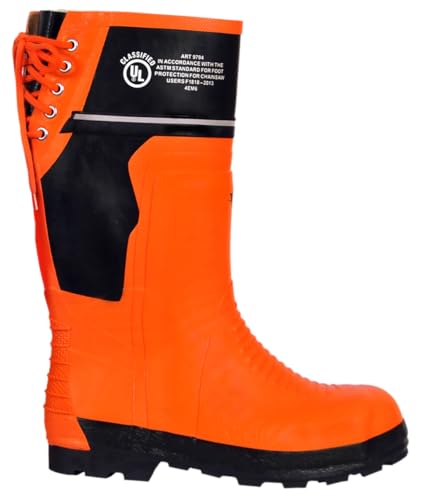
The Viking Class 2 Ultra Flexible takes a completely different approach to chainsaw boot construction — rubber instead of leather. The upper is built from heavy-duty SBR-blended natural rubber (a synthetic rubber compound known for chemical and abrasion resistance) with a cotton canvas interior lining. What you get is a boot that laughs at mud, water, chemicals, and rough terrain. ASTM F1818 Mid Class certification at 24 m/s puts it solidly in the professional-grade chainsaw protection category.
The deep NBR lug sole (nitrile butadiene rubber — the stuff used in chemical-resistant gloves) is designed specifically for water and ice conditions. It's compatible with ice studs if you work in northern climates during winter tree operations. The Grade 1 steel toe protects against impact and compression. For the price, the Viking punches well above its weight class in terms of certified protection and terrain versatility.
The trade-off is breathability. Rubber boots trap heat. If you're working long days in warm weather, your feet will get warm. But for wet, cold, chemically-exposed environments — think swampy terrain, post-storm cleanup, or ground treated with herbicides — the rubber construction of the Viking is actually an advantage over leather. It's also very easy to hose clean at the end of the day.
Pros:
- ASTM F1818 Mid Class chainsaw protection at 24 m/s
- Highly chemical-resistant SBR rubber upper
- Deep NBR lug sole compatible with ice studs
- Easy to clean — just hose down
- Strong value for certified chainsaw protection
Cons:
- Rubber upper limits breathability — warm in hot weather
- Less ankle articulation than leather designs
4. HAIX Protector Ultra Lime Green — Best for Electrical Hazard Environments
The HAIX Protector Ultra Lime Green is essentially the same boot as the Signal Red reviewed above, but in a high-visibility lime green colorway that's particularly popular in wildland firefighting and utility-adjacent forestry work. ASTM F2413 and CAN/CSA Z195 certified for toe protection, puncture resistance, and electrical hazards up to 18 kV — so your certification base is identical. Class 2 chainsaw cut protection with European bullhide leather and cut-resistant interior material gives you the same saw-stopping capability.
The steel safety toe provides impact protection with extra toe room, rubber-reinforced at the toe and heel for long-term durability. Fully waterproof construction and an anti-slip outsole make this boot viable across the full range of forestry terrain. If you work near power lines or in environments where electrical contact is a real possibility, this is one of very few boots that covers chainsaw AND electrical hazards simultaneously — that dual certification is not something you find on most arborist boots.
The lime green color isn't just aesthetic. High-visibility PPE (personal protective equipment) requirements exist on many job sites, and this boot satisfies footwear visibility requirements while still being a serious piece of safety gear. HAIX builds these in Germany to tight tolerances — the quality shows in the stitching, the materials, and the way the boot holds up over years of use.
Pros:
- ASTM F2413 + CAN/CSA Z195 certified — toe, puncture, electrical (18 kV)
- Class 2 chainsaw protection in tough European bullhide leather
- High-visibility lime green satisfies PPE requirements
- Suitable for wildland firefighting and utility work
- Premium German construction and materials
Cons:
- Same weight limitation as other HAIX Protector models
- High-visibility look isn't for everyone off the job site
5. ARBORTEC Kayo Chainsaw Boots — Best for Professional Climbers
The ARBORTEC Kayo is specifically engineered for climbers — people who are actually ascending trees, not just working at ground level. That distinction shapes everything about this boot's design. The proprietary lacing system combined with a secure inner sock creates a fit that hugs the foot precisely, which is critical when you're loading a climbing spur or working with spikes on a tree. A loose boot while climbing is a stability hazard, and Arbortec's inner sock solution addresses that directly for both wide and narrow feet.
The unique protective gaiter (a protective cover that wraps around the ankle and lower leg area) delivers full Class 2 chainsaw protection while the boot itself maintains the feel and mobility of a low-cut boot. That's an engineering feat. Most Class 2 chainsaw boots are chunky and rigid by necessity — the Kayo achieves the protection without sacrificing the mobility a climber needs to move in a tree. It also keeps debris — bark chips, sawdust, small branches — out of the boot far more effectively than a standard open-top design.
If you're a certified arborist who spends a significant portion of your day actually in the canopy, the Kayo is built for you. Ground workers who don't need climbing-specific fit will be fine with the Scafell Lite. But for active climbing, the Kayo's combination of Class 2 protection, precise fit, and mobility is hard to beat in 2026.
Pros:
- Designed specifically for active tree climbing
- Unique lacing + inner sock system for precise fit on wide or narrow feet
- Full Class 2 chainsaw protection via protective gaiter
- Low-cut boot feel with high-cut protection
- Effectively blocks debris entry
Cons:
- Premium price targeted at professionals
- Gaiter system takes getting used to for first-time wearers
6. Danner Logger 917 6" Waterproof Boots — Best Heritage Logger Boot
Danner has been making logger boots in Portland, Oregon since 1932, and the Logger 917 carries that heritage in every detail. This isn't a chainsaw-protection boot — it doesn't carry chainsaw cut ratings and you should not use it as a substitute for certified chainsaw footwear. What it is, is one of the best-built general-purpose logger and tree work boots available for tasks that don't involve active chainsaw operation. Stitchdown construction (a method where the upper is stitched down to a midsole platform) creates a bond between upper and sole that's repairable and extremely durable.
The Gore-Tex waterproof liner keeps your feet dry without the breathability sacrifices you get from lesser membranes — real breathable waterproofing, not just rubber. The Vibram SPE midsole absorbs shock on hard landings and uneven terrain. The 917 Traction outsole from Vibram handles slippery surfaces. Full-grain leather upper develops a patina over time and only gets better with proper maintenance. The included kilties (leather tongue covers) protect the lace system from dirt and debris — a traditional logger feature that's genuinely useful in the field.
If your tree work primarily involves scouting, light climbing, hauling brush, or operating on the ground without chainsaw exposure, the Danner Logger 917 delivers unmatched craftsmanship and comfort. For those exploring different types of work boots for outdoor trades, the Danner represents the heritage logger category at its best.
Pros:
- Heritage stitchdown construction — resoleable and extremely durable
- Gore-Tex waterproof liner with genuine breathability
- Vibram outsole for traction on varied terrain
- Full-grain leather improves with age and proper care
- Kilties protect laces from debris
Cons:
- No chainsaw cut protection — not suitable for active chainsaw work
- 6" height is lower than many dedicated forestry boots
7. Thorogood Logger Series 9" Work Boots — Best Insulated Logger Boot
The Thorogood Logger Series 9" is the cold-weather specialist of this lineup. 400g 3M Thinsulate insulation (a synthetic fiber that retains warmth even when wet) keeps your feet functional in sub-freezing temperatures where other boots fail. The 9-inch height gives serious ankle and lower leg protection, and the steel toe cap with steel shank provides structural support on uneven ground. This is a ground-operations logger boot — no chainsaw rating, but formidable for everything else cold, wet, and rough.
The Aztec waterproof lining keeps moisture out, and the Ultimate Shock Absorption footbed (a thick cushioned insole) handles long days on hard terrain. The Vibram slip-resistant heel outsole keeps you planted on wet logs, mud, and sloped ground. Premium leather construction means this boot will outlast cheaper alternatives with minimal care. At 9 inches tall, it covers more of your lower leg than most work boots — that extra coverage matters when you're pushing through brush and undergrowth.
Like the Danner, this boot does not carry chainsaw protection ratings and should not be used as a substitute for certified chainsaw footwear. But for cold-weather ground work, property clearing, land management, and tree work that doesn't involve running a saw, the Thorogood Logger 9" is an exceptional boot. The sole construction and outsole types are worth understanding — check out our guide to different types of boot soles if you want to dig into what makes the Vibram heel outsole perform differently than standard rubber.
Pros:
- 400g 3M Thinsulate insulation for genuine cold-weather performance
- 9-inch height provides extensive ankle and lower leg coverage
- Steel toe + steel shank for structural support
- Vibram slip-resistant heel outsole
- Aztec waterproof lining + shock-absorbing footbed
Cons:
- No chainsaw cut protection
- Insulation makes it too warm for summer use
- Heavier than low-insulation alternatives
Buying Guide: How to Choose the Best Boots for Tree Climbing
Buying boots for tree climbing and forestry work is not the same as buying general work boots. The hazards are specific, the certifications are technical, and the wrong choice can cost you more than money. Here's what you need to evaluate before purchasing in 2026. If you're exploring the broader trade boot market, our boots by trade guide covers footwear for dozens of specialized occupations.
Chainsaw Protection Rating: The Most Important Spec
If your work involves operating a chainsaw, you need chainsaw-rated boots. This is non-negotiable. Chainsaw safety clothing including boots is designed to slow a saw blade enough to give you time to react — the internal cut-resistant fibers jam the sprocket and stall the chain.
- Class 1 (20 m/s): Entry-level protection. Suitable for occasional users operating low-speed saws.
- Class 2 (24 m/s): The professional standard. Required for most commercial forestry and arborist work. All five chainsaw-rated boots in this review meet Class 2.
- ASTM F1818 / ASTM F2413: American testing standards for chainsaw protection and general safety toe/puncture resistance. Look for these on U.S.-sold boots.
- EN ISO 17249: The European standard for chainsaw protective footwear. Equivalent rigor to ASTM.
If you don't operate a chainsaw and your tree work is purely climbing, scouting, or light brush work, a quality logger boot like the Danner or Thorogood is sufficient. But the moment a saw enters your workflow, you need a certified chainsaw boot.
Waterproofing and Breathability
Tree climbing is a wet profession. Morning dew, rain, river crossings, swampy ground — your boots will get hit with moisture constantly. Waterproofing technology varies significantly:
- Gore-Tex liner: The gold standard for breathable waterproofing. Found in the Danner Logger 917. Lets moisture vapor out while blocking liquid water in.
- Proprietary membranes (like Arbortec's Breathe Dry): Can match Gore-Tex performance at a lower cost on boots purpose-built for forestry.
- Full rubber construction: 100% waterproof but traps heat. Best for cold, chemically-exposed, or extremely wet environments.
- Aztec lining (Thorogood): Waterproof for standard conditions — adequate for most use cases.
Don't overlook breathability if you're working in warm climates or during summer. A boot that's waterproof but not breathable will soak your feet in sweat by midday, creating blister and fungal risks.
Sole Traction and Construction
Tree climbers and forestry workers face terrain that would defeat a standard work boot sole in a day. You need deep, aggressive lug patterns, chemical resistance, and ideally compatibility with ice studs for winter work.
- Vibram outsoles: Industry benchmark for traction and durability. Found on the Danner and Thorogood.
- NBR rubber soles: Chemical and oil resistant — the Viking's NBR lug sole is designed for exactly this environment.
- Anti-slip outsoles: HAIX's anti-slip construction handles wet forestry terrain well.
- Ice stud compatibility: The Viking explicitly supports ice studs — essential for northern climates in winter operations.
Fit, Ankle Support, and Boot Height
Fit is more critical in tree climbing than in almost any other trade. A boot that slips on your heel when you're loading a climbing spur creates an unstable platform that can cause falls.
- Look for boots with inner socks or precision lacing systems if you're actively climbing (the ARBORTEC Kayo does this best).
- Higher boots (9"+) give more lower-leg coverage and ankle support — better for ground work in rough brush.
- Mid-height boots (6–8") offer more ankle articulation — better for actual climbing where you need to flex the ankle dynamically.
- Always try on chainsaw boots with the socks you'll actually wear. Chainsaw-rated boots tend to have less give than standard work boots.
- Pay attention to size guidance: the ARBORTEC Scafell Lite runs small. Order up.
Frequently Asked Questions
Do you need special boots for tree climbing?
Yes, if your work involves chainsaw operation you need boots with certified chainsaw protection — standard work boots provide no cut resistance. For climbing-only work without chainsaws, a high-quality logger boot with aggressive traction and ankle support is the minimum. Professional arborists in commercial settings typically require Class 2 chainsaw-rated boots by regulation or employer policy.
What is Class 2 chainsaw protection?
Class 2 chainsaw protection means the boot's internal cut-resistant material can stop a chainsaw chain traveling at 24 meters per second (roughly 53 mph). That's the speed at which many professional chainsaw blades operate. The protection works by jamming the chain with fiber material that stalls the sprocket — giving you a fraction of a second to pull your foot away. Class 1 protection covers 20 m/s and is appropriate for occasional, lower-speed chainsaw use only.
Are rubber or leather chainsaw boots better?
Both have legitimate uses. Leather boots like the ARBORTEC Scafell Lite and HAIX Protector Ultra are more breathable, more comfortable for all-day wear, and conform to your foot shape over time. Rubber boots like the Viking Class 2 Ultra are completely waterproof, chemical-resistant, and extremely easy to clean — ideal for swampy terrain, post-storm cleanup, or environments with chemical exposure. Your choice should depend on your primary working conditions.
Can you use regular logger boots for tree climbing?
For ground-based work and light climbing without chainsaw exposure, yes — boots like the Danner Logger 917 and Thorogood Logger Series are excellent. But they carry no chainsaw cut protection whatsoever. If you're running a chainsaw, regular logger boots will not protect your feet from blade contact. Never use non-rated boots as a substitute for certified chainsaw footwear on active cutting jobs.
How long do chainsaw boots last?
With proper maintenance, a quality pair of chainsaw boots lasts 3–5 years for full-time professional users. Leather boots benefit from regular cleaning and conditioning — dried-out leather cracks and fails earlier. After any chainsaw contact event, even minor, retire the boot immediately. The internal cut-resistant material compresses and loses effectiveness after a strike, even if the exterior damage looks minor.
What should I look for in boots for electrical hazard tree work?
If your tree work brings you near power lines or electrical infrastructure, you need boots with explicit electrical hazard (EH) certification. The HAIX Protector Ultra Signal Red and Lime Green both carry ASTM F2413 and CAN/CSA Z195 electrical hazard ratings up to 18,000 volts. Standard chainsaw boots do not provide this protection. Never assume a boot is EH-rated without seeing the certification printed on the boot or in the product specs — it must be explicitly stated.
Buy on Walmart
- ARBORTEC Scafell Lite Chainsaw Boots (8, Green) — Walmart Link
- HAIX Protector Ultra Signal Red Chainsaw Protection Boots - — Walmart Link
- Viking Class 2 Ultra Flexible Chainsaw Boots - Protective Gr — Walmart Link
- HAIX Protector Ultra Lime Green Forestry Boots - Waterproof — Walmart Link
- ARBORTEC Kayo Chainsaw Boots - Charcoal - Size 11 — Walmart Link
- Danner Logger 917 6" Waterproof Hiking Boots for Men - Full- — Walmart Link
- Thorogood Logger Series 9” Waterproof Insulated Steel Toe Wo — Walmart Link
Buy on eBay
- ARBORTEC Scafell Lite Chainsaw Boots (8, Green) — eBay Link
- HAIX Protector Ultra Signal Red Chainsaw Protection Boots - — eBay Link
- Viking Class 2 Ultra Flexible Chainsaw Boots - Protective Gr — eBay Link
- HAIX Protector Ultra Lime Green Forestry Boots - Waterproof — eBay Link
- ARBORTEC Kayo Chainsaw Boots - Charcoal - Size 11 — eBay Link
- Danner Logger 917 6" Waterproof Hiking Boots for Men - Full- — eBay Link
- Thorogood Logger Series 9” Waterproof Insulated Steel Toe Wo — eBay Link
The best boot for tree climbing is the one rated for the exact hazards you face — buy to your certifications, not your budget.


About James Miller
James Miller is a dedicated individual based in the vibrant city of San Francisco, CA, USA. His unwavering passion lies in the realm of construction, where he finds fulfillment in exploring and documenting various facets of construction equipment and processes. A graduate of the University of California Merced, James holds a dual degree in mechanical and electrical engineering, which has equipped him with a solid foundation in technical knowledge.With a keen eye for detail and a knack for articulation, James has channeled his enthusiasm into writing about the intricacies of construction gear and methodologies. His insightful writings offer valuable insights to both industry professionals and curious enthusiasts, shedding light on the machinery and techniques that shape the built environment.James Miller's educational background in mechanical and electrical engineering lends credibility to his work, allowing him to delve into the technical nuances of construction with precision. His passion for sharing knowledge and fostering understanding in the construction field is evident in his contributions, making him a respected voice in the industry.
Get FREE Boots Gifts now. Or latest free toolsets from our best collections.
Disable Ad block to get all the secrets. Once done, hit any button below