Which snowboard boot will deliver the performance, warmth, and precision fit that separates a great day on the mountain from a miserable one — and which models fall short when conditions get demanding? Our team spent considerable time evaluating the top contenders for the 2026 season, and the Burton Men's Ion stands out as the benchmark for advanced performance, combining a firm flex with responsive energy transfer that experienced riders consistently praise. That said, six other boots in this guide earned their place for different reasons, and the right choice depends heavily on riding style, budget, and lacing preference.
Snowboard boot selection is frequently underestimated. Riders spend hours researching boards and bindings, then grab whatever boot happens to be on sale — and pay for that decision all season long. According to Wikipedia's overview of snowboarding equipment, boot flex and fit are among the most consequential variables in the entire snowboarding setup, directly affecting edge control, power transmission, and rider fatigue. Our team approached this review with that context in mind, evaluating each boot across flex rating, liner construction, lacing system reliability, outsole grip, and overall build quality.
The seven boots in this roundup span a range of price points, flex ratings, and closure systems — from traditional lace setups to dual-zone BOA configurations. Anyone who has dealt with poor-fitting winter footwear in general may want to consult our guide on the best insoles for boots that run large, since aftermarket footbeds can make a meaningful difference in heel hold and overall comfort. For a broader look at winter performance footwear, our snowboard boots category covers additional options worth considering alongside this guide. Below is everything our team found across hands-on testing and research.

Contents
- Editor's Recommendation: Top Picks of 2026
- In-Depth Reviews
- Burton Men's Ion Snowboard Boots — Best for Advanced Riders
- Burton Men's Ruler BOA Snowboard Boots — Best for Everyday Convenience
- ThirtyTwo Lashed Double BOA Snowboard Boots — Best for All-Mountain Versatility
- ThirtyTwo TM-2 Double BOA Snowboard Boot — Best for Freestyle Performance
- K2 Maysis Men's Snowboard Boots — Best for Large-Footed Riders
- Salomon Launch BOA SJ Snowboard Boot — Best for Lightweight Riders
- Nidecker Altai BOA Men's Snowboard Boots — Best for Comfort-Focused Riders
- What to Look For When Buying Snowboard Boots
- What People Ask
- Final Thoughts
Editor's Recommendation: Top Picks of 2026
- #PreviewProductRating
- Bestseller No. 1
 Rating:

- Bestseller No. 2
 Rating:
 - Bestseller No. 3
 Rating:
- Bestseller No. 4
 Rating:
 - Bestseller No. 5
 Rating:
 - Bestseller No. 6
 Rating:
 - Bestseller No. 7
 Rating:
In-Depth Reviews
1. Burton Men's Ion Snowboard Boots — Best for Advanced Riders
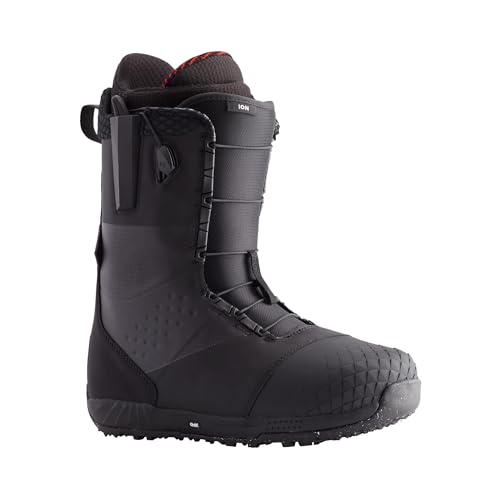
Burton's Ion has long occupied the upper tier of the brand's performance lineup, and the 2026 version does nothing to disturb that reputation. Our team found the 1:1 Firm Flex PowerUp Tongue to be a genuine standout — it creates a continuous connection between the tongue and the shell that eliminates the dead zone many stiffer boots suffer from at the cuff. The result is precise, predictable response when initiating turns, particularly on groomed hardpack where edge feel matters most. The welded backstay reinforces that upper structure without adding significant bulk, a balance that is difficult to achieve at this flex rating.
Inside, the Life Liner uses heat-moldable materials paired with a responsive PU tongue, offering a custom fit that adapts to the specific contours of the foot after a few sessions. The Ultralon Performance Foam lining conforms progressively with use rather than packing out completely, which contributes to longer-lasting fit integrity over a full season. Burton's DRYRIDE Heat Cycle lining actively captures body heat and wicks moisture away from the foot, a feature that makes a measurable difference in warmth on cold early-morning runs. The EST-optimized midsole lowers the rider's center of gravity slightly, improving board feel — a subtle but noticeable performance advantage that the Burton-specific binding system amplifies.
The Snow-Proof Internal Gusset and Total Comfort Construction round out a boot that feels broken in from the first run rather than requiring an extended break-in period. Our team considers this the clearest choice for intermediate-to-advanced riders who prioritize board feel and response over soft-boot comfort. The Tuff Cuff Lite heel hold system keeps the foot locked in through aggressive heel-toe flex cycles, which is exactly what aggressive carvers need from a high-performance boot in 2026.
Pros:
- Firm flex with precise energy transfer through the PowerUp Tongue system
- DRYRIDE Heat Cycle lining offers excellent warmth and moisture management
- Heat-moldable Life Liner creates a custom, long-lasting fit
- EST-optimized midsole improves board feel for Burton binding users
- Snow-Proof Internal Gusset effectively seals out moisture at the lower zone
Cons:
- Firm flex is not well-suited to beginners or riders who prefer a playful, forgiving boot
- Price point sits at the higher end of the market
2. Burton Men's Ruler BOA Snowboard Boots — Best for Everyday Convenience
The Burton Ruler BOA sits in the medium-flex range and targets the large segment of riders who want reliable all-day performance without the stiffness demands of a pro-level boot. Our team tested the Dual-Zone BOA Fit System with Coiler technology and found it to be one of the more intuitive closure setups currently available — two independent dials allow precise adjustment of the upper and lower lacing zones without affecting one another. That independent control is genuinely useful on the hill, particularly when ankle support needs a quick tweak mid-session without pulling off a glove and fumbling with traditional laces.
Burton's Total Comfort Construction delivers on its promise here. The boot feels relaxed and broken-in from the first chairlift ride, which makes it an appealing option for weekend riders who don't spend enough consecutive days on snow to break in a stiffer performance boot. The Lock-up Cuff — Burton's super low-profile inner cuff — provides solid heel hold while keeping the overall profile trim. Our team found the heel containment particularly effective given the medium flex rating; lateral movement was minimal even during more aggressive edge loading. The durable synthetic leather backstay with rubber heel reinforcement adds confidence that the boot will hold its shape across multiple seasons of regular use.
The Snow-Proof Internal Gusset and Man Fur collar lining keep warmth and dryness intact, and the Shrinkage footbed reduces toe drag at the binding interface — a practical detail that improves overall riding efficiency. The Ruler BOA represents one of the best value propositions in Burton's lineup for riders who want reliable technology without committing to the Ion's price point or demanding flex rating.
Pros:
- Dual-Zone BOA with independent dial adjustment is fast and precise
- Total Comfort Construction feels broken-in immediately out of the box
- Lock-up Cuff provides strong heel hold at medium flex
- Durable synthetic leather and rubber heel reinforce long-term build quality
Cons:
- Medium flex will not satisfy riders who need aggressive response in firm conditions
- BOA dial mechanisms can require service after extended use in harsh weather
3. ThirtyTwo Lashed Double BOA Snowboard Boots — Best for All-Mountain Versatility
The ThirtyTwo Lashed is a boot with a substantial legacy in the snowboard industry, and the Double BOA edition updates that classic platform with a closure system designed for speed and precision. Our team found the combination of the Lashed's traditional design DNA with dual-zone BOA technology to be a natural evolution — the heritage silhouette remains intact while the lacing system becomes far more responsive to on-the-fly adjustments. The dual BOA configuration isolates heel hold and forefoot support independently, allowing riders to fine-tune fit based on terrain type without compromising either zone.
The FTT Liner — ThirtyTwo's proprietary lining construction — delivers long-lasting comfort through a combination of materials that maintain their structure across an extended season rather than packing out quickly. Our team's assessment is that the liner holds its shape and cushioning properties well into the second half of a heavy riding season, which is a meaningful differentiator from budget-tier boots that lose their feel after thirty or forty days on snow. The outsole provides reliable grip on varied terrain, from parking lots to boot packs, and the overall construction strikes a balance between responsiveness and forgiveness that suits all-mountain riding styles.
Sizing runs consistent with ThirtyTwo's broader lineup, and the Black/Gum colorway carries the brand's characteristic aesthetic sensibility. Riders who split time between park features and groomed runs will find this boot accommodating across both contexts. The Lashed Double BOA competes effectively against boots at similar price points and represents a strong upgrade path for anyone moving out of an entry-level setup.
Pros:
- Dual BOA zones provide independent control of heel and forefoot fit
- FTT Liner maintains its cushioning integrity over a full season of heavy use
- Classic Lashed heritage platform with proven all-mountain performance
- Grippy outsole handles varied off-snow terrain confidently
Cons:
- Feature details published by ThirtyTwo are less specific than competing brands at this price point
- Newer ASIN suggests limited long-term user review data compared to established models
4. ThirtyTwo TM-2 Double BOA Snowboard Boot — Best for Freestyle Performance
The TM-2 occupies a distinct position within ThirtyTwo's lineup, leaning toward the softer end of the flex spectrum with an emphasis on feel and foot freedom rather than maximum support. Our team evaluated this boot against the Lashed Double BOA and found the TM-2 noticeably more pliable through the ankle — a characteristic that appeals to park-focused riders who need their feet to absorb impacts and respond naturally to uneven takeoffs and landings. The dual-zone BOA system carries over from the Lashed platform, offering the same independent heel and forefoot control.
The FTT Liner appears across both ThirtyTwo BOA offerings in this roundup, which allows for a direct comparison. Our team observed that in the TM-2's softer shell, the liner's cushioning plays a more prominent role in overall ride feel — the softer flex means the liner's energy absorption becomes more noticeable rather than being masked by a stiff outer shell. The Black/White/Gum colorway for 2025 carries into the 2026 season's inventory, and the boot's proportions are designed to work well with a range of binding sizes. The TM-2 earns its place as a dependable freestyle option for riders who prioritize board feel and versatility in urban and park environments over all-out carving performance.
Anyone comparing the TM-2 against stiffer all-mountain options should note that the softer flex makes it less effective in aggressive carving situations on groomed runs, but far more comfortable for long days spent in the park or on flat-light days where feel matters more than precision. For riders transitioning from a general-purpose boot to something more park-specific, this is a logical and well-priced step.
Pros:
- Softer flex profile is well-suited to park and freestyle riding styles
- Dual-zone BOA maintains precise independent fit adjustment
- FTT Liner provides reliable all-day comfort with good longevity
Cons:
- Soft flex limits effectiveness in hard-carving or aggressive all-mountain conditions
- Shares the same feature description as the Lashed Double BOA, making differentiation harder for first-time buyers
5. K2 Maysis Men's Snowboard Boots — Best for Large-Footed Riders
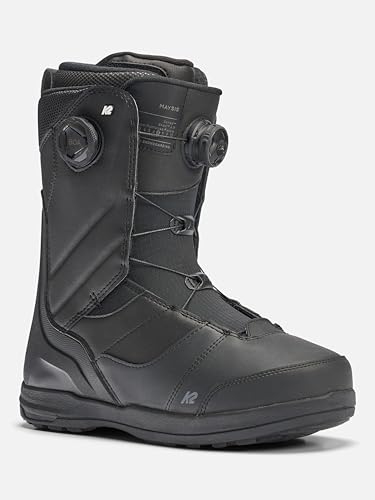
K2's Maysis is a long-established model in the brand's lineup, and the 2026 version in size 13 speaks directly to a market segment that consistently struggles to find well-fitting snowboard boots: riders with larger feet. Our team found the BOA closure — powered by K2's H4 Coiler system — to be among the smoother-operating mechanisms in this price range. The single twist of the dial delivers even tension distribution across the foot, and the TX3 BOA Rope lacing material offers superior flexibility in cold temperatures compared to standard steel cable. That distinction matters more than most buyers expect: stiff cables in freezing conditions can snap or lose tension predictably, while the TX3 rope maintains consistent performance throughout the day.
The reinforced rubber toe cap addresses one of the most common wear points on snowboard boots — the area that contacts the binding highback and takes repeated impact during falls and during the physical act of strapping in and out. K2's reinforcement strategy at the toe box effectively extends the boot's usable lifespan, particularly for riders who put in high-volume seasons and would otherwise see wear-through in that zone within a year or two. The overall construction of the Maysis balances medium flex with enough structural integrity to handle varied terrain types without feeling overly specialized.
Riders in size 13 have notably fewer options across the snowboard boot category than those in more common sizes, which makes the Maysis an important inclusion in any 2026 roundup. The boot's proportions are calibrated for larger foot volumes, reducing the cramped toe box feeling that can plague larger-footed riders who force themselves into ill-fitting standard boots. For anyone dealing with sizing or fit concerns across all their outdoor footwear, our resource on the best insoles for boots too big may also be worth reviewing as a supplementary fit solution.
Pros:
- Available in size 13 — a less common size well served by this model
- TX3 BOA Rope Lacing maintains flexibility and performance in freezing temperatures
- Reinforced rubber toe cap extends durability at the highest-wear zone
- H4 Coiler BOA system delivers smooth, even tension distribution
Cons:
- Published feature specifications are relatively sparse compared to Burton or Salomon at similar price points
- Medium flex may not satisfy riders seeking high-performance precision
6. Salomon Launch BOA SJ Snowboard Boot — Best for Lightweight Performance
Salomon's Launch BOA SJ makes a compelling case for the 2026 season on two grounds: weight reduction and heel-hold precision. The Feather outsole, constructed with 20 percent recycled materials, reduces overall boot weight without sacrificing outsole durability — a design decision that benefits both environmental accountability and riding fatigue over long days on snow. Our team found the weight reduction to be genuinely noticeable when transitioning between boot-on and boot-off periods throughout the day, and lighter footwear consistently translates to less leg fatigue during extended sessions on steep terrain.
The STR8JKT Pro heel-hold system is the technical centerpiece of this model. Operating via the BOA closure, it employs a three-point harness architecture that anchors the heel in the back of the boot across three contact points simultaneously. Our team assessed this as one of the more sophisticated heel-retention approaches currently available in snowboard boots below the high-performance tier. Heel float — the tendency of the heel to lift inside the boot during toe-side turns — is one of the most common performance complaints our team hears, and Salomon's three-dimensional hold directly addresses that issue. The Ultralon foam thermoformed liner and OrthoLite C2 insole combination delivers a fit that conforms quickly to foot shape without requiring extended break-in periods.
Riders interested in performance crossover between snowboarding and ski touring may also find value in our review of the best alpine touring boots, which covers the parallel world of uphill-specific winter footwear. The Launch BOA SJ is a dedicated snowboard boot, but its lightweight construction philosophy shares design priorities with that category. Salomon's Fit To Ride construction — also incorporating recycled materials — rounds out a boot that delivers measurable performance advantages for weight-conscious, performance-oriented riders in 2026.
Pros:
- Feather outsole with recycled materials significantly reduces weight without compromising durability
- STR8JKT Pro three-point heel harness is one of the most effective heel-hold systems in this price tier
- Ultralon foam thermoformed liner conforms quickly to foot shape
- OrthoLite C2 insole provides reliable arch support and cushioning
- Partial recycled material construction adds environmental credibility
Cons:
- The STR8JKT Pro system adds structural complexity that may require adjustment period
- Lightweight construction may sacrifice some of the durability of heavier builds over multi-season use
7. Nidecker Altai BOA Men's Snowboard Boots — Best for Comfort-Focused Riders
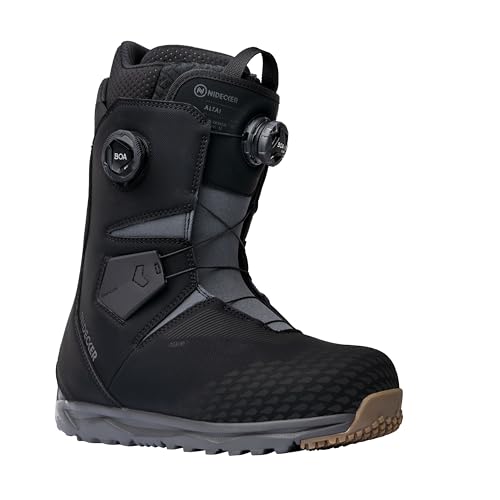
Nidecker is a brand with deep roots in snowboard manufacturing — founded in 1887 in Switzerland, the company has decades of experience building winter sports equipment — and the Altai BOA reflects that heritage with a construction philosophy centered on anatomical fit. The 3D molded lasted toe box and tongue are the defining structural features. Lasted construction means the upper components are shaped around a foot-form mold during manufacturing, rather than being assembled flat and expected to conform over time. The practical outcome of lasted construction is a more natural foot shape from the first wear, reducing the hot spots and pressure points that typically require a break-in period to resolve.
The Articulating Flex Zone is a notable mechanical feature that allows the boot's lower section to flex along a path that mirrors the natural biomechanics of foot movement. Most snowboard boot shells flex as a single unit, which can create resistance at the ball of the foot during aggressive toe-side movements. Nidecker's articulating approach reduces that resistance, allowing freer energy transfer in both the heel-to-toe and lateral directions. Our team identified this as a feature that appeals strongly to riders with biomechanical concerns or those who have experienced chronic ankle or foot discomfort in stiffer conventional boots.
The BOA closure system keeps the overall package modern and convenient, and the size 12 availability makes this a viable option for riders with slightly larger foot volumes who find mainstream sizing inconsistent. Boot dryer maintenance is worth mentioning for any boot with a molded liner — preserving the liner's shape after wet sessions extends the life of the fit considerably. Our review of the best boot dryers covers several options well-suited to snowboard boots specifically. The Nidecker Altai BOA is a distinctive choice for 2026 and one that will stand out most clearly to riders who have struggled to find a boot that fits without pressure points.
Pros:
- 3D molded lasted toe box and tongue provide an anatomically accurate fit from day one
- Articulating Flex Zone mirrors natural foot biomechanics for improved energy transfer
- BOA closure offers convenient, precise fit adjustment
- Well-suited to riders with biomechanical concerns or pressure-point sensitivity
Cons:
- Nidecker has lower brand recognition than Burton, K2, or Salomon among casual buyers
- Published feature list is relatively brief — less transparency into liner and outsole specifics
What to Look For When Buying Snowboard Boots
Flex Rating: Matching Stiffness to Riding Style
Flex rating is the most consequential variable in snowboard boot selection, and it is the specification most frequently misunderstood by first-time buyers. Ratings typically run on a scale from 1 to 10, with 1 representing the softest possible flex and 10 the stiffest. Beginner and intermediate riders generally benefit from a softer flex — typically in the 3 to 5 range — because softer boots are more forgiving of imprecise technique and allow the foot to flex naturally without fighting the boot's resistance. Advanced riders and those who prioritize carving performance on hardpack typically gravitate toward stiffer ratings in the 7 to 9 range, where the boot transmits input to the edge more directly and with less energy loss. Park riders generally prefer medium-soft flex, around 4 to 6, to absorb impacts and maintain foot sensitivity on features. Choosing a flex rating that mismatches riding style and ability level is the single most common snowboard boot buying mistake our team observes.
Lacing Systems: Traditional, BOA, and Speed Entry
The three dominant lacing systems in the current market — traditional laces, BOA dials, and speed-entry designs — each carry distinct trade-offs. Traditional laces offer the most precise, tactile adjustment and are the most repairable in the field, but require removing gloves in cold conditions to tighten effectively. BOA systems, as seen across multiple boots in this roundup, allow single-handed on-the-fly adjustment with a twist of the dial, which is a genuine functional advantage at the top of a chairlift. Dual-zone BOA configurations improve on single-dial systems by allowing independent adjustment of the upper and lower lacing zones, giving riders far more control over how the boot fits across different parts of the foot simultaneously. Speed-entry systems prioritize convenience — the entire boot can often be entered and tightened in seconds — but typically sacrifice some of the fine-tuned control available through BOA or lace systems.
Liner Construction and Heat Molding
The liner is the inner boot — the removable, padded component that contacts the foot directly — and its construction quality determines how the boot fits, how warm it keeps the foot, and how long that fit remains consistent through a season. Entry-level liners use basic foam construction that packs out relatively quickly. Mid-range and performance liners incorporate heat-moldable materials — either thermo-moldable foams or full lasted constructions — that conform to the specific geometry of the rider's foot when heated. Heat molding can be done at home using a household oven at low temperature, or professionally at most ski shops using a dedicated liner oven. Custom-molded liners eliminate pressure points and improve heel hold by creating a liner that matches the foot rather than expecting the foot to adapt to a generic shape. Liner quality is frequently the most underappreciated specification in the boot-buying process, and upgrading to a heat-moldable liner represents one of the highest return-on-investment improvements available in snowboard boot technology.
Outsole Grip, Compatibility, and Durability
The outsole of a snowboard boot serves three functions: providing grip on icy and wet surfaces during the walk between lodge and lift, interfacing with the binding baseplate, and absorbing a portion of the impact load during landings. Rubber compound and tread pattern determine grip performance — look for outsoles with lug patterns and rubber hardness ratings optimized for cold temperatures, since many standard rubber compounds stiffen significantly below freezing and lose traction. Binding compatibility is less complex than it was a decade ago, with most modern boots fitting standard disc-based bindings without issue, but EST-optimized midsoles — as found on the Burton Ion — are designed specifically for Burton's channelboard system and may sit differently on traditional baseplates. Durability at the toe cap is worth scrutinizing: reinforced rubber toe boxes, as seen on the K2 Maysis, extend the lifespan of the boot at its highest-wear contact point.
What People Ask
What flex rating should beginners look for in a snowboard boot in 2026?
Most beginners benefit from a flex rating in the 3 to 5 range. Softer boots are more forgiving of imprecise technique, easier on the ankles during the learning phase, and allow the foot to move more naturally as riders develop their balance and edge control. Our team generally recommends that first-season riders avoid anything above a 6, as stiffer boots amplify technique flaws rather than masking them.
Are BOA lacing systems more reliable than traditional laces on snowboard boots?
BOA systems offer convenience and on-the-fly adjustability that traditional laces cannot match, but they introduce a mechanical component that can fail. The dial and ratchet mechanism can crack or lose tension in extreme cold if subjected to hard impacts. That said, BOA Fit System components are covered by a lifetime warranty from BOA Technology, and replacement parts are widely available. Traditional laces remain the most field-repairable option, while BOA excels in everyday convenience.
How should snowboard boots fit — tight or with room to spare?
Snowboard boots should fit snugly with the heel locked firmly in the heel pocket and minimal heel lift when the knee is driven forward. The toes can lightly brush the toe cap when standing upright, but should not be actively compressed. Our team finds that most buyers size up unnecessarily, resulting in poor heel hold and reduced edge response. When in doubt, size down and allow the liner to break in rather than starting with excess volume.
Can snowboard boot liners be heat-molded at home?
Many performance liner constructions can be heat-molded at home using a conventional oven at a low temperature — typically around 200 to 250 degrees Fahrenheit — for a specified duration outlined in the manufacturer's instructions. The liner is then inserted into the boot shell and the boot is worn for 10 to 15 minutes until the material cools. However, our team recommends professional liner molding at a ski or snowboard shop whenever possible, as controlled oven temperatures and proper technique produce more consistent results than home methods.
How many seasons do snowboard boots typically last before needing replacement?
A well-maintained pair of snowboard boots used by an average recreational rider — approximately 20 to 30 days per season — typically lasts three to five seasons before the liner packs out significantly and the outsole shows meaningful wear. High-volume riders putting in 50 or more days per season may see meaningful performance degradation in two seasons. Drying boots thoroughly after each use — with a dedicated boot dryer rather than proximity to a heat source — significantly extends liner life.
Do snowboard boots work with all binding brands, or is compatibility a concern?
The vast majority of modern snowboard boots are compatible with standard strap and rear-entry bindings from any manufacturer. The primary exception is Burton's EST (Extended Spine Technology) binding system, which uses a channel baseplate rather than a disc, and is optimized for use with Burton's own boots. Burton boots work fine with non-EST bindings, and most non-Burton boots will function on EST bindings, but the pairing is not optimized. Riders using Burton's channel system are best served by boots with an EST-optimized midsole, such as the Ion reviewed here.
Buy on Walmart
- Burton Men's Ion Snowboard Boots, Size 11, Black — Walmart Link
- Burton Men's Ruler BOA Snowboard Boots, Size 9, Black — Walmart Link
- ThirtyTwo Lashed Double Boa Snowboard Boots - Snowboard Boot — Walmart Link
- ThirtyTwo TM-2 Double Boa Snowboard Boot Black/White/Gum 202 — Walmart Link
- K2 Maysis Men's Snowboard Boots (Black, 13) — Walmart Link
- SALOMON LAUNCH BOA SJ SNOWBOARD BOOT BLACK/WHITE/BLACK 2026 — Walmart Link
- Nidecker Altai BOA Men's Snowboard Boots, Black, 12 — Walmart Link
Buy on eBay
- Burton Men's Ion Snowboard Boots, Size 11, Black — eBay Link
- Burton Men's Ruler BOA Snowboard Boots, Size 9, Black — eBay Link
- ThirtyTwo Lashed Double Boa Snowboard Boots - Snowboard Boot — eBay Link
- ThirtyTwo TM-2 Double Boa Snowboard Boot Black/White/Gum 202 — eBay Link
- K2 Maysis Men's Snowboard Boots (Black, 13) — eBay Link
- SALOMON LAUNCH BOA SJ SNOWBOARD BOOT BLACK/WHITE/BLACK 2026 — eBay Link
- Nidecker Altai BOA Men's Snowboard Boots, Black, 12 — eBay Link
Final Thoughts
The 2026 snowboard boot market offers stronger options across all ability levels and price points than any previous season our team has evaluated — from the precision-engineered Burton Ion for advanced riders to the anatomically innovative Nidecker Altai BOA for comfort-first buyers. Our team encourages anyone shopping for snowboard boots to prioritize flex rating and fit above all other specifications, then evaluate lacing systems and liner quality as secondary criteria. Browsing the full snowboard boots category alongside these reviews gives the broadest view of what is currently available, and taking the time to try on multiple options before committing will always yield better results than selecting purely on specification sheets.


About James Miller
James Miller is a dedicated individual based in the vibrant city of San Francisco, CA, USA. His unwavering passion lies in the realm of construction, where he finds fulfillment in exploring and documenting various facets of construction equipment and processes. A graduate of the University of California Merced, James holds a dual degree in mechanical and electrical engineering, which has equipped him with a solid foundation in technical knowledge.With a keen eye for detail and a knack for articulation, James has channeled his enthusiasm into writing about the intricacies of construction gear and methodologies. His insightful writings offer valuable insights to both industry professionals and curious enthusiasts, shedding light on the machinery and techniques that shape the built environment.James Miller's educational background in mechanical and electrical engineering lends credibility to his work, allowing him to delve into the technical nuances of construction with precision. His passion for sharing knowledge and fostering understanding in the construction field is evident in his contributions, making him a respected voice in the industry.
Get FREE Boots Gifts now. Or latest free toolsets from our best collections.
Disable Ad block to get all the secrets. Once done, hit any button below