Best Work Boots for Winter and Cold Weather: Review and Buying Guide 2026
by James Miller
Which work boot will actually keep your feet warm and dry through a brutal winter shift — and which ones fall apart by February? That's the question every tradesperson, construction worker, and outdoor laborer faces when cold weather rolls in. After evaluating the top contenders for 2026, the Timberland PRO Boondock stands out as the overall best work boot for winter — but the right pick depends heavily on your specific job site and how cold it actually gets where you work.
Winter work boots are not simply insulated versions of standard footwear. The best models combine genuine waterproof membranes, rated insulation, safety-toe compliance, and outsoles engineered to grip ice and frozen ground. A boot that fails on any one of those dimensions will cost you comfort, safety, or both. The waterproof boots category has expanded significantly in recent years, with brands competing hard on insulation ratings, comfort technology, and safety certifications that meet or exceed current ASTM standards.
This guide reviews seven of the strongest options available in 2026, breaks down the technical specs that matter, and gives you a clear buying framework so you can match the right boot to your work environment. Whether you're pouring concrete in sub-zero temperatures or navigating a wet oil-field platform, one of these boots belongs on your feet.

Contents
- Top Rated Picks of 2026
- Detailed Product Reviews
- Carhartt Men's Ground Force 8" Comp Toe
- Timberland PRO Boondock 8" Composite Safety Toe
- Danner Quarry USA 8" 400G NMT
- Wolverine Men's Floorhand Insulated Waterproof Boot
- MUCK Arctic Sport Steel Toe Waterproof Boot
- Ariat Men's WorkHog XT 8" BOA Carbon Toe
- Carhartt Ironwood Waterproof Insulated Safety Toe
- How to Pick the Best Work Boot for Winter
- Common Questions
- Final Thoughts
Top Rated Picks of 2026
- #PreviewProductRating
- Bestseller No. 1
 Rating:

- Bestseller No. 2
 Rating:
 - Bestseller No. 3
 Rating:
 - Bestseller No. 4
 Rating:
 - Bestseller No. 5
 Rating:
 - Bestseller No. 6
 Rating:
 - Bestseller No. 7
 Rating:
Detailed Product Reviews
1. Carhartt Men's Ground Force 8-Inch Comp Toe Waterproof Work Boot — Best Lightweight Composite Toe for Cold Weather
The Carhartt Ground Force opens with a composite safety toe that checks three critical boxes simultaneously: it's lightweight, non-metallic, and non-conductive to both heat and cold. That third property matters more than most buyers realize. A traditional steel toe becomes a heat sink in freezing temperatures, pulling warmth away from your toes even when the rest of the boot is well-insulated. The composite toe on the Ground Force eliminates that problem entirely while still meeting and exceeding ASTM 2413-24 impact and compression standards.
Carhartt's Storm Defender waterproof system provides breathable, full-boot protection against water infiltration. Unlike basic membrane-only designs, Storm Defender integrates waterproofing into the upper construction rather than relying solely on a liner, which means the protection holds up under prolonged exposure rather than degrading when the upper flexes repeatedly. The Insite footbed rounds out the package with high-rebound cushioning and podiatrist-designed arch support — a feature that separates this boot from lower-tier options that use flat foam insoles with no ergonomic shaping.
For workers on electrical job sites or in environments where metal detection is a concern, this boot delivers safety-toe protection without the downsides of steel. The 8-inch shaft height provides solid ankle support for uneven or frozen terrain. Fit tends to run true to size, though workers with wide feet may want to size up a half size to accommodate thick winter socks. Pair these with quality aftermarket insoles for work boots if you plan to put in 10-plus hour shifts in deep winter.
Pros:
- Composite toe is non-conductive to cold — no heat-sink effect in freezing temps
- Storm Defender waterproofing is breathable and structurally integrated into the upper
- Insite footbed offers genuine arch support backed by podiatrist input
- Meets ASTM 2413-24 — current 2024 safety standard
Cons:
- No published insulation rating — not ideal for extreme sub-zero conditions
- Sizing can be tight in the toe box for wide feet
2. Timberland PRO Men's Boondock 8" Composite Safety Toe — Best Overall Winter Work Boot for 2026
The Timberland PRO Boondock earns the top overall ranking in 2026 by combining three systems that each perform at a high level independently and work even better together. The Anti-Fatigue Technology midsole uses geometrically shaped, shock-absorbing components that return energy to the foot on each stride — a design Timberland PRO has refined over multiple product generations and which consistently separates their lineup from competitors relying on basic EVA foam. On a 10-hour shift across frozen ground or concrete, that energy return is measurable in how your legs and lower back feel at the end of the day.
The composite safety toe meets both ASTM F2412-18a and ASTM F2413-18 I/C standards for impact and compression, and it delivers the same non-conductive advantage as any composite over steel in cold weather. The waterproof membrane meets ASTM F1671-07, a standard most often associated with bloodborne pathogen resistance — which also confirms the membrane's integrity against sustained liquid exposure, not just brief splashes. Puncture resistance adds a layer of protection that's particularly relevant on winter construction sites where debris gets buried under snow and ice.
The 2024-updated model addresses fit complaints from previous versions, with a slightly roomier toe box that accommodates thick thermal socks without compressing the toes and restricting circulation. Restricted circulation in cold weather is not a minor inconvenience — it's a direct path to cold feet regardless of insulation rating. This boot understands that geometry and thermal performance are connected. If you're researching the broader category before deciding, the best waterproof boots for men guide covers additional options across different price points.
Pros:
- Anti-Fatigue Technology delivers genuine all-day energy return, not just marketing language
- Triple ASTM certification: F2412-18a, F2413-18 I/C, and F1671-07
- Puncture-resistant construction adds job-site safety beyond standard toe protection
- 2024 updated fit accommodates thick winter socks without toe compression
Cons:
- Premium pricing compared to basic insulated work boots
- Heavier than minimalist composite-toe options
3. Danner Quarry USA 8" 400G NMT — Best Premium American-Made Winter Work Boot
Danner builds the Quarry USA in Portland, Oregon, and it shows in the construction quality. The nubuck leather upper ages well under punishment — scuffs that would degrade synthetic materials develop into character on nubuck while the structural integrity of the leather remains intact. 400 grams of insulation positions this boot for serious cold-weather work, providing meaningful warmth at temperatures well below freezing without the bulk that higher-rated insulation adds. The Quarry midsole is a Danner proprietary design that balances underfoot cushioning with the stability you need on uneven frozen terrain.
The non-metallic toe (NMT) designation confirms this boot meets safety-toe standards without steel, giving you the composite-toe advantage of no cold conduction through the toe cap. Danner's waterproofing system seals the upper against water infiltration across the full 8-inch shaft, which is critical when you're walking through slush or snow that can breach lower-cut boots at the ankle. The Quarry USA is resoleable, which is a meaningful long-term value consideration — a well-maintained pair can outlast two or three pairs of boots that can't be rebuilt at the cobbler.
The distressed brown finish and traditional boot silhouette make this the most visually classic option in this lineup. Workers who spend time in both field and office environments will find this boot navigates professional settings more comfortably than aggressively styled tactical designs. The fit is typically true to size with a slight lean toward a snug build, so if you plan to wear 400-gram wool socks, test fit with those socks in hand.
Pros:
- Made in the USA — Portland, Oregon construction with documented quality control
- 400G insulation provides substantial warmth for extended cold-weather shifts
- Resoleable construction extends service life significantly beyond non-resoleable options
- Nubuck leather upper develops durability with age rather than degrading
Cons:
- Higher price point than mass-market alternatives
- Fit runs snug — requires careful sizing when wearing thick insulating socks
4. Wolverine Men's Floorhand Insulated Waterproof Boot — Best Value Winter Work Boot
The Wolverine Floorhand delivers a full-grain leather upper at a price point that undercuts most of the premium options on this list. Premium full-grain leather is not marketing shorthand here — full-grain refers to the outermost, tightest-grain layer of the hide, which is inherently more water-resistant and durable than corrected-grain or split-grain alternatives used in budget boots. Combined with a breathable waterproof membrane and moisture-wicking mesh lining, the Floorhand creates a system where outside water stays out and inside moisture moves away from the foot.
The removable full-cushioned molded EVA footbed is a practical advantage that's easy to undervalue. Most workers replace factory footbeds within a few months of heavy use. The Floorhand's footbed provides a functional baseline, but more importantly, it's designed for removal — so when you decide to upgrade to an orthotic or a higher-spec insole, you're not compromising the boot's fit. This is especially relevant in winter when foot fatigue compounds the challenges of cold and wet conditions.
Wolverine's Floorhand is built for construction environments and handles slick or muddy frozen surfaces reliably. The wheat colorway blends with standard work site appearances, and the 8-inch shaft keeps cold air and snow out at ankle level. For workers who need a solid, honest winter work boot without committing to a top-tier price point, this is the most defensible value pick in the 2026 lineup. Workers dealing with foot pain issues may also want to consult the guide to best insoles for work boots to maximize comfort during long winter shifts.
Pros:
- Premium full-grain leather upper at a mid-range price point
- Breathable waterproof membrane paired with moisture-wicking mesh lining
- Removable EVA footbed accommodates aftermarket insoles without fit issues
Cons:
- Insulation rating not prominently specified — less suitable for extreme cold
- Safety toe options limited compared to some competitors
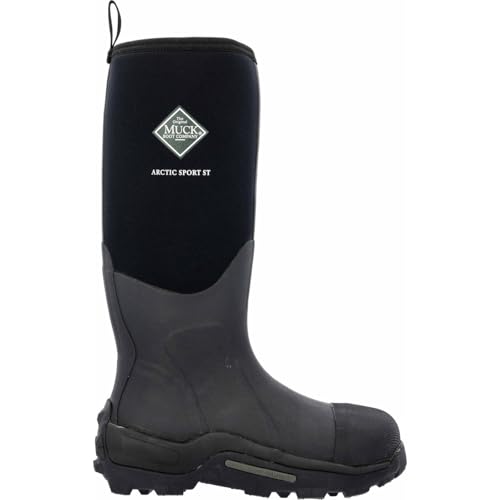
5. MUCK Arctic Sport Steel Toe Waterproof Insulated Work Boot — Best for Extreme Cold and Wet Conditions
The MUCK Arctic Sport occupies a category of its own. Where every other boot on this list is built around traditional boot construction with a waterproof membrane, the Arctic Sport is built around an 8mm CR flex-foam bootie with four-way stretch nylon that makes the entire boot inherently 100% waterproof — not membrane-reliant waterproof. That distinction matters when you're working in standing water, mud, or conditions where traditional boots would eventually leak at seams or around the ankle collar. The CR flex-foam construction is the same technology used in wetsuits and is engineered to remain flexible in low temperatures rather than stiffening like standard rubber.
The fleece lining and 2mm thermal foam underlay on the instep add active insulation that complements the inherent thermal properties of the neoprene-based outer shell. The steel safety toe meets the protection requirements for heavy industrial environments. MUCK rates the Arctic Sport for conditions well below freezing, making it the appropriate choice when you're working in genuinely arctic conditions rather than simply cold ones. This is the boot for ice fishermen who need safety-toe protection, workers on frozen waterways, and anyone whose job regularly puts them in standing water at sub-freezing temperatures.
The trade-off for this level of waterproof performance and extreme-cold protection is weight and breathability. The Arctic Sport is heavier than any other boot on this list and less breathable in moderate temperatures. If you wear this boot in conditions warmer than about 20°F for extended periods, your feet will sweat. It is not a four-season boot. It is a specialist tool for specific harsh conditions, and in those conditions, nothing else on this list comes close.
Pros:
- 100% waterproof CR flex-foam construction — not membrane-dependent
- Remains flexible in extreme cold rather than stiffening like standard rubber
- Fleece lining plus thermal foam underlay for genuine arctic-level warmth
- Appropriate for standing water and sustained wet exposure that defeats traditional boots
Cons:
- Heavy — not suited for jobs requiring agility or long-distance walking
- Limited breathability makes this a poor choice in moderate temperatures
6. Ariat Men's WorkHog XT 8" BOA Waterproof Carbon Toe — Best for Oil and Gas and Custom Fit
The Ariat WorkHog XT is engineered specifically for oil and gas exploration environments — a sector where side-to-side stability on slick pipe yards and platform surfaces is a life-safety concern, not a comfort preference. The micro-adjustable BOA Fit System allows you to dial in precise fit tension across the entire lace zone with a single dial rotation, eliminating the pressure points and uneven tension that come with traditional lacing on thick-socked feet. In below-freezing conditions where you're wearing gloves, the BOA system is also dramatically faster and easier to operate than traditional lace-through systems.
Ariat's DRYShield waterproof construction combines waterproof full-grain leathers with an impermeable internal barrier, creating redundant protection that performs where membrane-only systems fail. The carbon safety toe meets current ASTM standards while being lighter than steel — relevant when you're on your feet for 12-hour shifts on industrial platforms. The Goodyear welt construction is the critical long-term value feature: this boot is resoleable, meaning when the outsole wears down, a cobbler rebuilds it rather than you buying a new pair.
The WorkHog XT carries a premium price that reflects both the BOA hardware and the Goodyear welt build quality. Workers outside oil and gas will still find value here — the stability and fit precision benefit anyone working on uneven frozen ground. The BOA system is also worth considering if you have ever struggled with cold-weather lacing or experienced boot loosening mid-shift as leather stretches in wet conditions. According to OSHA's foot protection guidelines, proper fit is foundational to safety-toe effectiveness, and the BOA system delivers fit precision that traditional lacing cannot match.
Pros:
- BOA Fit System provides precision, glove-friendly adjustment in cold weather
- Goodyear welt construction enables resoling for long-term value
- Carbon safety toe — lighter than steel, meets ASTM standards
- DRYShield combines waterproof leather upper with impermeable internal barrier
Cons:
- Premium price point — highest on this list
- BOA system requires manufacturer service if the dial mechanism fails
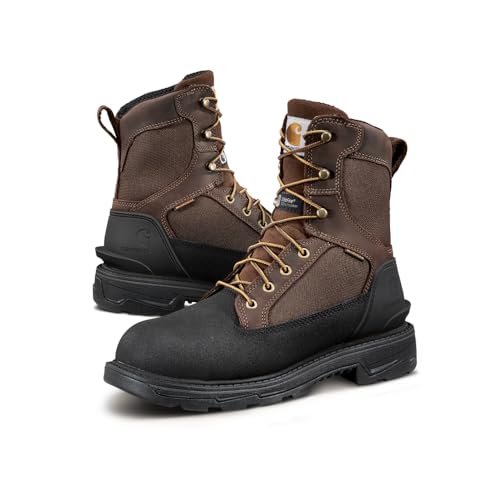
7. Carhartt Ironwood Waterproof Insulated Safety Toe Work Boot — Best for Harsh Industrial Environments
The Carhartt Ironwood takes a different safety-toe approach than the composite options on this list. Its alloy safety toe — crafted from a metal and aluminum combination — delivers a slimmer, lighter profile than traditional steel while maintaining the strength required to meet ASTM 2413-24 impact and compression standards. The alloy construction gives you more room in the toe box than full-steel designs of equivalent protection rating, which translates directly to comfort when your feet swell during long winter shifts.
The upper construction layers three materials in sequence: oil-tanned leather for water resistance and abrasion durability, Carhartt's Carstrong fabric for structural integrity, and Helcor reinforcement at high-stress points. Storm Defender technology seals the system against water infiltration while maintaining breathability — the same system found across Carhartt's professional work boot lineup. Oil-tanned leather is particularly well-suited to winter environments because the oil content helps the leather maintain flexibility in cold temperatures rather than stiffening and cracking as untreated leather can.
The slip-resistant outsole is engineered for the mixed surfaces of industrial work environments — concrete, metal grating, wet floors, and frozen ground. The dark brown and black colorway is appropriately understated for industrial settings. Workers in welding environments should note that a related option in the welding-specific category — detailed in the guide to best welding work boots — may better suit environments with spark exposure, but for general industrial winter work, the Ironwood delivers a complete and honest package at a reasonable price point.
Pros:
- Alloy safety toe is slimmer and lighter than full steel with equivalent ASTM 2413-24 protection
- Three-layer upper: oil-tanned leather, Carstrong fabric, and Helcor reinforcement
- Storm Defender waterproofing is breathable and performs in sustained wet exposure
- Slip-resistant outsole handles mixed industrial and frozen surfaces
Cons:
- Alloy toe is still conductive to temperature — not ideal when thermal isolation from cold is a priority
- No published gram-weight insulation rating — harder to benchmark against rated alternatives
How to Pick the Best Work Boot for Winter and Cold Weather
Insulation Rating: Match the Number to Your Climate
Insulation in work boots is measured in grams per square meter of fill material. The number is not a temperature rating — it's a volume measurement — but industry convention translates it into rough temperature bands. 200G insulation handles temperatures down to about 20°F for active workers. 400G extends usable range to around 0°F. 600G and above is appropriate for static work or genuinely arctic conditions. The key variable is activity level: if you're moving constantly, your body generates heat that supplements the boot's insulation, so you need less. If you're standing still at a frozen job site, you need more. Overly insulating for your activity level causes sweating, and wet feet lose heat 25 times faster than dry feet — defeating the purpose entirely.
Waterproofing Technology: Membranes, Construction, and Real-World Performance
Modern work boot waterproofing falls into two categories: membrane-based systems and construction-based systems. Membrane-based boots (Gore-Tex, Timberland's membrane, Carhartt's Storm Defender) bond a waterproof breathable film to the interior of the upper. They perform excellently in most conditions but can fail at seams over time with heavy use. Construction-based systems, like MUCK's CR flex-foam bootie approach, make the entire boot shell inherently waterproof without relying on a liner. Construction-based systems are more durable in sustained immersion but sacrifice some breathability. For most job sites, a high-quality membrane system is the right balance. For standing water or immersion conditions, construction-based waterproofing wins. Look for boots that certify their waterproofing against a published ASTM standard — F1671-07 is the relevant test — rather than brands that use unverified "waterproof" marketing language.
Safety Toe Selection: Steel, Composite, Alloy, and Carbon
In cold weather, safety toe selection becomes a thermal consideration, not just a safety one. Steel toes conduct cold directly to your toes when exposed to freezing temperatures — a documented comfort and circulation problem on sub-freezing job sites. Composite toes (fiberglass, carbon fiber, or polymer blends) are non-conductive and eliminate this problem while meeting the same ASTM impact and compression standards. Alloy toes use aluminum-metal blends that are lighter than full steel but remain conductive. Carbon safety toes represent the highest-spec composite option — lighter than standard composite materials with equivalent protection. For winter-specific work, composite and carbon toes are the technically superior choice. Steel and alloy make sense when budget constraints are real or when job site regulations specifically require metallic toe protection.
Outsole Grip: What "Slip-Resistant" Means on Ice and Frozen Ground
No standard work boot outsole provides reliable traction on pure glare ice without additional traction aids. What outsole design does determine is performance on frozen mud, icy concrete, wet metal surfaces, and compacted snow — the conditions that make up the majority of winter work environments. Deep lugs with aggressive tread patterns shed packed snow and mud rather than letting it accumulate and reduce grip. Rubber compounds matter: standard rubber stiffens in cold and loses grip, while specialized cold-temperature rubber compounds maintain flexibility and grip at temperatures below freezing. If your job site regularly involves pure ice, consider attachable traction aids like Yaktrax as a supplement to any boot on this list — no factory outsole eliminates the need for those in true icing conditions. For workers interested in how thermal socks interact with boot insulation to affect overall warmth, the best thermal socks review provides detailed pairing guidance.
Common Questions
What insulation rating do I need for winter work boots?
For active work in temperatures above 20°F, 200G insulation provides adequate warmth without excessive sweating. For temperatures between 0°F and 20°F, 400G is the appropriate range. Below 0°F or for static work in the cold, look for 600G or higher. If your activity level varies throughout the day, err toward less insulation and supplement with quality thermal socks — overheating and sweating in an over-insulated boot causes wet feet, which lose heat far faster than the cold alone would.
Are composite toe boots as safe as steel toe boots in winter?
Yes. Both composite and steel safety toes must meet the same ASTM impact and compression standards to be sold as safety footwear. The key difference in winter is thermal performance: composite toes are non-conductive, meaning they do not transfer cold from the outside environment directly to your toes the way steel does. For cold-weather work, composite toe construction is technically superior from both a comfort and circulation standpoint while providing identical certified protection.
How do I keep my feet warm in work boots even with insulation?
Insulation rating is one variable, but fit, sock choice, and moisture management determine whether you actually stay warm. A boot that's too tight when you wear thick socks restricts circulation — and restricted circulation means cold feet regardless of gram rating. Wear moisture-wicking sock liners under your thermal socks to keep feet dry, since wet feet lose heat rapidly. Make sure the boot has room for your sock thickness without compressing your toes. Replace factory footbeds with high-quality aftermarket insoles that add both cushioning and thermal insulation from the ground up.
What's the difference between waterproof membranes and waterproof construction?
Waterproof membrane systems bond a breathable waterproof film inside the boot upper. They perform well in rain, slush, and wet ground, and they maintain good breathability. Over time and with heavy use, seams can degrade. Waterproof construction systems — like MUCK's neoprene-based bootie approach — make the entire boot shell inherently waterproof without relying on a liner. Construction-based waterproofing handles standing water and sustained immersion more reliably but sacrifices some breathability. For most winter work conditions, a quality membrane system is sufficient. For sustained wet or standing-water exposure, construction-based waterproofing is the more reliable choice.
How long should a quality winter work boot last?
A well-built winter work boot with a Goodyear welt construction — like the Danner Quarry USA or Ariat WorkHog XT — can last five to ten years with proper maintenance and periodic resoling. Non-resoleable boots typically last one to three years under daily work use, depending on conditions. Leather conditioning, cleaning mud and salt deposits promptly, and drying boots properly after wet shifts significantly extend service life across all construction types. Salt from winter road treatment is particularly corrosive to leather and should be removed with a damp cloth and conditioned after each exposure.
Can I use aftermarket insoles in winter work boots?
Yes, and for most workers it's a worthwhile upgrade. Factory footbeds in work boots are often functional but basic. Aftermarket insoles add arch support, additional thermal insulation from the ground up, and improved shock absorption — all of which matter more in cold weather when joints are stiffer and fatigue sets in faster. When selecting aftermarket insoles, choose ones with a thermal or closed-cell foam layer for winter use. Confirm the insole fits the boot's volume without compressing the toe box, which would negate the warmth benefit by restricting circulation.
Buy on Walmart
- Carhartt Men's Ground Force 8-Inch Comp Toe Waterproof Work — Walmart Link
- Timberland PRO Men's Boondock 8 Inch Composite Safety Toe Pu — Walmart Link
- Danner Quarry USA 8" 400G NMT Men's Work Boots - Durable, Wa — Walmart Link
- Wolverine Men's Floorhand Insulated Waterproof Boot Construc — Walmart Link
- MUCK Arctic Sport Steel Toe Waterproof Insulated Work Boot, — Walmart Link
- Ariat Men’s WorkHog XT 8” BOA Waterproof Carbon Toe Work Boo — Walmart Link
- Carhartt Ironwood Waterproof Insulated Safety Toe Work Boots — Walmart Link
Buy on eBay
- Carhartt Men's Ground Force 8-Inch Comp Toe Waterproof Work — eBay Link
- Timberland PRO Men's Boondock 8 Inch Composite Safety Toe Pu — eBay Link
- Danner Quarry USA 8" 400G NMT Men's Work Boots - Durable, Wa — eBay Link
- Wolverine Men's Floorhand Insulated Waterproof Boot Construc — eBay Link
- MUCK Arctic Sport Steel Toe Waterproof Insulated Work Boot, — eBay Link
- Ariat Men’s WorkHog XT 8” BOA Waterproof Carbon Toe Work Boo — eBay Link
- Carhartt Ironwood Waterproof Insulated Safety Toe Work Boots — eBay Link
Final Thoughts
The right winter work boot in 2026 is the one that matches your actual job site conditions — not the one with the most features on paper. Start with your temperature range and hazard requirements, then evaluate waterproofing type, safety toe material, and insulation rating in that order. If you need a proven all-around performer, start with the Timberland PRO Boondock; if you need extreme-cold or standing-water protection, the MUCK Arctic Sport is the clear answer — and whatever you choose, invest in quality thermal socks and aftermarket insoles to get the full performance your boot is capable of delivering.


About James Miller
James Miller is a dedicated individual based in the vibrant city of San Francisco, CA, USA. His unwavering passion lies in the realm of construction, where he finds fulfillment in exploring and documenting various facets of construction equipment and processes. A graduate of the University of California Merced, James holds a dual degree in mechanical and electrical engineering, which has equipped him with a solid foundation in technical knowledge.With a keen eye for detail and a knack for articulation, James has channeled his enthusiasm into writing about the intricacies of construction gear and methodologies. His insightful writings offer valuable insights to both industry professionals and curious enthusiasts, shedding light on the machinery and techniques that shape the built environment.James Miller's educational background in mechanical and electrical engineering lends credibility to his work, allowing him to delve into the technical nuances of construction with precision. His passion for sharing knowledge and fostering understanding in the construction field is evident in his contributions, making him a respected voice in the industry.
Get FREE Boots Gifts now. Or latest free toolsets from our best collections.
Disable Ad block to get all the secrets. Once done, hit any button below