The Thorogood American Heritage 6" Moc Toe is the top pick in this roundup — it delivers premium full-grain leather construction, proven slip resistance, and genuine American craftsmanship at a price that doesn't require a second mortgage. If you're shopping for boots built on U.S. soil in 2026, you have more options than ever, but not all are created equal.
American-made work boots occupy a distinct space in the footwear market. You're not just buying a product — you're investing in domestic manufacturing, skilled labor, and materials selected for durability over cost-cutting. Brands like Thorogood, Red Wing, Nicks, and Wesco have maintained U.S. production lines for decades, and that continuity shows in how these boots perform on the job site. According to the U.S. Department of Labor, domestic manufacturing jobs carry strict quality and safety oversight — and the best boot makers exceed those standards voluntarily.

This guide covers seven American-made boots across different categories — work, heritage, western, and tactical — so you can find the right fit for your job, your style, and your budget. Each pick was evaluated on construction quality, sole performance, comfort features, and real-world durability. If you want a broader look at the landscape, the full boot reviews directory has you covered. For a focused comparison of two of the biggest names here, check out our breakdown of Thorogood vs Red Wing.
Contents
- Best Choices for 2026
- In-Depth Reviews
- Thorogood American Heritage 6" Moc Toe — Best Overall
- Red Wing Heritage Iron Ranger — Best Heritage Boot
- Carolina CA7016 Ferric 8" — Best Work Boot Value
- Justin Jeb 10" Roper — Best Western Work Boot
- Lucchese Classics Charles — Best Premium Dress Boot
- Nicks BuilderPro® — Best Handmade Heavy Duty
- Wesco Jobmaster 10" — Best Hardcore Work Boot
- What to Look For When Buying
- Common Questions
Best Choices for 2026
- #PreviewProductRating
- Bestseller No. 1
 Rating:

- Bestseller No. 2
 Rating:
- Bestseller No. 3
 Rating:
 - Bestseller No. 4
 Rating:
 - Bestseller No. 5
 Rating:
 - Bestseller No. 6
 Rating:
 - Bestseller No. 7
 Rating:
In-Depth Reviews
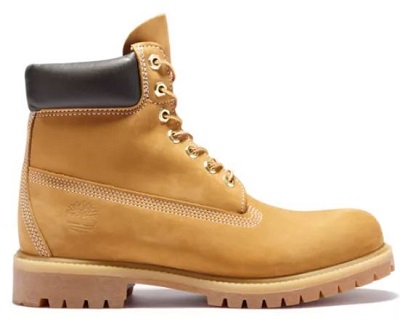
1. Thorogood American Heritage 6" Moc Toe Work Boots — Best Overall
Thorogood has been making boots in the United States since 1892, and the American Heritage 6" Moc Toe is the boot that keeps that reputation alive. Crafted at Thorogood's U.S. plants using American and globally sourced components, this boot runs the full production cycle domestically — from lasting to finishing. The tobacco brown colorway is the flagship, but you can also get it in Trail Crazyhorse brown, black with ivory sole, and black with black sole.
The upper is oil-tanned full-grain leather — dense, protective, and slow to absorb moisture. The moc toe design gives your forefoot extra width and a relaxed fit without sacrificing structure. What sets this boot apart from the competition is the MAXwear Wedge outsole. It flexes more naturally than traditional lug or logger soles, absorbs impact on hard floors and concrete, and meets ASTM F3445-21 slip-resistance standards — meaning it's tested and certified, not just claimed. If you spend your days on wet floors, oily decks, or loose gravel, that certification matters.
The comfort insole is dual-density and holds up over long shifts. There's no safety toe on this particular model, which keeps the fit relaxed and the weight down. The EH rating (electrical hazard) adds a critical layer of protection for anyone working near live circuits. Break-in time is moderate — expect two to three weeks before the leather fully molds to your foot.
Pros:
- Genuine American production with decades of proven quality
- MAXwear Wedge outsole certified to ASTM F3445-21 slip-resistance standards
- Oil-tanned full-grain leather resists moisture and abrasion
- EH rated for electrical hazard environments
- Multiple colorways available; moc toe allows wider forefoot fit
Cons:
- No safety toe option on this specific model
- Break-in period of 2–3 weeks before peak comfort
- Price is higher than import alternatives
2. Red Wing Heritage Iron Ranger 6" Boot — Best Heritage Boot
The Red Wing Iron Ranger is not a budget boot, and it's not trying to be. Built in Red Wing, Minnesota, this boot draws its name from the iron ore miners who wore Red Wings in the early 20th century. The Amber Harness leather is natural, vegetable-tanned, and will develop a patina over years of wear that's impossible to replicate with synthetic materials. That's the core appeal: this boot gets better the longer you wear it.
The double-layer leather toe cap — the "cap toe" that gives the Iron Ranger its silhouette — provides impact protection without a steel or composite insert. The leather heel pocket cradles your foot and reduces slippage inside the boot. Red Wing recommends sizing down half to one full size, which is a real consideration before you order. The bump toe gives extra room across the widest part of the foot, making it more comfortable for wider feet than the brand's round-toe models.
For styling versatility, the Iron Ranger sits at the intersection of work and heritage wear. It pairs cleanly with raw denim, chinos, or work pants. Minor scuffs rub out easily with a dry cloth and light buffing. The Vibram outsole — depending on the colorway — provides solid grip on most surfaces. If you want to understand how different sole constructions compare, the guide on different types of boot soles covers the trade-offs in detail.
Pros:
- Made in Red Wing, Minnesota — full domestic production
- Natural harness leather develops a rich patina over time
- Double-layer leather toe cap for durability without added weight
- Extremely resoleable — lasts decades with proper care
- Versatile enough for both work and casual wear
Cons:
- Sizing runs large — most buyers need to go down half to a full size
- Premium price point; significant upfront investment
- Long break-in period due to thick leather construction
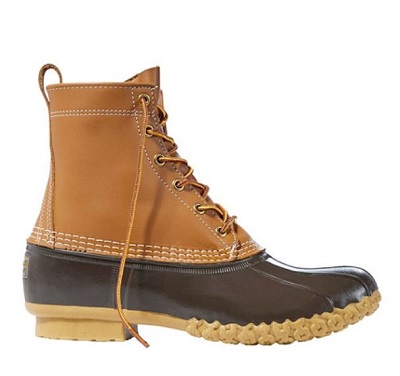
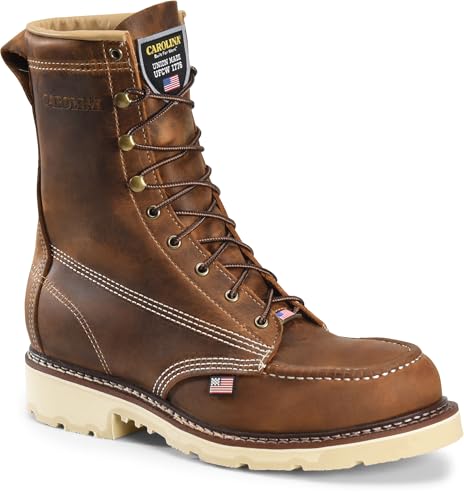
3. Carolina Men's CA7016 Ferric 8" Soft Toe Work Boot — Best Work Boot Value
Carolina Shoe Company has operated out of Asheboro, North Carolina since 1999, and the CA7016 Ferric represents the brand's working-class roots. The upper is constructed from Old Town Folklore leather — a rugged full-grain hide chosen specifically for heavy-use environments. At 8 inches of shaft height, this boot gives your ankle and lower leg meaningful protection on uneven terrain, in brush, or when debris is a constant hazard.
The footbed is where Carolina separates itself on value: the Poron Performance insole is a medical-grade polyurethane foam that resists compression over time. Most budget work boots use cheap foam that pancakes within a few months. Poron holds its cushioning profile through the life of the boot. The electrical hazard rating means the sole construction meets ASTM standards for protection against open circuits up to 18,000 volts in dry conditions — an important certification for electricians, utility workers, and anyone on job sites with exposed wiring.
The Ferric 8" is a straightforward, no-nonsense work boot. It doesn't have the heritage aesthetic of Red Wing or the brand cachet of Thorogood, but it delivers solid safety credentials and long-shift comfort at a more accessible price point. If you're comparing safety toe options for your specific job, our breakdown of steel toe vs composite toe work boots will help you decide which protection level fits your situation.
Pros:
- Old Town Folklore leather upper — durable full-grain construction
- Poron Performance insole resists long-term compression
- EH rated for electrical hazard environments
- 8" height provides solid ankle and lower leg coverage
- Made in the U.S.A. by Carolina Shoe Company
Cons:
- Less brand recognition than Thorogood or Red Wing
- Limited colorway options
- Heavier than 6" alternatives for the same job protection
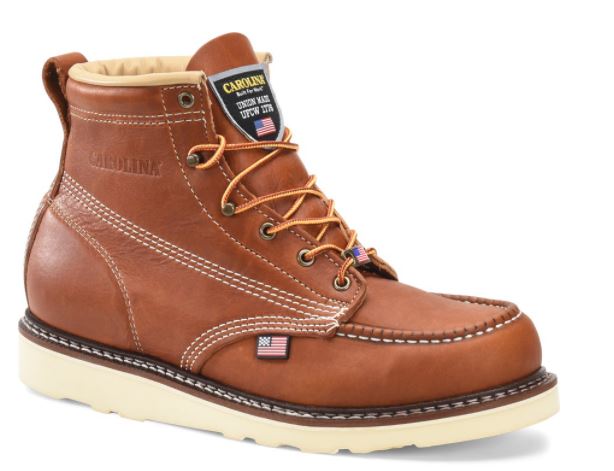
4. Justin Jeb 10" Roper Mens Western Boots — Best Western Work Boot
Justin Boot Company has been making western boots in the United States since 1879 — one of the oldest continuously operating American boot makers still in business. The Jeb 10" Roper in Tan Apache leather is a working cowboy boot built for ranch use, livestock work, and long days in the saddle or on the ground. The 10-inch shaft height and classic roper toe design give this boot a traditional silhouette that hasn't needed updating because it already works.
Premium leather construction throughout — the upper is sturdy, the stitching is clean, and the overall build quality reflects more than a century of refinement. The metallic shank runs through the midsole, delivering the arch support and torsional stability that western work boots require. Without a good shank, a tall boot like this would flex awkwardly underfoot and fatigue you faster. The rubber outsole provides durable ground contact and better grip than leather soles on modern surfaces.
The rounded toe keeps your foot comfortable for all-day wear, which matters when you're pulling 10 to 14-hour shifts. This isn't a jobsite boot with safety ratings — it's a working ranch and western utility boot, and it excels in that role. If you're pairing these with your work pants or jeans, the guide on how to wear work boots with jeans has practical advice on getting the look right.
Pros:
- American heritage brand with 145+ years of production experience
- Premium leather upper with robust stitching and construction
- Metallic shank provides torsional stability and arch support
- Comfortable rounded toe for all-day wearability
- Durable rubber outsole for modern ground surfaces
Cons:
- No safety toe or EH rating — not suitable for OSHA-regulated job sites
- Tall shaft requires more break-in time
- Western styling limits versatility outside ranch or casual settings
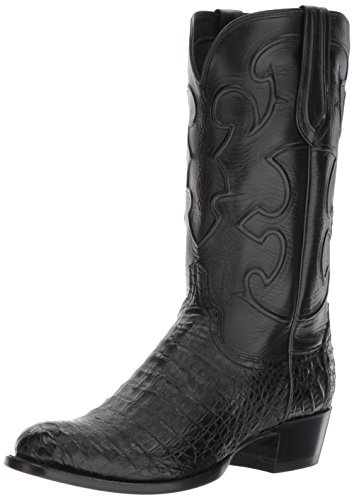
5. Lucchese Classics Men's Charles Belly Croc/Derby Calf Riding Boot — Best Premium Dress Boot
Lucchese is not a work boot brand. It is an American luxury boot brand, founded in San Antonio in 1883, and the Charles riding boot in black belly crocodile with derby calf accents represents the pinnacle of what domestic boot making can produce. Every Lucchese boot is handcrafted in El Paso, Texas, using techniques that have been passed down through generations of artisan bootmakers. This is a boot you buy once and pass on.
The material combination here is exceptional: belly crocodile leather for the vamp provides natural texture and extraordinary durability, while the smooth black derby calf upper adds contrast and refinement. The construction method — hand-lasting, hand-welting, and hand-stitching on the toe medallion — produces a fit and finish that machine-made boots simply cannot replicate. Riding boot geometry means a pointed toe, underslung heel, and tall shaft designed for equestrian use, though these boots translate seamlessly to formal occasions.
The Charles is not priced for job site use, and it's not designed for that purpose. But if you're looking for an American-made boot that represents the absolute top of the craft, Lucchese delivers it. You're buying into a 140-year legacy of hand skills, rare materials, and an El Paso tradition that still exists when almost everything else in the premium footwear space has moved offshore.
Pros:
- Handcrafted in El Paso, Texas — true American luxury production
- Belly crocodile and derby calf materials represent premium tier leathers
- Hand-lasting, hand-welting, and artisan finishing throughout
- Riding boot design with authentic equestrian geometry
- Legacy brand with 140+ years of continuous American boot making
Cons:
- Significant premium price — among the most expensive on this list
- Narrow use case: dress, formal, and equestrian only
- Exotic leather requires specialized care and conditioning
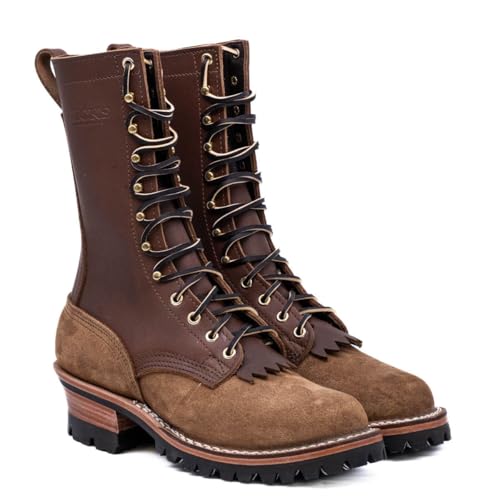
6. Nicks Handmade Boots BuilderPro® Heavy Duty Work Boot — Best Handmade Heavy Duty
Nicks Handmade Boots out of Spokane, Washington is one of the most respected names in the American boot making revival. The BuilderPro® is their purpose-built heavy-duty work boot, designed from the ground up for logging, wildland firefighting, construction, and other physically demanding trades. Every pair is built by hand in Spokane using premium full-grain leathers and Vibram or custom lug outsoles capable of taking serious punishment.
The BuilderPro® is a true custom-fit boot — Nicks offers an extensive sizing and last selection process so that your foot is measured and matched to the right build. This is not off-the-shelf footwear. The construction uses a Goodyear welt that allows repeated resoling, which is the key to why workers in demanding trades keep coming back to Nicks. A pair of BuilderPros that are properly cared for and resoled regularly can last 10 to 15 years in hard use — far longer than any import alternative. The 64 Brown leather is an oil-tanned, full-grain hide chosen for abrasion resistance and moisture management.
The upfront cost is substantial. But when you calculate cost-per-year of ownership against a boot that lasts a decade, Nicks' value proposition becomes very clear. In 2026, with supply chains still creating unpredictability in imported goods, a boot made entirely in Spokane by traceable American labor is also a supply-chain hedge. This is the boot for someone who treats footwear as a professional tool, not a consumable.
Pros:
- Fully handmade in Spokane, Washington — no offshore components
- Custom sizing and last selection for precise fit
- Goodyear welt construction supports repeated resoling
- 10–15 year lifespan in hard use with proper maintenance
- Built for the most demanding trades: logging, firefighting, construction
Cons:
- Highest upfront cost on this list
- Long lead time — custom production means weeks of wait
- Significant break-in period for the stiff initial leather
7. Wesco Jobmaster 10" Black Leather Work Boot — Best Hardcore Work Boot
Wesco Boot Company has been manufacturing in Scappoose, Oregon since 1918. The Jobmaster is their most iconic model — a 10-inch black oil-tanned leather work boot with a heavy lug sole that has been worn by loggers, linemen, ironworkers, and wildland firefighters for generations. Seven ounces of oil-tanned leather per side of the upper — that's the spec. Not marketing language. An actual material measurement that tells you how thick and protective this boot is.
The closure system uses 12 brass eyelets, including speed lace hooks on the upper half of the boot, so you can get in and out quickly without sacrificing security. Brass hardware resists corrosion better than steel, which matters in wet environments and on job sites where your boots take a daily beating. The water-resistant construction keeps your feet dry in rain, mud, and wet grass, though it's not waterproof in standing water. The heavy lug outsole delivers traction on loose terrain, slopes, and debris — the kind of ground surfaces where a wedge or leather sole would fail.
The Wesco Jobmaster is built for people who work in genuinely hostile conditions. It is not a heritage fashion boot and it's not a light-duty office-to-site crossover. It's a purpose-built tool for hard environments. If you're a lineman, logger, or ironworker, this boot has a 100-year track record of keeping American workers safe on the job. Resole service is available directly from Wesco, and the boot's construction supports multiple sole replacements over its life.
Pros:
- Made in Scappoose, Oregon since 1918 — 100+ years of American production
- 7-oz oil-tanned black leather — exceptionally thick and protective upper
- 12 brass eyelets with speed lace hooks for fast, secure closure
- Heavy lug sole for grip on loose, steep, or wet terrain
- Water-resistant construction; resole service available from Wesco
Cons:
- Heavy — the thick leather and lug sole add significant weight
- Not a casual or heritage fashion boot — strictly functional styling
- Stiff break-in period; not comfortable out of the box
What to Look For When Buying American Made Boots
Verify the "Made in USA" Claim
The phrase "American made" is not federally standardized the same way across all industries. For footwear, the FTC requires that "Made in USA" claims be truthful and non-deceptive — meaning all or virtually all of the product must be made in the United States. Some brands use "assembled in USA" to describe products with significant foreign component sourcing. Thorogood, for instance, is transparent that some components are globally sourced while assembly and production occur in U.S. plants. Nicks and Wesco manufacture with domestic leather and hardware from the start. Know what you're buying and what the brand is actually claiming before you spend the money.
- Look for specific plant locations, not just country of origin labels
- Ask whether the leather, hardware, and outsole are also U.S.-sourced
- Brands with century-long U.S. production histories are more verifiable than newer entrants
Construction Method: Goodyear Welt vs. Cement vs. Stitch-Down
Construction method determines how long your boot lasts and whether it can be repaired. Goodyear welt construction is the gold standard for longevity — the outsole is stitched to a welt that's sewn to the insole, creating a structure that can be resoled repeatedly without degrading the upper. Most premium American-made work boots use this method. Cement construction bonds the outsole with adhesive — cheaper to produce, but when the sole wears out, the boot is done. Stitch-down construction offers a middle path with good durability and some resole capability. If you're spending premium money on American-made boots, confirm you're getting Goodyear welt or stitch-down construction.
- Goodyear welt: Best longevity, fully resoleable — Nicks, Wesco, Red Wing
- Stitch-down: Durable, partially resoleable — Carolina, some Thorogood models
- Cement: Avoid at the premium tier — indicates cost-cutting in production
Safety Ratings and Job Site Requirements
Not every job site requires a safety toe, but many do. OSHA standards mandate foot protection in environments with falling or rolling objects, puncture hazards, and electrical risks. EH (electrical hazard) ratings are different from impact/compression toe ratings — a boot can be EH rated without having a steel or composite toe. Verify which certifications your employer or job site requires before selecting a boot. ASTM F2413 covers impact and compression protection (safety toes), while ASTM F2412 covers test methods. For slip resistance, the standard is ASTM F3445-21, which the Thorogood MAXwear Wedge meets explicitly. If you need a safety toe on a domestic boot, look at Carolina's lineup or Thorogood's steel and composite toe models.
- EH rating: protects against open circuits up to 18,000V in dry conditions
- ASTM F2413: the standard for impact/compression-rated safety toes
- ASTM F3445-21: slip-resistance certification — check for explicit compliance
- Some job sites require all three; verify your workplace requirements first
Fit, Sizing, and Break-In Time
American-made boots in the premium tier almost always require a break-in period. That's a feature, not a defect — it means the leather is thick and dense enough to conform precisely to your foot over time rather than arriving pre-stretched and shapeless. Red Wing recommends sizing down half to a full size on the Iron Ranger. Thorogood fits closer to standard sizing. Nicks offers a custom measurement process. Never buy premium leather boots by size alone — measure your foot width and consult each brand's fit guide. A boot that fits wrong from day one will only get worse, regardless of how good the construction is. If you're dealing with foot shape or toe issues that affect fit, the articles on what causes skin to split under toes and proper boot fit can help you identify fit problems early.
- Allow 2–4 weeks of daily wear for premium leather boots to fully break in
- Use thick wool socks during break-in to speed up the molding process
- Wide-foot buyers should check brand-specific width options (2E, EE)
- Custom options from Nicks or Wesco eliminate the fit guesswork entirely
Common Questions
Are American-made boots worth the higher price?
For most buyers who work hard on their feet, yes. The price gap between domestic and imported boots narrows significantly when you factor in lifespan. A $400 American-made boot that lasts 8 years costs $50 per year. A $120 import that degrades in 18 months costs $80 per year and gets thrown away. Add in the resole option on Goodyear-welt construction and the math tilts further toward domestic production. The craft quality is also measurably higher — thicker leather, better hardware, and more consistent construction than offshore mass production.
What does "Made in USA" actually mean for boots?
For footwear, the FTC requires that "Made in USA" claims reflect that all or virtually all of the product is made domestically. In practice, some brands use U.S. assembly with globally sourced components — which is legal and disclosed, but different from fully domestic production. Thorogood states explicitly that it uses both U.S. and globally sourced components. Nicks and Wesco source leather and hardware domestically. If full domestic content matters to you, research each brand's supply chain rather than relying on the "Made in USA" label alone.
How long do American-made work boots last?
With proper maintenance and Goodyear welt construction, 8 to 15 years is a realistic lifespan. Nicks and Wesco are regularly cited by tradespeople for 10+ years of hard daily use before the boot requires anything beyond standard resoling. Red Wing Iron Rangers held for decades when cared for. The key variables are leather conditioning frequency, resoling before the outsole wears through the welt, and proper storage when not in use. Neglected boots of any origin fail faster.
Which American-made boot is best for construction work in 2026?
For most construction environments, the Thorogood American Heritage 6" Moc Toe is the top choice — it balances EH rating, slip-resistance certification, all-day comfort, and domestic production at a price that most workers can justify. For the most demanding heavy-duty construction environments — ironwork, structural steel, elevated platforms — the Wesco Jobmaster's 10-inch shaft and heavy lug sole provide more protection. For logging or wildland firefighting adjacent roles, Nicks BuilderPro is the professional-grade choice.
Do American-made boots require a long break-in period?
Yes, and that's expected. Premium full-grain and oil-tanned leathers are dense and stiff when new. The break-in period — typically 2 to 4 weeks of regular wear — is the leather conforming to your foot's unique shape. Wearing thick wool socks, using leather conditioner from day one, and flexing the boot through its natural range of motion speeds up the process. Avoid breaking in new leather boots on an unusually demanding day — start with moderate wear and build up gradually.
Can American-made boots be resoled, and where?
Goodyear-welt construction boots — which includes Red Wing, Nicks, and Wesco — are fully resoleable. Wesco and Nicks both offer factory resole service directly, which is the most reliable option since the factory knows the exact construction and materials. Red Wing operates authorized repair shops across the country. For other brands, a cobbler experienced in welt construction can handle the job. Most premium American-made boots can be resoled two to four times before the upper reaches end of life, which is the primary reason their per-year cost beats cheaper alternatives.
Buy on Walmart
- Thorogood American Heritage 6” Moc Toe Work Boots for Men - — Walmart Link
- Red Wing Heritage Iron Ranger 6" Boot,Amber Harness,8.5 D(M) — Walmart Link
- Carolina Men's CA7016 Ferric 8 Inch Soft Toe Work Boot, Brow — Walmart Link
- Justin Jeb 10" Roper Mens Western Boots, Premium Leather, Cl — Walmart Link
- Lucchese Classics Men's Charles-blk Belly Croc/blk Derby Cal — Walmart Link
- Nicks Handmade Boots BuilderPro® Heavy Duty Work Boot - Made — Walmart Link
- Wesco Jobmaster 10” Black Leather Work Boot with Heavy Lug S — Walmart Link
Buy on eBay
- Thorogood American Heritage 6” Moc Toe Work Boots for Men - — eBay Link
- Red Wing Heritage Iron Ranger 6" Boot,Amber Harness,8.5 D(M) — eBay Link
- Carolina Men's CA7016 Ferric 8 Inch Soft Toe Work Boot, Brow — eBay Link
- Justin Jeb 10" Roper Mens Western Boots, Premium Leather, Cl — eBay Link
- Lucchese Classics Men's Charles-blk Belly Croc/blk Derby Cal — eBay Link
- Nicks Handmade Boots BuilderPro® Heavy Duty Work Boot - Made — eBay Link
- Wesco Jobmaster 10” Black Leather Work Boot with Heavy Lug S — eBay Link
Buy the boot that matches your hardest day on the job — American-made construction means the leather outlasts the trend, and the welt outlasts the leather.


About Jason Flores
Jason Flores is a multi-talented individual whose unique journey has led him to blend his passion for craftsmanship and fashion into a creative endeavor. During his formative years, he found himself immersed in the world of handiwork, spending countless hours in his grandfather's workshop. These early experiences allowed him to develop a deep understanding of practical skills and a keen eye for detail.Simultaneously, Jason harbored an innate love for fashion, drawn to the artistry and self-expression it offers. As he grew older, he recognized the potential to combine his proficiency in craftsmanship with his fashion sensibilities. This realization led him to a path where he began to explore and write about the intersection of fieldwork fashion.
Get FREE Boots Gifts now. Or latest free toolsets from our best collections.
Disable Ad block to get all the secrets. Once done, hit any button below