The Timberland PRO Men's Pit Boss 6 Inch Steel Toe earns the top spot in 2026 — its 24/7 Comfort Suspension System combined with ASTM-certified steel protection makes it the definitive all-day work boot for demanding job sites. If you've been spending hours on your feet and ending each shift with aching arches, your boots are failing you, and that's a problem this list is designed to solve.
Lace-up work boots remain the gold standard for a reason: they give you a precise, adjustable fit that slip-ons and pull-ons simply cannot match, and they distribute ankle support across a wider contact zone when the terrain gets unpredictable. Whether you're working on concrete slabs, wet steel decking, or loose gravel, the right lace-up holds your foot locked in position and lets the boot's engineering do the protection work. You can browse the full range of reviewed footwear at our work boot reviews hub to compare categories side by side.
In 2026, the market has matured significantly — composite toes have largely closed the gap on steel in impact ratings while shedding weight, waterproof membranes have become more breathable, and midsole energy-return technology has eliminated the "break-in wall" that once made quality boots painful for the first two weeks. According to OSHA foot protection guidelines, proper footwear selection is one of the most preventable workplace injury categories — and the seven boots reviewed here all meet or exceed current ASTM standards. This guide covers every serious contender, breaks down the specs that actually matter, and tells you exactly which boot matches your trade.
Contents
- Our Top Picks for 2026
- In-Depth Reviews
- Timberland PRO Pit Boss 6" Steel Toe — Best for All-Day Comfort
- Thorogood American Heritage 6" Moc Toe — Best American-Made
- Carhartt 6" Rugged Flex Composite Toe — Best for On-the-Move Tradespeople
- KEEN Utility Pittsburgh Energy 6" — Best Waterproof Composite Toe
- CAT Second Shift Steel Toe — Best Budget Work Boot
- Wolverine Hellcat UltraSpring 6" — Best for Energy Return
- KEEN Utility San Jose 6" Alloy Toe — Best Wedge Sole Work Boot
- Key Features to Consider When Choosing
- Questions Answered
Our Top Picks for 2026
- #PreviewProductRating
- Bestseller No. 1
 Rating:

- Bestseller No. 2
 Rating:
 - Bestseller No. 3
 Rating:
 - Bestseller No. 4
 Rating:
- Bestseller No. 5
 Rating:
 - Bestseller No. 6
 Rating:
 - Bestseller No. 7
 Rating:
In-Depth Reviews
1. Timberland PRO Men's Pit Boss 6 Inch Steel Safety Toe — Best for All-Day Comfort
The Timberland PRO Pit Boss has earned its reputation across manufacturing floors, construction sites, and heavy industrial environments, and the 2024 updated version arriving in 2026 refines what was already one of the most comfortable steel-toe platforms on the market. The 24/7 Comfort Suspension System is the centerpiece here — it's a full-footbed arch-support and cushioning assembly that addresses foot fatigue at the structural level rather than just adding a thin foam layer on top of a hard insole. After a ten-hour shift on concrete, the difference between this system and a standard insole is something you feel in your lower back as much as your feet.
The steel safety toe meets ASTM F2412-18a and F2413-18 I and C standards, making it code-compliant on virtually every job site in North America, and the asymmetrical shape means the toe cap doesn't pinch your big toe laterally the way older symmetrical designs did. Electrical hazard protection rounds out the safety package, providing secondary underfoot insulation against circuits up to 600 volts — an important feature for any electrician or anyone working near live infrastructure. The outsole delivers firm grip across wet and dry surfaces, and the full-grain leather upper breaks in quickly relative to other steel-toe boots in this price range. If you want to understand how the PRO line differs architecturally from standard Timberland, the detailed breakdown in our Timberland vs Timberland PRO comparison is worth reading before you commit.
The Pit Boss runs slightly narrow in the toe box through the first week, so size up a half size if you have wide feet or plan to add an aftermarket insole. Speaking of which, pairing this boot with a higher-arch aftermarket insole can push comfort from excellent to exceptional — our Best Insoles for Work Boots guide covers the top options that fit this footbed cavity.
Pros:
- 24/7 Comfort Suspension System reduces foot fatigue significantly over long shifts
- Asymmetrical steel toe eliminates the lateral pinch common in older designs
- Full electrical hazard protection meets ASTM F2892-18 standards
- Full-grain leather upper holds up to abrasion without excessive break-in pain
- ASTM F2412-18a and F2413-18 I/C certified — universally code-compliant
Cons:
- Runs narrow in the toe box for wide-footed wearers — size up half a size
- Heavier than composite-toe alternatives at the same price point
2. Thorogood American Heritage 6" Moc Toe — Best American-Made Lace-Up Work Boot
Thorogood builds the American Heritage in their US plants using a combination of domestic and globally sourced components, and the craftsmanship shows in every detail from the hand-stitched moc toe seam to the oil-tanned full-grain leather that genuinely improves with age. This is not a boot built to be replaced every eighteen months — it's built to be resoled and worn for years, which is exactly the kind of value proposition that serious tradespeople understand. The MAXWear Wedge Outsole is a legitimate differentiator: it flexes more naturally than a conventional lug sole, absorbs impact energy before it travels up your leg, and meets ASTM F3445-21 slip-resistance standards on wet, oily surfaces where most wedge soles give up.
The moc toe design gives you noticeably more room across the forefoot than a traditional work boot profile, which becomes critical when you're on hour eight of a shift and your feet have expanded from heat and activity. There's no steel or composite safety toe here — this is a soft-toe boot, which means it's not the right call for environments where OSHA requires impact and compression protection. However, on job sites where toe protection isn't mandated, the soft-toe construction eliminates the cold conductivity of steel and the weight penalty of any reinforced toe cap entirely. The tobacco brown colorway ages beautifully with Neatsfoot oil treatment and develops a patina that factory-finished boots simply cannot replicate.
The break-in period is real — expect the first week to require some patience as the oil-tanned leather conforms to your foot shape — but once it does, the fit becomes one of the most personalized you'll experience in a production boot. If American manufacturing provenance matters to you, Thorogood is one of the few remaining brands that actually delivers on that claim at scale.
Pros:
- Genuine American manufacturing with skilled craftsmen in US Thorogood plants
- MAXWear Wedge outsole meets ASTM F3445-21 slip-resistance on wet and oily surfaces
- Oil-tanned full-grain leather improves with age and conditioning
- Moc toe design provides generous forefoot room for all-day comfort
- Electrical hazard rated for secondary circuit protection
- Resolable construction extends the boot's lifespan significantly
Cons:
- No safety toe — not compliant for sites requiring impact/compression protection
- Break-in period is longer than most competitors due to stiff oil-tanned leather
3. Carhartt Men's 6 Inch Rugged Flex Composite Toe — Best for On-the-Move Tradespeople
Carhartt built the Rugged Flex around a specific problem: work boots that restrict ankle articulation and add resistance to every step burn more energy than they should, and for tradespeople who climb ladders, kneel on roofing, or crouch in crawl spaces all day, that energy tax accumulates fast. The Rugged Flex construction uses a more pliable last and upper material combination that bends closer to where your foot naturally wants to flex, which is a measurable reduction in lower-leg fatigue compared to traditional stiff-lasted work boots. The composite safety toe is non-metallic and meets ASTM F2413-24 standards for impact and compression protection, which means it's cold-weather friendly and won't set off metal detectors at secure work sites.
The FastDry Technology lining is one of Carhartt's stronger execution points here — it's an active moisture-wicking fabric that pulls sweat away from your foot rather than letting it pool against the insole, and in a full-day work scenario in warm conditions, this distinction matters more than most people anticipate. The electrical hazard protection rating under ASTM F2413-24 EH standards covers incidental contact with circuits up to 18,000 volts in dry conditions, giving you a secondary safety layer that steel-toe-only boots frequently omit. The oil-tanned brown leather upper is rugged enough for rough use without being so stiff that comfort becomes a negotiation. If you've been comparing the full landscape of composite-toe options, our dedicated Best Composite Toe Work Boots guide covers the broader category in greater depth.
The Carhartt Rugged Flex fills a specific niche: it's the right boot for the carpenter, electrician, or HVAC tech who needs certified toe protection and full-day comfort but spends more time moving than standing still. The flex advantage is real and noticeable from day one, with no break-in penalty attached to it.
Pros:
- Rugged Flex construction reduces energy expenditure during high-mobility work
- Composite safety toe meets ASTM F2413-24 — no metal detector interference
- EH rated under ASTM F2413-24 EH for secondary electrical hazard protection
- FastDry lining actively wicks moisture throughout the full shift
- Minimal break-in period relative to steel-toe alternatives at this price
Cons:
- Not waterproof — limited use in consistently wet outdoor environments
- Lighter construction sacrifices some of the ankle support found in heavier boots
4. KEEN Utility Pittsburgh Energy 6" Composite Toe Waterproof — Best Waterproof Composite Toe Boot
KEEN's Pittsburgh Energy represents a serious engineering commitment in a category where most brands treat waterproofing as an afterthought — here it's a foundational design parameter, implemented through KEEN.DRY, a breathable waterproof membrane that lets vapor escape outward while blocking water ingress from below. The result is a boot that keeps your feet dry in rain, standing water, and mud without trapping the moisture your own feet produce, which is the primary failure mode of cheaper sealed waterproof boots that eventually feel like you're wearing a steam room. The KEEN.ReGEN midsole delivers 50% more energy return than standard EVA foam — this is a real and perceptible difference over a full day, particularly for anyone who switches between standing and walking phases repeatedly throughout a shift.
The carbon-fiber composite toe meets ASTM F2412 and F2413 M I/75 and C/75 standards and weighs 15% less than an equivalent steel toe, which compounds into meaningful fatigue reduction across thousands of steps per day. KEEN's left-right asymmetrical toe cap design gives the toe box a more anatomical shape than generic symmetrical caps, eliminating the lateral crowding that causes pressure points after hour four. The wide (2E) sizing option makes this particularly valuable for workers with naturally wider feet who've been forced into boots that are too narrow for comfort. This is one of the most complete packages on the list — waterproof, composite-toe certified, energy-return midsole, wide availability — at a price that reflects the engineering but doesn't require a second mortgage.
If your work consistently exposes you to water — roofing, landscaping, concrete work in early morning, or outdoor construction in variable weather — the Pittsburgh Energy is the most complete lace-up option in 2026 for wet-condition durability without sacrificing all-day comfort.
Pros:
- KEEN.DRY waterproof membrane is breathable — keeps sweat out while blocking water in
- KEEN.ReGEN midsole provides 50% more energy return than standard EVA
- Carbon-fiber composite toe is 15% lighter than steel with equivalent ASTM certification
- Available in wide (2E) sizing for broader foot profiles
- Left-right asymmetrical toe cap eliminates lateral pressure points
Cons:
- Premium price point sits higher than most competitors in this review
- Slightly bulkier silhouette than low-profile competitors due to waterproof construction
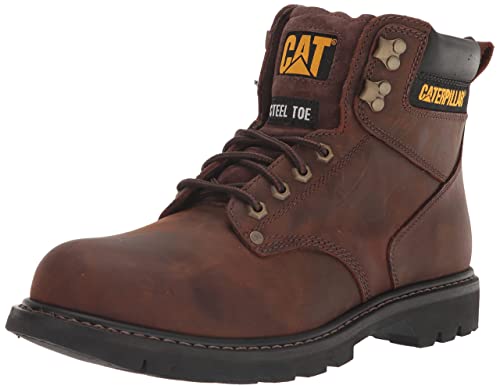
5. CAT Men's Second Shift Steel Toe — Best Budget Work Boot for 2026
The CAT Second Shift has been a staple of budget-conscious tradespeople for years, and it earns its place on this list in 2026 not through advanced technology but through reliable execution of the fundamentals at a price point that makes it accessible to anyone who needs certified protection without spending premium dollars. The steel toe is straightforward, code-compliant, and well-positioned in the boot's last — it doesn't crowd the toes in the way that budget steel toes often do when manufacturers cut corners on the cap geometry. The padded ankle collar and oil-resistant outsole are the two features that distinguish this from even cheaper alternatives: ankle padding reduces chafing on long shifts, and oil resistance on the outsole keeps you upright in workshops and kitchens where petroleum products coat the floor.
The engineered nylon mesh lining optimizes breathability in a way that leather-only interiors cannot match, which makes the Second Shift a reasonable spring and summer option for workers in warmer climates who need protection but can't tolerate a hot, stuffy interior. This is classified as a spring/summer boot by the manufacturer, so it's not the right call for winter construction or cold outdoor environments. The dark brown leather upper is simple and professional — it works in environments where appearance matters alongside safety compliance, such as industrial facilities with visitor-facing areas.
The CAT Second Shift won't out-perform boots at double its price, and it's not designed to — it's designed to deliver steel-toe protection and basic comfort at a price point that makes replacing worn-out boots a budget-neutral decision rather than a financial event. For apprentices, seasonal workers, or anyone who needs a backup pair on standby, this is the honest answer.
Pros:
- Highly accessible price point without sacrificing ASTM steel-toe compliance
- Padded ankle collar prevents chafing during extended wear
- Oil-resistant outsole provides traction in petroleum-contaminated environments
- Engineered mesh lining promotes breathability in warm conditions
- Professional appearance suitable for customer-facing industrial environments
Cons:
- Designated spring/summer boot — not suited for cold-weather or wet outdoor work
- Lacks waterproofing and advanced midsole technology found in premium options
- Durability ceiling is lower than higher-priced full-grain leather competitors
6. Wolverine Men's Hellcat UltraSpring 6 Inch Composite Toe — Best for Energy Return
Wolverine engineered the Hellcat UltraSpring around a midsole technology that genuinely changes the end-of-day experience for high-activity workers — the UltraSpring ETPU midsole uses expanded thermoplastic polyurethane, a material with significantly higher rebound properties than conventional EVA foam, delivering an energized return on every step that you feel as a reduction in leg fatigue rather than just a comfort abstraction. Goodyear Welt construction anchors the outsole to the upper through a time-tested mechanical bonding method that allows resoling and extends the boot's service life well beyond what cement-construction alternatives offer, making the Hellcat a legitimate long-term investment rather than a disposable seasonal purchase.
The premium waterproof full-grain leather upper is reinforced by a breathable waterproof membrane that pairs with moisture-wicking mesh to manage interior humidity across full-day use in wet conditions. The CarbonMAX composite toe is ASTM F2413-18 M I/75 C/75 EH rated, covering both safety toe requirements and electrical hazard protection in a single certified package. The Ortholite UltraLite footbed is removable — which matters if you prefer aftermarket orthotic support — and provides a cushioning platform that works in concert with the ETPU midsole rather than fighting it. A nylon shank bridges the midsole and outsole to provide torsional rigidity on uneven terrain where a flexible sole would allow excessive twisting. The Hellcat is one of Wolverine's strongest entries in years; for a broader look at the brand's work boot lineup, the Wolverine Overpass review provides useful context on how their different platforms compare in real-world use.
The Hellcat is the right choice for construction workers, ironworkers, and site supervisors who log high step counts across difficult terrain every day and have previously found that standard EVA midsoles are effectively dead by mid-afternoon. The UltraSpring technology is not marketing language — it's a physics difference in material rebound that translates directly into less fatigue.
Pros:
- UltraSpring ETPU midsole delivers measurably higher energy return than EVA alternatives
- Goodyear Welt construction enables resoling for extended boot lifespan
- CarbonMAX composite toe meets ASTM F2413-18 I/75 C/75 EH certification
- Premium waterproof full-grain leather paired with breathable membrane
- Removable Ortholite footbed accommodates aftermarket orthotics
- Nylon shank provides torsional rigidity on uneven surfaces
Cons:
- Premium price reflects the engineering — not the most budget-accessible option here
- Heavier than ultralight composite-toe competitors due to Goodyear Welt construction
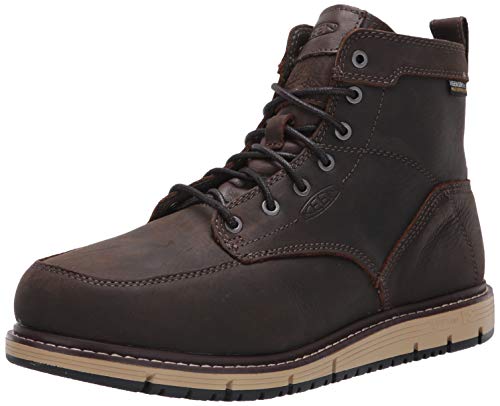
7. KEEN Utility Men's San Jose 6" Alloy Toe Waterproof Wedge — Best Wedge Sole Work Boot
The KEEN San Jose occupies a specific performance niche that most work boot brands ignore: the alloy-toe wedge-sole format that splits the difference between a heavy lug-outsole work boot and a lightweight casual shoe, delivering a platform that's genuinely comfortable on hard flat surfaces — concrete floors, warehouse environments, and utility installations — while maintaining full ASTM safety certification and waterproof construction. The aluminum alloy safety toe weighs 35% less than an equivalent steel cap while meeting ASTM F2412 and F2413 M I/75 and C/75 EH standards, and its asymmetrical left-right design eliminates the lateral pressure that standard toe caps create on the pinky-toe side after prolonged wear.
KEEN.DRY waterproof membrane technology handles moisture exactly as described in the Pittsburgh Energy — vapor out, water blocked — and the mesh liner integration prevents the delamination issues that affect lower-quality waterproof constructions after heavy use. The wedge tread outsole uses a siped surface pattern that provides reliable traction on slick, flat terrain without accumulating the debris that aggressive lug soles collect on clean indoor-outdoor transitions, meeting ASTM F1677 Mark II and ASTM F2913 SATRA non-slip standards for verified slip resistance. For environments where you move between outdoor wet conditions and clean indoor floors repeatedly throughout the day, the wedge sole's non-marking rubber compound prevents the dark streaks that lug soles leave on polished concrete and tile. The oil-resistant compound completes the traction profile for workshops and industrial floors.
The San Jose's wedge platform also provides a natural platform height that reduces Achilles tendon tension compared to flat-soled boots — an insider observation that matters to anyone who has dealt with plantar fasciitis or chronic heel discomfort. This is the definitive lace-up wedge work boot on the market in 2026 for anyone whose job keeps them primarily on flat, variable-condition surfaces rather than rough outdoor terrain.
Pros:
- Aluminum alloy toe is 35% lighter than steel while meeting identical ASTM certification
- KEEN.DRY waterproof membrane keeps feet dry without trapping internal moisture
- Siped wedge outsole meets ASTM F1677 and ASTM F2913 SATRA non-slip standards
- Non-marking rubber outsole suitable for clean indoor-outdoor transition environments
- Oil-resistant compound extends traction to workshop and industrial floor conditions
- Wedge platform reduces Achilles tendon stress compared to flat-soled alternatives
Cons:
- Wedge sole lacks the aggressive lug grip needed for muddy or steep outdoor terrain
- Alloy toe conducts cold slightly more than composite alternatives in extreme winter conditions
Key Features to Consider When Choosing Lace-Up Work Boots
Safety Toe Material: Steel vs. Composite vs. Alloy
Your toe protection choice shapes the entire boot's weight, thermal behavior, and metal-detector compatibility — so it deserves careful consideration before anything else. Steel toes are the heaviest option but are typically the most impact-resistant gram for gram and remain the lowest-cost way to achieve ASTM I/75 and C/75 certification. Composite toes, made from carbon fiber, fiberglass, or reinforced plastic, eliminate metal-detector interference and conduct significantly less cold in winter environments, while matching steel in ASTM certification at 15–20% less weight. Alloy toes — aluminum-based — split the difference: lighter than steel, thinner profile than composite, still conductive but less cold-prone than steel. Your trade environment, climate, and job site rules should drive the selection.
- Steel toe: Heaviest, most affordable, highest cold conductivity — best for temperate climates and cost-conscious buyers
- Composite toe: Lightest certified option, metal-detector safe, minimal cold conductivity — best for electrical work, aviation, and winter outdoor environments
- Alloy toe: Lighter than steel, thinner profile, non-ferrous — best for workers who need a low-profile toe box with some weight savings
Waterproofing: Membrane Quality and Breathability
Not all waterproof work boots are created equally, and the distinction between a sealed waterproof boot and a breathable waterproof membrane boot becomes viscerally obvious after four hours. Sealed constructions block water effectively but trap interior moisture, leading to the clammy, blister-prone conditions that make "waterproof" feel like a liability by mid-morning. Membrane systems like KEEN.DRY use microporous films that allow water vapor (sweat) to pass outward while blocking liquid water from entering — the physics of vapor pressure differential does the work. If you regularly work in wet conditions, a breathable membrane system is worth the additional cost. If your work is occasional-wet or primarily indoor, a water-resistant leather treatment may be sufficient without the added bulk of a full membrane construction.
Outsole Design: Lug vs. Wedge vs. Heel-Based
Outsole architecture determines where your boot excels and where it struggles, and most workers underestimate how dramatically this choice affects daily performance. Lug soles with deep channel patterns provide maximum grip on mud, loose gravel, and uneven terrain but accumulate debris on clean indoor surfaces and can feel stiff on hard flat floors. Wedge soles distribute weight more evenly across the full foot, provide a more natural gait on flat surfaces, and don't collect debris in lug channels — but they sacrifice grip on loose or steep terrain. Heel-based outsoles with a distinct heel strike zone provide the most natural feel for workers who transition frequently between indoor and outdoor environments. Match your outsole to your primary surface type, not your occasional one.
Midsole Technology and Long-Shift Foot Fatigue
The midsole is the most consequential invisible component in any work boot, and it's the one most often ignored by buyers who evaluate work boots by upper quality and outsole grip alone. Standard EVA foam midsoles compress under load and lose roughly 30–40% of their cushioning effectiveness within the first hundred hours of wear — which means the comfortable boot you tried on in the store may feel significantly firmer after a month of daily use. Advanced midsole materials like ETPU (expanded thermoplastic polyurethane, used in Wolverine's UltraSpring) and KEEN.ReGEN foam maintain compression resistance and energy return over thousands of hours of use. If you're on your feet for more than six hours per day, the midsole technology is where you should concentrate your budget — even a well-designed aftermarket insole cannot fully compensate for a failed midsole, as our Best Insoles for Work Boots review explains in detail when covering cases where the boot itself is the root problem.
Questions Answered
What is the best lace-up work boot for all-day standing on concrete?
The Timberland PRO Pit Boss 6 Inch Steel Toe is the strongest choice for all-day concrete work due to its 24/7 Comfort Suspension System, which specifically addresses foot fatigue from hard, unforgiving surfaces. The KEEN Pittsburgh Energy with its KEEN.ReGEN midsole is a close second, particularly if you need waterproofing as well. Both boots deliver noticeably more end-of-shift comfort than standard foam-midsole alternatives in the same price range.
Are composite toe boots as safe as steel toe boots in 2026?
Yes — modern composite toe boots certified to ASTM F2413-24 standards provide equivalent impact and compression protection to steel toe boots certified under the same standard. The ASTM I/75 and C/75 ratings define the performance threshold, not the material used to achieve it. Composite toes offer additional advantages in cold conductivity reduction, weight savings of 15–20%, and metal-detector transparency that make them preferable in many trade environments where the safety equivalence is identical.
How do I know if I need a waterproof work boot?
If you regularly work in rain, standing water, wet grass, morning dew on outdoor surfaces, or environments where liquids are present on the floor, a waterproof boot with a breathable membrane is worth the investment. If your work is primarily indoor and dry conditions are reliable, a quality water-resistant leather upper with regular conditioning is usually sufficient. The key distinguishing question is frequency: occasional exposure can be managed with leather treatment, while daily exposure demands a proper membrane system like KEEN.DRY or an equivalent breathable waterproof construction.
What is the advantage of a wedge sole over a lug sole on a work boot?
A wedge sole distributes your body weight evenly across the full foot contact area rather than concentrating it at the heel and toe lugs, which reduces pressure points on hard flat surfaces like concrete, tile, and steel decking. Wedge soles also don't collect mud, gravel, or debris in deep lug channels, making them cleaner for environments where you move between outdoor and indoor areas repeatedly. The trade-off is that wedge soles provide less traction on loose, muddy, or steeply angled terrain where lug soles' channel depth becomes critical for grip.
How long should a quality pair of lace-up work boots last?
A quality work boot from a reputable brand — Thorogood, Wolverine, KEEN Utility, Timberland PRO — should deliver 12 to 24 months of daily wear before the outsole requires significant attention, with the upper lasting considerably longer if properly conditioned with boot oil or wax. Boots with Goodyear Welt construction, like the Wolverine Hellcat, can be resoled multiple times and potentially serve five or more years with proper maintenance. The midsole typically becomes the limiting factor before the upper — if the boot feels significantly firmer than when new, the midsole has compressed and the boot should be resoled or replaced regardless of upper condition.
What safety standards should my work boots meet in 2026?
For most North American job sites, the current governing standards are ASTM F2412 (test methods) and ASTM F2413 (performance requirements) for impact, compression, and electrical hazard protection. The I/75 and C/75 ratings indicate the boot has passed 75-foot-pound impact and 2,500-pound compression resistance tests. Electrical hazard (EH) rating means the boot provides secondary insulation against incidental contact with live circuits under dry conditions. Slip-resistance certifications — ASTM F3445-21, ASTM F2913, ASTM F1677 Mark II — are increasingly important and are now required on many commercial job sites. All seven boots reviewed here carry at least the baseline ASTM safety toe and EH certifications.
Buy on Walmart
- Timberland PRO Men's Pit Boss 6 Inch Steel Safety Toe Indust — Walmart Link
- Thorogood American Heritage 6” Moc Toe Work Boots for Men - — Walmart Link
- Carhartt Men's 6 Inch Rugged Flex Composite Toe Boot,Brown O — Walmart Link
- KEEN Utility Men’s Pittsburgh Energy 6" Composite Toe Waterp — Walmart Link
- CAT Men's Second Shift Steel Toe Work Boot, Dark Brown, 10.5 — Walmart Link
- Wolverine Men's Hellcat UltraSpring 6 Inch Composite Toe Con — Walmart Link
- KEEN Utility Men's San Jose 6" Alloy Toe Waterproof Wedge Wo — Walmart Link
Buy on eBay
- Timberland PRO Men's Pit Boss 6 Inch Steel Safety Toe Indust — eBay Link
- Thorogood American Heritage 6” Moc Toe Work Boots for Men - — eBay Link
- Carhartt Men's 6 Inch Rugged Flex Composite Toe Boot,Brown O — eBay Link
- KEEN Utility Men’s Pittsburgh Energy 6" Composite Toe Waterp — eBay Link
- CAT Men's Second Shift Steel Toe Work Boot, Dark Brown, 10.5 — eBay Link
- Wolverine Men's Hellcat UltraSpring 6 Inch Composite Toe Con — eBay Link
- KEEN Utility Men's San Jose 6" Alloy Toe Waterproof Wedge Wo — eBay Link
Buy the boot that matches your actual job site — not the one with the most features on paper — and your feet will tell you by Friday that you made the right call.


About James Miller
James Miller is a dedicated individual based in the vibrant city of San Francisco, CA, USA. His unwavering passion lies in the realm of construction, where he finds fulfillment in exploring and documenting various facets of construction equipment and processes. A graduate of the University of California Merced, James holds a dual degree in mechanical and electrical engineering, which has equipped him with a solid foundation in technical knowledge.With a keen eye for detail and a knack for articulation, James has channeled his enthusiasm into writing about the intricacies of construction gear and methodologies. His insightful writings offer valuable insights to both industry professionals and curious enthusiasts, shedding light on the machinery and techniques that shape the built environment.James Miller's educational background in mechanical and electrical engineering lends credibility to his work, allowing him to delve into the technical nuances of construction with precision. His passion for sharing knowledge and fostering understanding in the construction field is evident in his contributions, making him a respected voice in the industry.
Get FREE Boots Gifts now. Or latest free toolsets from our best collections.
Disable Ad block to get all the secrets. Once done, hit any button below