Which safety toe should you put on your feet every single workday — composite or steel? If you've been going back and forth on this decision, you're not alone. Millions of workers face this exact choice, and getting it wrong means unnecessary weight on your feet, failed safety inspections, or a preventable injury. When comparing composite toe vs steel toe boots, the right answer depends on your trade, your job site rules, and your daily conditions — and this guide gives you everything you need to decide.
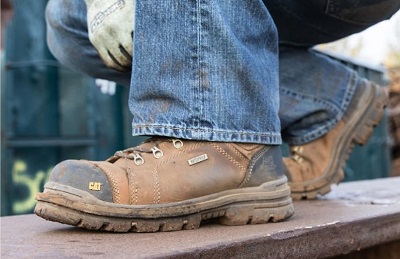
Both steel and composite toe caps meet recognized safety certifications — but they perform differently under extreme conditions, in cold and heat, and at airport security checkpoints. Steel toes have been the industry benchmark for decades. Composite toes are the newer challenger, built from non-metal materials like Kevlar, carbon fiber, and fiberglass. Each has real advantages. Each has real drawbacks.
This guide walks you through construction differences, protection levels, trade-specific use cases, persistent myths, and the mistakes that cost workers money and comfort. If you've recently bought a new pair, also check out this guide on breaking in work boots to get them ready faster.
Contents
The Origin and Evolution of Safety Toe Boots
How Steel Toe Became the Industry Standard
Safety toe boots didn't appear overnight. The need for toe protection grew directly out of industrial expansion — factories, shipyards, and construction sites where heavy materials and machinery were constant hazards. Steel toe caps became the default solution because steel was cheap, widely available, and extremely durable under compression loads.
For most of the 20th century, if you worked a trade job, you wore steel toes. The construction was straightforward:
- A hardened steel cap pressed and shaped to fit over the toe box
- Bonded between the boot's outer shell and inner lining
- Designed to absorb and deflect crush weight and falling objects
Steel toe boots dominated because the protection was proven and the standards were clear. They became the reference point that every other safety toe design would be measured against.
When Composite Toe Entered the Picture
Composite toe technology emerged as job sites became more varied. Electricians working around live circuits needed non-conductive footwear. Airport ground crews needed boots that wouldn't trigger metal detectors on every shift. Cold-weather workers needed a toe box that didn't transfer outside temperatures directly to their skin.
Composite toes are built from non-metal materials, most commonly:
- Carbon fiber
- Kevlar
- Fiberglass
- Hard thermoplastics
These materials are lighter than steel and don't conduct electricity or temperature. The tradeoff: composite caps take up slightly more space inside the toe box because they're thicker than steel at equivalent protection ratings. But for the right worker in the right environment, they're clearly the superior choice.
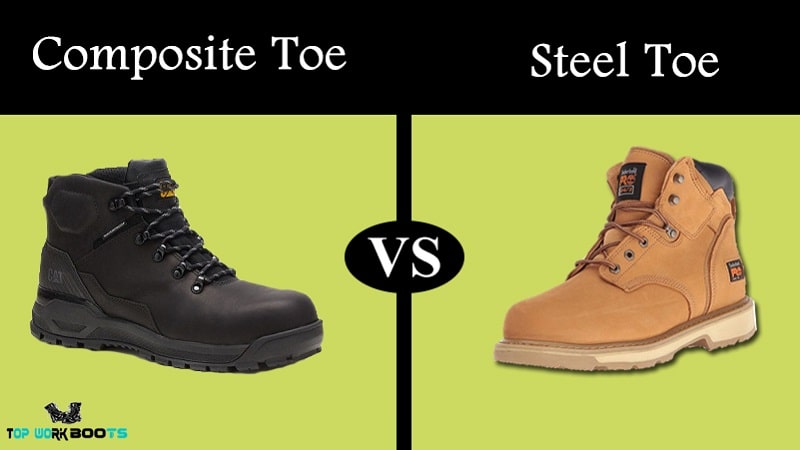
Composite Toe vs Steel Toe Boots: Head-to-Head
Here's where most buyers need the clearest information. The differences between composite toe vs steel toe boots come down to five key factors: weight, protection level, temperature performance, electrical hazard rating, and metal detector compatibility. Use the table below as your quick reference before diving into the details.
| Feature | Steel Toe | Composite Toe |
|---|---|---|
| Weight per cap | Heavier (~5–7 oz) | Lighter (~2–3 oz) |
| Impact protection | Excellent — meets ASTM I/75 | Excellent — meets ASTM I/75 |
| Temperature conduction | Conducts heat and cold | Non-conductive — insulates better |
| Electrical hazard (EH) | Not EH rated by default | EH rated by default |
| Metal detector | Triggers metal detectors | Does not trigger metal detectors |
| Toe box space | More room (thinner cap) | Slightly less room (thicker cap) |
| Price point | Generally lower | Generally higher |
| Durability | Very high | High |
Weight and Comfort
Over an 8- to 12-hour shift, every extra ounce adds up. Steel toe caps weigh roughly twice what composite caps do. If you log serious daily steps or stand without breaks, composite toes reduce foot fatigue noticeably over the course of a full shift. Steel toes, on the other hand, offer a slightly roomier toe box because the metal cap is thinner than composite materials at the same protection rating — a meaningful benefit if you have wider feet or need extra room.
Protection and Impact Resistance
Both steel and composite toes must pass the same recognized impact and compression standards to earn their safety certification. At the I/75 and C/75 rating levels, a steel toe and a composite toe provide equivalent protection — neither is definitively stronger at standard certification. You're not sacrificing safety by going composite; you're choosing a different material that achieves the same tested outcome.
Temperature Sensitivity
Steel conducts temperature. In freezing conditions, a steel toe cap becomes a cold spot pressed directly against your toes. In extreme heat environments, the reverse happens. Composite materials don't conduct temperature, which makes composite toes the clear winner for outdoor work in cold climates or environments with significant thermal exposure.
Pro tip: If you work outdoors in winter, composite toe boots keep your toes noticeably warmer — pair them with insulated work boot socks for maximum thermal protection all day.
Which Safety Toe Fits Your Trade?
Jobs Where Steel Toe Has the Edge
Steel toe boots are the right call when you're facing the heaviest compression and impact risks — and when electrical hazard exposure isn't your primary concern. These trades and environments lean toward steel:
- General construction — heavy materials, constant drop and crush risks
- Warehousing and logistics — forklift zones, pallet drops, loading docks
- Foundry and metalworking — thinner steel profile suits tight toe boxes near machinery
- Roofing — nail puncture risk, no electrical hazard present
- Manufacturing assembly lines — heavy equipment proximity without electrical exposure
Steel toes also tend to cost less for equivalent protection, which matters when your employer requires annual boot replacement or you're covering the cost yourself.
Jobs Where Composite Toe Has the Edge
Composite toes solve specific problems that steel simply can't address. If your job involves any of the following conditions, composite is almost certainly your best option:
- Electrical work — composite toes are non-conductive, making them EH-rated by design
- Airport ground crews — no metal detector delays or repeated screening mid-shift
- Cold storage and refrigeration — no temperature transfer against your toes
- Security-sensitive facilities — metal-free requirement for entry checkpoints
- Long-distance walking trades — lighter weight reduces cumulative fatigue
The Carhartt CMF6366 composite toe boot is a solid example of how far composite technology has come — durable, well-fitting, and purpose-built for demanding work environments without the weight penalty of steel.
Safety Standards for Protective Footwear
ASTM F2413 Requirements
In the United States, safety footwear is governed by ASTM F2413, the standard specification for performance requirements. Both steel and composite toe boots must meet these minimums to earn certification. The standard covers:
- Impact resistance (I) — withstand a 75 ft-lb impact (rated I/75)
- Compression resistance (C) — withstand 2,500 lbs of static load (rated C/75)
- Metatarsal protection (Mt) — optional but required in some trades
- Electrical hazard (EH) — open circuit resistance minimum of 14,000 ohms
- Puncture resistance (PR) — tested against nail penetration through the insole
You can review specific certification requirements and what they mean for your industry on our safety standards page.
What the Ratings Actually Mean
When you see "ASTM F2413 I/75 C/75 EH" stamped inside a boot, that label tells you exactly what the boot has been tested for. Here's how to read it:
- I/75 — passed impact test at 75 foot-pounds
- C/75 — passed compression test at 2,500 lbs
- EH — electrical hazard rated (open circuit, secondary protection only)
- Mt/75 — metatarsal protection included
- PR — puncture-resistant insole
A composite toe boot can carry all of these ratings. A steel toe boot cannot carry the EH rating because steel conducts electricity. This is a non-negotiable distinction if your trade involves working near live electrical components or energized equipment.
Common Myths About Safety Toe Boots
Myth: Steel Toes Can Cut Off Your Toes
This is the most persistent myth in safety footwear. The claim goes: if something heavy enough falls on a steel toe boot, the deforming metal cap will shear your toes off. This is false. Here's why that story doesn't hold up:
- The force required to deform a certified steel cap that dramatically would cause catastrophic injury to the entire foot regardless of footwear type
- Biomechanical testing shows that even severely deformed steel caps don't produce a shearing action against the toes
- No verified occupational cases exist of steel toe caps amputating toes under impact conditions
- A steel toe prevents far more injuries than the theoretical risk described in this myth
Don't let this myth push you toward a footwear decision that doesn't fit your actual job hazards. Base your choice on certification requirements and work conditions — not urban legends.
Myth: Composite Toes Offer Less Protection
Because composite materials aren't metal, many workers assume they provide inferior protection. This is incorrect. Composite toe boots certified to ASTM F2413 at the I/75 and C/75 levels have passed the exact same performance tests as certified steel toe boots. The protection threshold is identical at the certification level.
What IS true: composite caps are thicker to achieve the same rated protection, which reduces internal toe box volume slightly. That's a fit consideration — not a safety deficiency. When shopping, try both types on to compare how each sits on your foot.
Mistakes to Avoid When Picking Safety Toe Boots
Ignoring Your Work Environment
Most workers pick a safety toe based on price or brand habit — not actual job site requirements. That approach costs you in comfort and sometimes in compliance. Before you buy, ask yourself these questions:
- Does your employer require EH-rated footwear? (composite only)
- Do you pass through metal detectors regularly? (composite advantage)
- Do you work in subzero temperatures or cold storage? (composite insulates better)
- Are you handling extremely heavy materials with maximum crush risk? (both meet ASTM, steel offers more toe box room)
- Does your site have a written PPE footwear policy with specific certifications listed?
Read your employer's PPE requirements before you buy. A boot that doesn't meet site requirements isn't just uncomfortable — it's non-compliant, and that's on you.
Skipping the Proper Fit Check
A safety toe boot that doesn't fit correctly undermines its own protection. These are the most common fit mistakes workers make:
- Buying too small — toes pressing against the cap all day causes blisters, bruising, and long-term nail damage
- Buying too large — the foot slides forward, the cap sits incorrectly, and protection positioning shifts
- Ignoring width — steel and composite caps have different internal profiles; always try both types if you're switching
- Not accounting for thick socks — work boot socks add volume; size your boots accordingly
When you try on safety toe boots, press your thumb against the boot above the toe area. You should feel roughly a thumb's width of space between your longest toe and the cap. This ensures the boot sits correctly and the cap provides full coverage on direct impact.
Frequently Asked Questions
Are composite toe boots as safe as steel toe boots?
Yes. Both must pass the same ASTM F2413 impact and compression tests. At the I/75 and C/75 rating levels, composite and steel toe boots provide equivalent certified protection. You are not compromising safety by choosing composite over steel.
Which is lighter — composite or steel toe?
Composite toe caps are significantly lighter, weighing roughly half what steel caps do. Over a full shift, that reduction in weight noticeably decreases foot fatigue, especially for workers who cover a lot of ground or rarely sit down.
Can composite toe boots be EH rated?
Yes — and this is one of composite toe's biggest advantages. Because the material is non-conductive, composite toe boots can carry a full EH (electrical hazard) rating. Steel toe boots cannot receive an EH rating because steel conducts electricity.
Do composite toe boots set off metal detectors?
No. Composite toe boots are completely metal-free, so they don't trigger standard metal detectors. This makes them the required choice for workers at airports, secure government facilities, or any environment with regular security screening checkpoints.
Are steel toe boots colder in winter than composite?
Yes. Steel conducts temperature, so steel toe caps become cold spots in freezing conditions, transferring the outside temperature directly against your toes. Composite materials don't conduct temperature, making composite toe boots substantially warmer for outdoor cold-weather work.
Which toe type is better for construction?
For general construction with high crush and impact risk, steel toe boots remain a proven and cost-effective choice. However, composite toe boots meeting the same ASTM certification provide equivalent protection at lower weight. If any electrical hazard exposure exists on site, composite is required by ASTM EH rating standards.
How do I know if my boots meet safety requirements?
Look for the ASTM F2413 marking stamped inside the boot or printed on the tongue label. It lists every certification the boot carries: I/75 for impact, C/75 for compression, EH for electrical hazard, and PR for puncture resistance. Match those ratings against your employer's written PPE policy.
Is there a significant price difference between composite and steel toe boots?
Generally, yes. Composite toe boots cost more than equivalent steel toe boots because composite materials are more expensive to manufacture and shape. The price gap has narrowed as composite technology has become mainstream, but you should expect to pay a modest premium for composite at the same build quality.
Final Thoughts
Now that you know exactly how composite toe vs steel toe boots compare — in certified protection, daily comfort, temperature performance, electrical hazard ratings, and trade-specific fit — you have everything you need to choose with confidence. Head over to our safety standards page to confirm the exact certifications your job site requires, then match those requirements to the toe type that genuinely fits your work environment. The right safety toe isn't the most expensive option — it's the one built for what your day actually looks like.


About Jason Flores
Jason Flores is a multi-talented individual whose unique journey has led him to blend his passion for craftsmanship and fashion into a creative endeavor. During his formative years, he found himself immersed in the world of handiwork, spending countless hours in his grandfather's workshop. These early experiences allowed him to develop a deep understanding of practical skills and a keen eye for detail.Simultaneously, Jason harbored an innate love for fashion, drawn to the artistry and self-expression it offers. As he grew older, he recognized the potential to combine his proficiency in craftsmanship with his fashion sensibilities. This realization led him to a path where he began to explore and write about the intersection of fieldwork fashion.
Get FREE Boots Gifts now. Or latest free toolsets from our best collections.
Disable Ad block to get all the secrets. Once done, hit any button below